


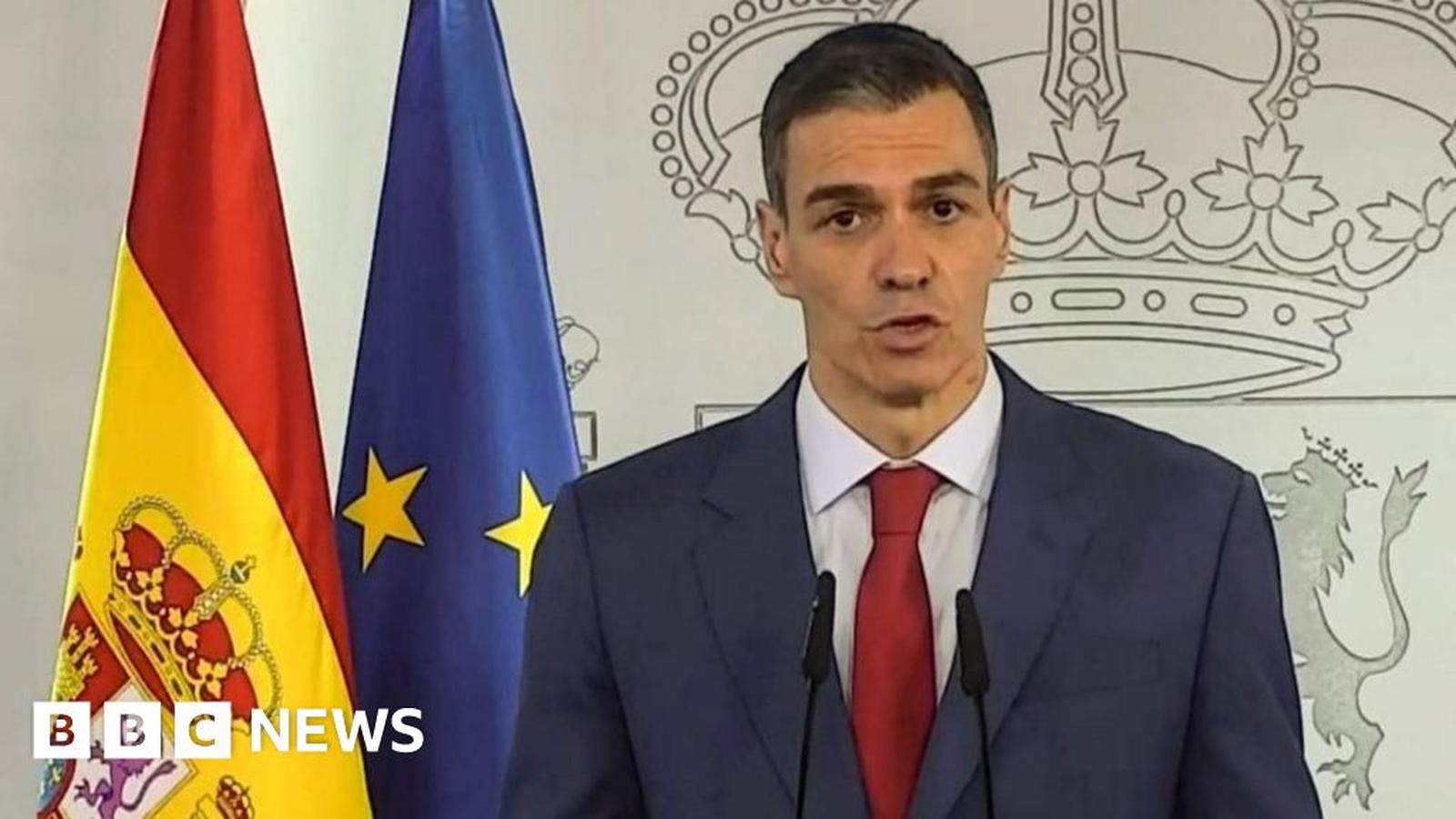
MADRID (Azat TV) – Spanish Prime Minister Pedro Sánchez has firmly rejected requests from the United States to use its military bases for missions related to airstrikes against Iran, maintaining a ‘No to war’ stance despite threats from former President Donald Trump to sever trade ties. Sánchez’s government declared its position on March 4, 2026, creating a significant diplomatic rift and positioning Spain as a leading European critic of the escalating U.S. and Israeli military actions in the region.
The standoff intensified after President Donald Trump, during a March 3 meeting with German Chancellor Friedrich Merz, openly threatened to halt all trade deals with Spain. Trump’s remarks came in response to Spain’s refusal to grant the U.S. military access to its strategic bases at Morón de la Frontera and Rota for operations linked to the Iran strikes. ‘Spain has been terrible,’ Trump stated, directing Treasury Secretary Scott Bessent to ‘cut off all dealings with Spain.’
Sánchez’s ‘No to War’ Stance on Iran Conflict
In a televised address on March 4, Prime Minister Sánchez unequivocally articulated his government’s position: ‘The position of the Government of Spain can be summed up in three words: No to war.’ He emphasized that the world and Europe had faced similar situations in the past, citing the Iraq War nearly a quarter-century ago, and ongoing conflicts in Ukraine and Gaza, as cautionary tales against military solutions. Sánchez reiterated his government’s commitment to international law and rejected the notion that global problems could be solved through conflict and bombs, urging against repeating past mistakes.
Defense Minister Margarita Robles reinforced this stance, telling Cadena SER Radio on March 5 that Spain’s position had been ‘very clear from Day 1.’ She further stated, ‘No single country should act as a guardian of the world. We have international rules.’ The U.S. military had already relocated more than a dozen refueling aircraft from Spanish bases over the weekend after being denied permission to launch missions from them, according to NPR.
Trump’s Retaliation and White House Contradictions
The White House initially claimed a reversal in Spain’s position. On March 4, White House Press Secretary Karoline Leavitt stated that Spain had ‘agreed to co-operate’ with the U.S. military after hearing Trump’s message ‘loud and clear.’ However, Spanish Foreign Minister José Manuel Albares swiftly and categorically denied this claim. ‘I categorically deny it,’ Albares told Cadena Ser, adding, ‘The position of the Spanish government regarding the war in the Middle East, the bombings in Iran, and the use of our bases has not changed one bit.’ Albares’s denial was echoed by Defense Minister Robles, directly contradicting the U.S. administration’s narrative.
Treasury Secretary Scott Bessent had earlier accused Spain of endangering American lives by impeding U.S. operations. ‘Anything that slows down our ability to engage and prosecute this war in the fastest, most effective manner puts American lives at risk. The Spanish put American lives at risk,’ Bessent told CNBC’s ‘Squawk Box’ on March 4, referring to ‘Operation Epic Fury.’
European Union Backs Spain Amid Diplomatic Tensions
Despite Trump’s threats, the European Union quickly rallied behind Spain. European Council President António Costa, in a March 4 post on X, affirmed, ‘The EU will always ensure that the interests of its member states are fully protected.’ He added that the EU reaffirmed its ‘firm commitment to the principles of international law and the rules-based order everywhere in the world.’ French President Emmanuel Macron also conveyed his ‘solidarity’ with Spain during a phone conversation with Sánchez, as reported by the BBC. German Chancellor Friedrich Merz reportedly told Trump that he could not conclude a separate trade agreement with Germany or Europe that excluded Spain.
Kaja Kallas, the European Union’s foreign policy chief, warned that further escalation of the war could threaten Europe and beyond ‘with unpredictable consequences,’ emphasizing steps to ensure the safety of EU citizens in the region, NPR noted.
Pedro Sánchez’s Broader Foreign Policy Positions
Sánchez, a renowned socialist and one of Europe’s most prominent left-leaning leaders since taking power in 2018, has consistently adopted a critical stance on several international issues. He has been a vocal critic of Israel’s military actions in Gaza following the 2023 Hamas attacks, highlighting massive civilian casualties. Furthermore, Spain was the only NATO member to secure a last-minute exemption from committing to increase military spending to 5% of its GDP last year, with Sánchez insisting Spain would only spend up to 2.1%, which he deemed ‘sufficient and realistic.’ Trump had previously floated the idea of expelling Spain from NATO due to this stance.
Sánchez has also bucked anti-immigrant trends in Europe, moving to grant work and residency permits to half a million foreigners in Spain, contrasting with the Trump administration’s policies. Even amidst criticism from Elon Musk for a plan to prohibit under-16s from accessing social media, Sánchez’s government has faced significant domestic political pressure, including allegations of corruption against allies. Standing firm against the U.S. president on a highly visible foreign policy issue may also carry domestic political benefits for the embattled Socialist leader, reminiscent of the widespread unpopularity of Spain’s support for the Iraq invasion two decades prior.
The current diplomatic dispute over the Iran conflict underscores a deepening ideological divide between Spain, under Pedro Sánchez, and segments of the U.S. political establishment, particularly the Trump administration. Sánchez’s unwavering commitment to multilateralism and international law, even in the face of significant economic and political pressure, highlights a strategic effort to carve out an independent foreign policy path for Spain within the European Union, potentially strengthening his domestic standing and reinforcing Europe’s collective resolve on global security matters.