


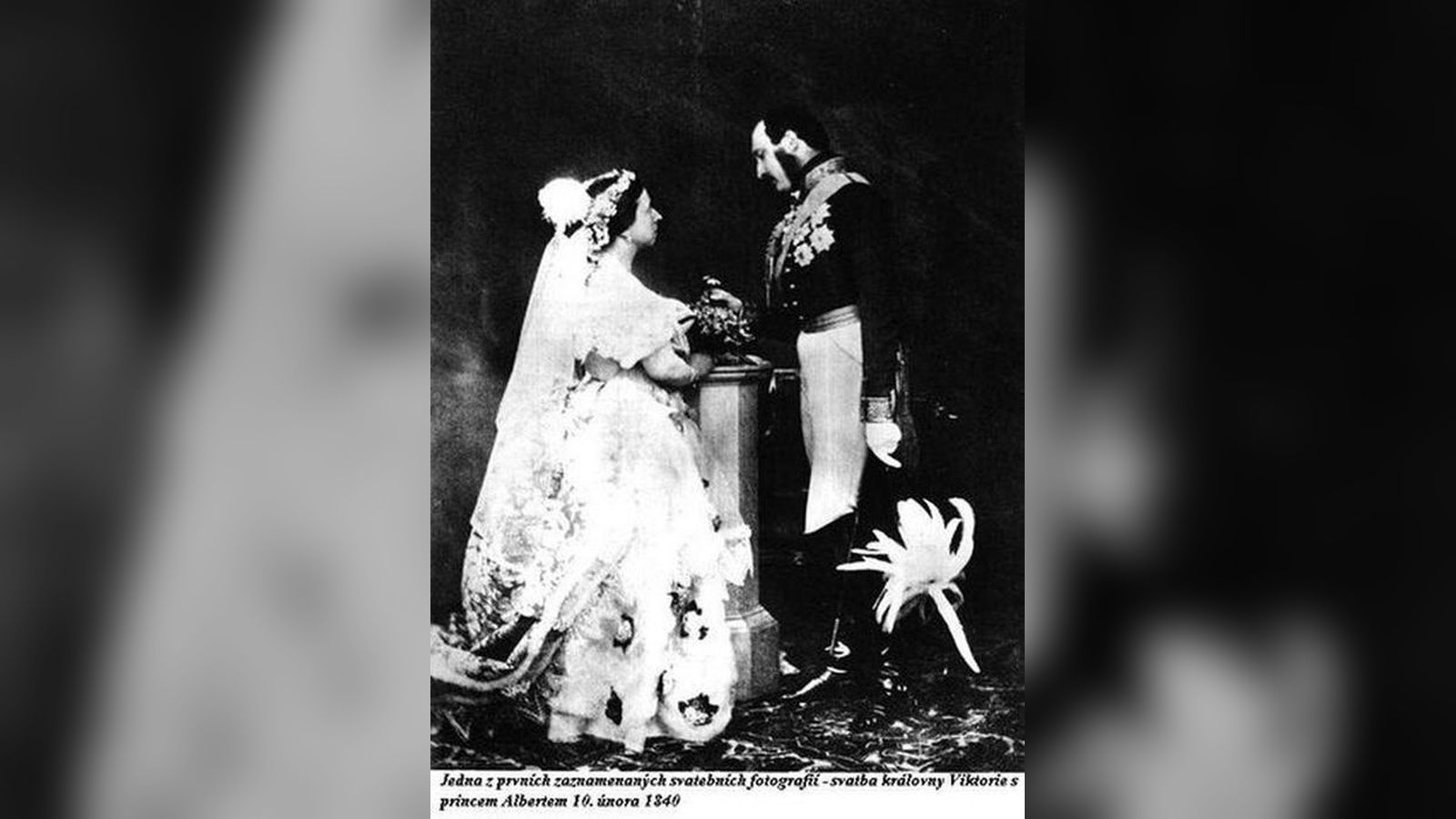
In the frame, a solemn woman in an ornate white lace veil stands beside a man in full military dress, their posture stiff, their gaze averted from the camera, and their hands quietly resting in an arrangement that evokes aristocratic dignity. For decades, across internet archives, social media posts, and even casual history compilations, this portrait has circulated under an astonishing caption: the royal wedding of Queen Victoria and Prince Albert of Saxe-Coburg and Gotha on February 10, 1840, celebrated as one of the very earliest wedding photographs in human history. Yet looking closely at the image reveals a visual paradox. The technology to capture such a crisp, controlled portrait did not exist in Britain in early 1840, nor were royal weddings documented by cameras at that dawn of the photographic medium. What does this photograph actually show, when was the shutter truly released, and why did the British monarch reenact her most famous day years later?
What the photograph shows
The image presents Queen Victoria and Prince Albert staged inside an interior space, arranged as if taking their nuptial vows or presenting themselves immediately after the altar. Victoria wears a voluminous gown, draped with intricate lace, crowned with a floral wreath and an expansive bridal veil that cascades down her back. Her husband, Prince Albert, stands tall in a dark uniform adorned with royal orders, sashes, and military regalia. There is no spontaneous joy or candid movement captured here. The exposure required the sitters to remain frozen in place, leaning slightly toward each other yet looking off into separate diagonals. The physical toll of the exposure is etched into Victoria’s guarded expression and Albert’s restrained, formal countenance. The composition borrows heavily from classical painting traditions, framing the royal couple not as dynamic newlyweds, but as enduring pillars of an established dynasty.
The myth of the 1840 wedding picture
Queen Victoria and Prince Albert were indeed married on February 10, 1840, at the Chapel Royal in St James’s Palace. Their union was a monumental political and cultural milestone. Victoria’s choice to wear an ivory-white satin gown woven from Spitalfields silk, trimmed with delicate Honiton lace from Devon, ignited the modern global tradition of the white wedding dress. However, on that rainy February day in 1840, practical photography was in its infancy. Louis Daguerre in France and William Henry Fox Talbot in Britain had made their photographic inventions public only the year before, in 1839. Exposure times were excruciatingly long, cameras were cumbersome optical contraptions, and photographic portraiture was still an experimental novelty confined to specialized studios under harsh sunlight. No camera stood inside the Chapel Royal in 1840. The event was recorded solely by painters like Sir George Hayter, printmakers, and print journalists.
Photographer and provenance: Roger Fenton’s 1854 restaging
The true story of the photograph began fourteen years after the nuptials. On May 11, 1854, pioneering British photographer Roger Fenton—who would soon achieve international fame for his images of the Crimean War—was granted access to Buckingham Palace. Fenton, a founding member and honorary secretary of the Photographic Society of London, was among the most technically accomplished practitioners of the wet collodion glass-plate process. Prince Albert, an ardent advocate of modern science and industry, was the patron of the society and a visionary supporter of the medium. The royal couple commissioned Fenton to make a series of portraits. Queen Victoria recorded the occasion directly in her journal: she brought out her wedding veil and lace gown, donning them once more so that the couple could recreate the iconography of their nuptials for the camera. Victoria was critical of her appearance in several plates from that session, even scratching out her own face on a glass negative she deemed unflattering. Yet several versions survived in the Royal Collection, preserving a staged memory rather than a live event.
The white dress and royal image-making
Why would a reigning monarch restage her wedding fourteen years later? In the 1850s, photography was transforming how the British public perceived their leaders. Victoria and Albert recognized that photography offered an unmatched aura of domestic authenticity and democratic accessibility. The couple had already welcomed nine children and faced complex political shifts, yet the foundational narrative of their reign remained their harmonious partnership. By slipping back into the white bridal dress and lace that symbolized British manufacturing and domestic purity, Victoria allowed photography to retroactive-engineer history. The camera retroactively sealed the romantic myth that had begun in 1840. The image became an early example of modern public relations: a staged reenactment distributed to cement a permanent visual legacy.
Why it still matters
The enduring confusion surrounding this photograph speaks directly to the power of the photographic image as an object of historical trust. Because the sitters wear the recognizable accoutrements of February 10, 1840, viewers instinctively assign the image to that exact calendar date. In doing so, modern audiences project photographic expectations backward into an era that had not yet developed the tools to record itself. Recognizing Roger Fenton’s 1854 portraits for what they really are—a deliberate, meticulous royal restaging—does not diminish the value of the photograph. Instead, it elevates the image from a simple wedding portrait into a foundational document in the history of visual culture, revealing how Queen Victoria and Prince Albert actively mobilized a revolutionary new technology to shape their enduring memory.