


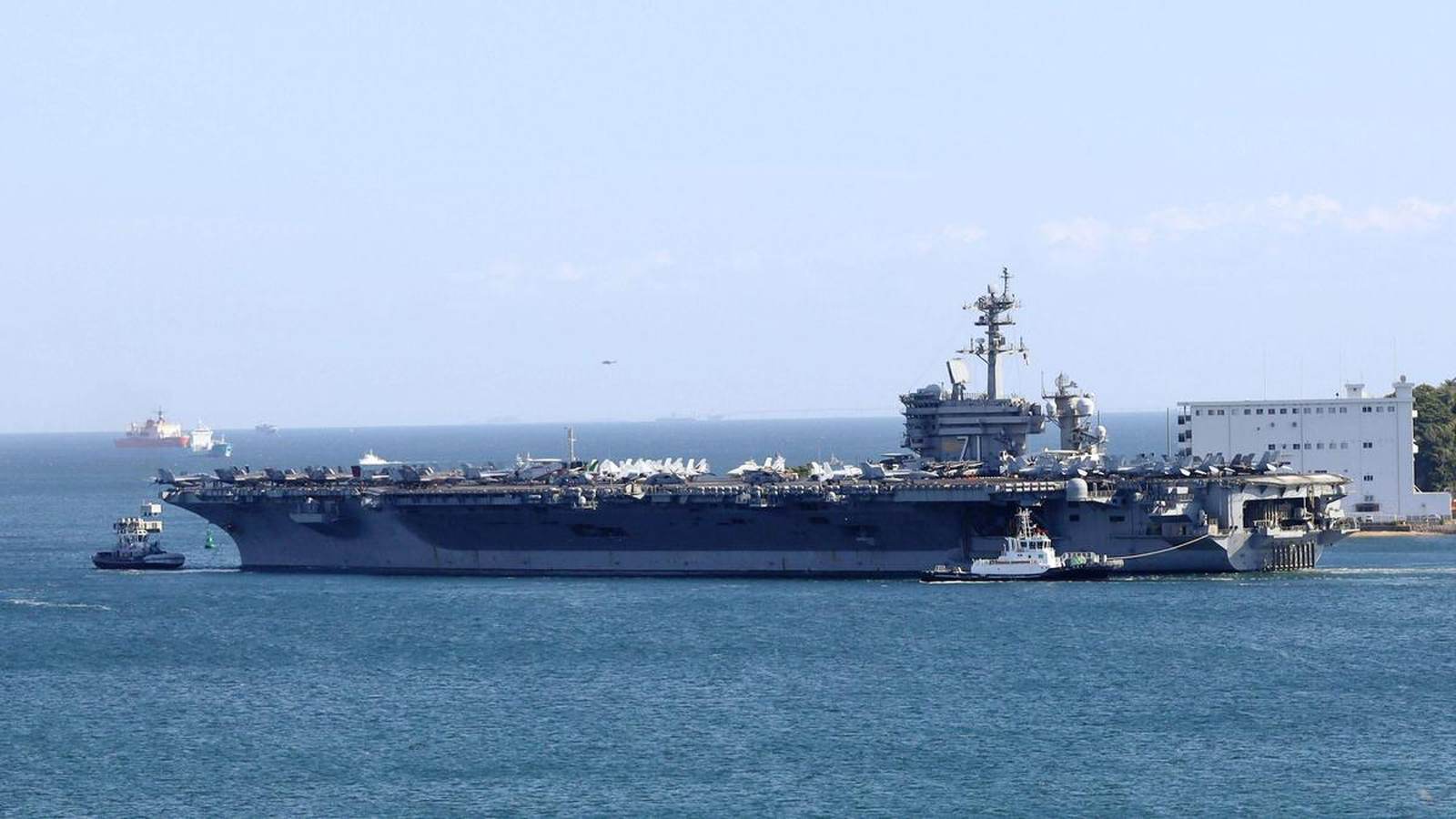
Strategic Buildup in the Arabian Sea
The U.S. Navy has increased its regional presence with the arrival of the USS Theodore Roosevelt in the Middle East, a deployment confirmed on Monday, November 16, 2026. This move brings the total number of American aircraft carriers currently stationed in the region to three, a rare concentration of naval power that underscores the administration’s continued focus on the eight-month-old Iran war. The Roosevelt, which departed San Diego in September, joins the USS George H.W. Bush and the USS George Washington to bolster a massive maritime blockade of Iranian shipping routes, as reported by The Boston Herald.
According to U.S. Navy data, the current flotilla in the Arabian Sea now includes the three carrier strike groups, supported by 13 destroyers, two cruisers, and a littoral combat ship. Two additional destroyers are operating in the Red Sea. This buildup occurs as President Donald Trump navigates a complex political landscape following recent midterm election losses for the Republican Party, which analysts have partially attributed to domestic dissatisfaction with the ongoing conflict and its economic consequences.
The Strait of Hormuz Flashpoint
The strategic stakes remain highest in the Strait of Hormuz, where maritime traffic has been severely disrupted since the commencement of hostilities. Independent maritime tracking data from Lloyd’s List indicates that vessel traffic through the critical waterway is currently less than one-third of pre-war levels. The U.S. military reports that it has redirected 150 merchant vessels and disabled five since June as part of its enforcement of the blockade.
Tensions in the strait escalated further this week. On November 16, 2026, Iranian state media reported that mines damaged six oil tankers, while the United Kingdom Maritime Trade Organization confirmed that a separate projectile strike caused an engine room fire on another vessel. The Iranian Revolutionary Guard has warned shipping companies that U.S.-led transit routes are compromised by underwater hazards, highlighting the volatile nature of the current naval stand-off.
Policy Stance and Diplomatic Stagnation
President Trump has maintained a dual-track approach to the conflict. While he recently informed reporters that the war is “militarily effectively over” and suggested a new deal with Tehran may not be necessary, he has simultaneously kept the option of further military strikes on the table. Last week, the President warned that the U.S. military remains “locked and loaded” and is monitoring facilities linked to Iran’s nuclear program, such as Pickaxe Mountain.
This oscillation reflects a strategic hedge: the administration is signaling immense military readiness to deter Iranian escalation while attempting to manage the internal political fallout from the war. Vice President JD Vance, who previously led ceasefire negotiations, has been redirected by the White House to focus on domestic political initiatives. Meanwhile, formal diplomatic efforts remain stalled, with Tehran conditioning any resolution on the lifting of the naval blockade—a demand the U.S. has yet to entertain.
The deployment of the USS Theodore Roosevelt serves as a physical manifestation of this “wait and see” posture. By maintaining three carrier groups, the U.S. retains the capability to launch large-scale strikes on short notice should the situation in the Strait of Hormuz deteriorate further, even as the administration publicly downplays the likelihood of renewed major combat operations.