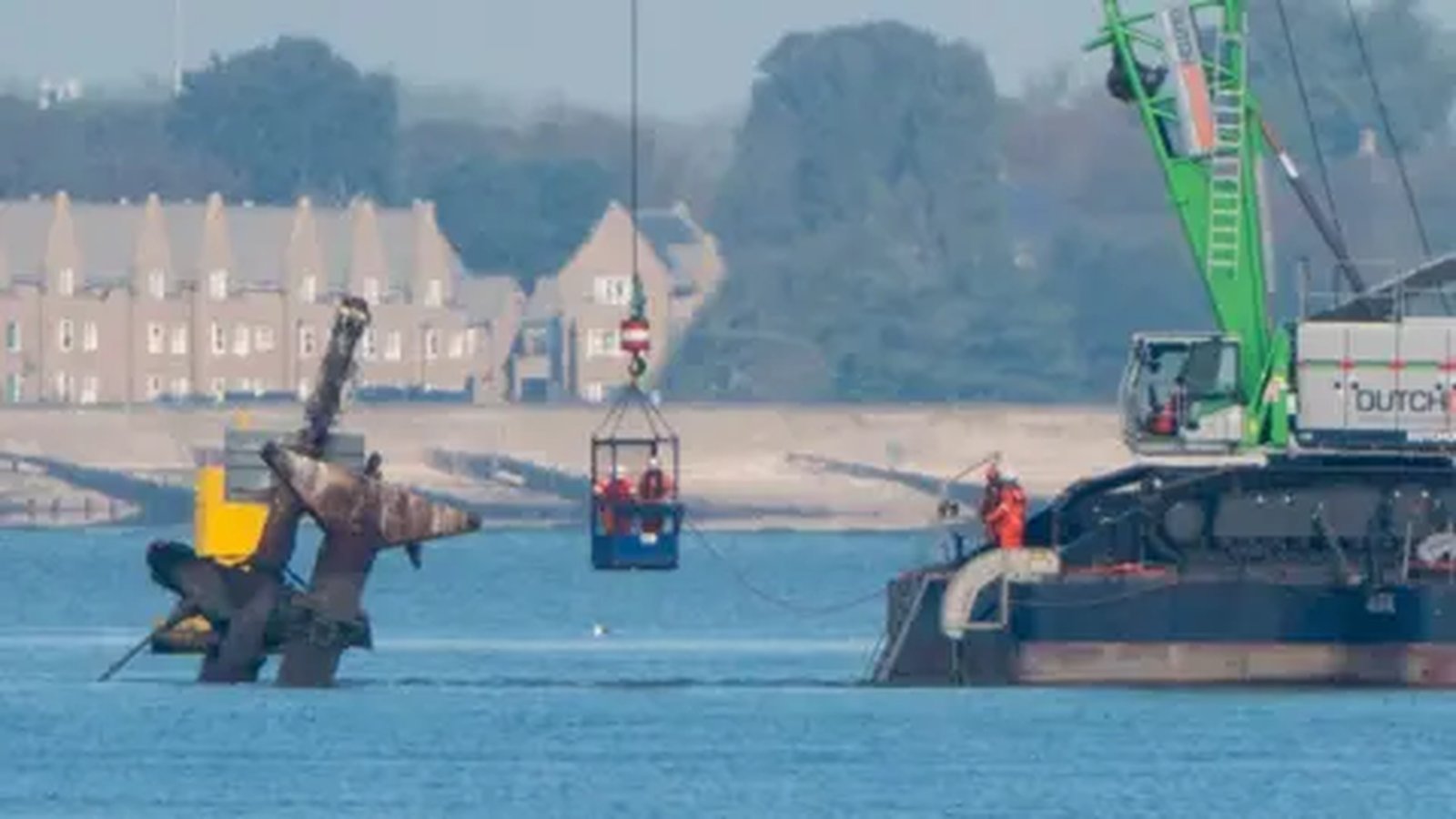
Marine salvage teams have completed the delicate operation to remove the final remaining steel masts from the wreck of the SS Richard Montgomery, a World War II Liberty ship resting in the Thames Estuary off the coast of Sheerness, Kent. The removal, finalized on Wednesday afternoon, marks a milestone in mitigating long-standing safety fears that decaying structural elements could collapse and detonate the approximately 1,400 tonnes of high explosives still trapped in the vessel’s hold.
Advertisement
The operation, overseen by the UK Department for Transport (DfT) and executed by global marine solutions provider Resolve Marine, required months of technical preparation and precision engineering. Divers worked in near-pitch black conditions, guided by advanced sonar imagery, operating from a specialized barge to support the three poles with cranes before cutting through them.
Built during wartime, the SS Richard Montgomery was loaded with roughly 7,000 tonnes of munitions when it ran aground on a sandbank in August 1944 after anchoring off the Kent coast. Although salvage teams managed to remove a significant portion of the cargo immediately following the grounding, the vessel eventually cracked in two and was abandoned. For more than 80 years, its three distinctive mast tops remained visible above the waterline roughly five miles from Southend-on-Sea, becoming both a familiar local landmark for coastal communities and a draw for curious tourists.
However, decades of marine corrosion steadily weakened the structural integrity of the iron and steel framework. Recent technical surveys warned that the deteriorating masts were becoming increasingly unstable, raising alarms that an accidental collapse could trigger a catastrophic explosion capable of generating a severe blast wave and localized flooding along the Kent and Essex shores.
Engineering Precision and Conservation Plans
Project lead Nolan Conway noted that executing the dismantling work required urgent timing while the metal retained enough structural coherence to be handled safely. “It was really important they came off now while the masts were still in a condition where they could be safely removed,” Conway told the BBC.
Following their safe extraction, the historic masts will not be discarded. The Chatham Historic Dockyard has been designated to conserve the steel structures after local campaigns emphasized their deep cultural and historical ties to the region, despite the vessel technically remaining the property of the United States government. UK Maritime Minister Keir Mather praised the operation as a monumental step in managing the hazardous site while preserving an extraordinary chapter of wartime maritime history for future generations.
Follow-up Questions
What will happen to the remaining hull and explosives?
UK authorities continue regular underwater surveys to monitor the stability of the main hull, leaving the remaining munitions submerged under strict navigational exclusion zones
What remains unclear: It remains undecided whether any full-scale removal of the underwater munitions cargo will be attempted in the future
Who owns the retrieved mast structures now?
The physical structures technically remain the property of the United States government, but agreements have been arranged to place them on permanent display in Kent
What remains unclear: The exact exhibition timeline at the Chatham Historic Dockyard has not yet been finalized
Perspectives
Engineering perspective vs Local community perspective
Story lens
Engineering perspective
Resolve Marine engineers framed the extraction as a delicate, high-risk operation requiring rigorous risk management. Successfully cutting the steel elements without inducing shockwaves protects both the diving crews and the sensitive munitions below, mitigating immediate structural collapse risks
Local community perspective
Coastal residents in Kent and Essex viewed the visible masts as both a historic landmark and an underlying hazard for decades. Securing the relics for local exhibition at Chatham Historic Dockyard satisfies public desire to preserve wartime heritage while removing daily safety anxieties
A Manhattan judge upheld New York City’s rent freeze on 1 million stabilized apartments, dismissing a landlord lawsuit challenging the policy’s legality.
Nidal Hasan has requested a delay to his December 3 execution, citing constitutional rights, as legal and procedural battles intensify at Fort Leavenworth.