


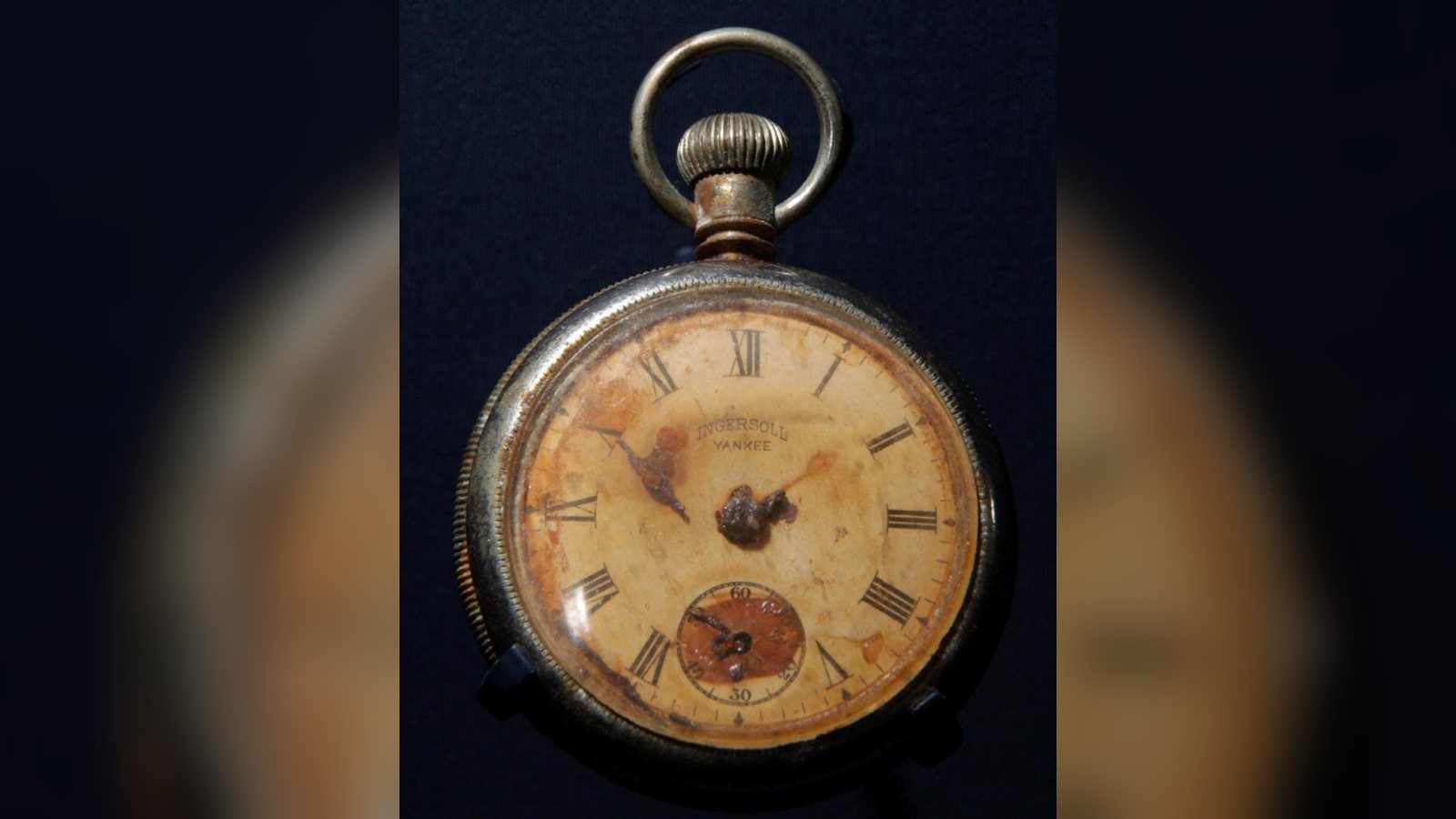
In the climate-controlled, hushed halls of the SeaCity Museum in Southampton, a small, salt-corroded pocket watch rests behind thick protective glass. It is a deceptively simple object, yet it commands a heavy silence from those who stand before it. The dial is frozen at exactly 1:50, a haunting, mechanical marker of the precise moment the icy Atlantic waters claimed both the watch and its owner during the final, agonizing descent of the RMS Titanic. This photograph captures not merely a damaged antique, but a tangible, chilling bridge to the early morning hours of April 15, 1912, when the ‘unsinkable’ ship finally vanished beneath the surface. By looking at the frame, we are forced to confront the mechanical reality of a disaster that is often mythologized into abstraction.
What the photograph shows
The image highlights the watch’s weathered face, where the rhythmic passage of time was halted by a catastrophic encounter with the deep. The metal casing, darkened by decades of salt-water immersion and intense deep-sea pressure, shows the unmistakable signs of oxidation and corrosion. The glass cover is clouded, obscuring parts of the dial but leaving the hands clearly visible, fixed stubbornly at 1:50. These hands serve as a visceral connection to the passengers who faced the freezing darkness of the North Atlantic. Unlike the grand, sweeping scale of the ship itself, this object is profoundly intimate. It represents the personal life of an individual—perhaps a crew member or a first-class passenger—who was never intended to be part of a historical exhibit, but whose final moments were recorded by the very gears they carried in their pocket. The composition of the photograph, focusing tightly on the dial, forces the viewer to confront the specific, granular reality of the artifact.
The moment behind the image
The Titanic struck an iceberg at 11:40 PM on April 14, 1912. By 1:50 AM, the ship was in its final, chaotic stage of sinking. The bow was already deeply submerged, and the stern was rising sharply out of the water, exposing the massive propellers to the air. Witnesses described the scene as one of terrifying gravity; the ship was groaning under the immense stress of its own weight. This watch, likely worn by someone on the deck or in the upper cabins, would have been exposed to the freezing water at this precise time. The sudden thermal shock and the influx of water caused the mechanical movement to seize instantly. It is a rare, tangible link to the panic, the cold, and the absolute finality of those last ten minutes before the ship broke apart. The image captures the moment the watch stopped being a tool for timekeeping and became a historical monument.
Photographer and provenance
The photograph of this artifact is a product of professional museum documentation, commissioned by the SeaCity Museum to catalog their collection for public engagement and historical preservation. While the identity of the specific photographer remains an internal archival detail, the image’s power lies in its technical clarity. It allows the viewer to see the minute details of the damage—the pitting on the metal and the discoloration of the face—that tell the story of the watch’s long journey from the ocean floor to the display case. The provenance of such items is carefully tracked by the museum, which works to preserve these artifacts as part of the maritime legacy of Southampton. The watch was recovered during one of the many salvage expeditions that have visited the wreck site since its discovery in 1985, though the exact expedition remains part of the broader, complex history of Titanic salvage operations, which often spark debate over the ethics of disturbing a grave site.
Historical context
Southampton is a city inextricably linked to the Titanic; it was the home port of the ship and the place where many of its crew members lived. The SeaCity Museum serves as a repository for the stories of the city’s maritime history, including the 549 local residents who perished in the disaster. This watch is a centerpiece of their collection, recovered from the wreckage during various salvage expeditions. Preserving such items is a delicate process, as they are prone to rapid degradation once removed from the stable, anaerobic environment of the seabed. The museum’s efforts ensure that the human element of the tragedy remains at the forefront of the historical narrative. The watch is not just a relic of a ship; it is a relic of the industrial age, a time when mechanical precision was a point of pride, only to be dismantled by the indifference of nature.
Why it still matters
More than a century later, the Titanic remains a global symbol of human hubris and the fragility of life. While films and documentaries often focus on the grand spectacle of the sinking, artifacts like this pocket watch bring the tragedy down to a human scale. It reminds us that every minute recorded in history books was experienced by individuals whose lives were interrupted in an instant. This watch does not just tell us when the ship sank; it asks us to consider the person who checked the time, perhaps hoping for a rescue that would never arrive. It is a silent, frozen witness that forces us to confront the reality behind the myth. The photograph serves as a reminder that history is not just about ships and icebergs, but about the small, everyday objects that carry the weight of human experience into the future, bridging the gap between the living and the lost.