


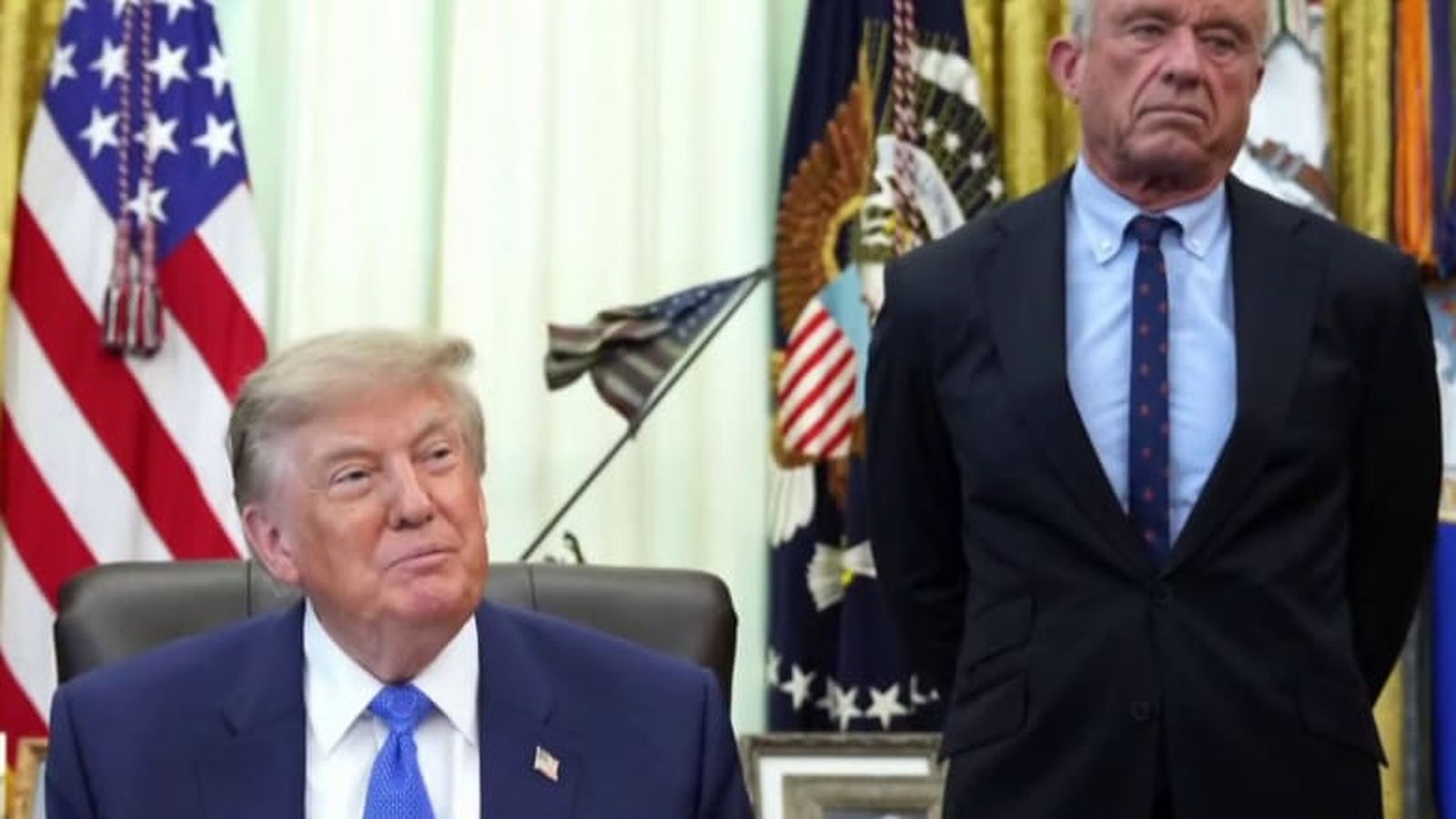
President Donald Trump has signed an executive order aimed at overhauling the United States’ recommended childhood immunization schedule, formalizing a major public policy shift spearheaded alongside Health and Human Services (HHS) Secretary Robert F. Kennedy Jr. According to White House documentation, the executive directive advises federal health agencies to reduce the number of targeted diseases on the universally recommended childhood vaccine list from 18 down to 11, moving remaining routine immunizations into a discretionary clinical category.
Under the updated policy framework, immunizations removed from the universal baseline will no longer be automatically advised for all children across federal health guidelines. Administration documents state that non-core vaccines—including specific combination shots such as measles, mumps, and rubella (MMR) alternatives or secondary pediatric immunizations—should instead be governed by “shared clinical decision-making.” This approach requires individualized, case-by-case consultations between parents and pediatric medical providers rather than reliance on a single national routine schedule.
Congressional Pushback and Medical Consensus
The executive action aligns with public health directives previously outlined by Secretary Kennedy earlier this year, which encountered immediate legal challenges and court blocks following opposition from state public health agencies and medical societies. By issuing a formal presidential order, the administration seeks to embed these guidance changes directly into federal agency protocol, including procedures utilized by the Centers for Disease Control and Prevention (CDC).
The announcement immediately generated sharp bipartisan friction in Washington, drawing strong criticism from prominent medical professionals and lawmakers. Senator Bill Cassidy (R-La.), a physician who serves as chairman of the Senate Health, Education, Labor and Pensions (HELP) Committee, publicly denounced the executive order shortly after its signing. “I’m a doctor. This executive order is wrong,” Cassidy stated in a public message, emphasizing that extensive scientific research proves vaccines are safe and effective. Cassidy explicitly dismissed long-debunked claims regarding pediatric immunizations, adding that “parents should listen to their child’s pediatrician about vaccines rather than listening to an inaccurate executive order.”
Institutional Stakes for Public Health and Insurance
Cassidy’s opposition highlights a substantial divide between scientific institutions and the political leadership of HHS. Major public health organizations, including the American Academy of Pediatrics and the American Medical Association, continue to reinforce that broad childhood immunization schedules have drastically cut infant mortality and virtually eradicated severe viral threats. Federal research bodies have repeatedly confirmed that rigorous clinical evidence demonstrates no casual link between childhood vaccines and autism spectrum disorders.
While presidential executive orders establish administrative policy for executive branch agencies, public school immunization mandates remain under the constitutional authority of individual state governments. However, federal recommendations heavily shape state public health laws, Medicaid coverage guidelines, and commercial health insurance reimbursement models. Shifting seven disease immunizations away from the core national recommendation raises operational questions for insurers, who may adjust mandatory coverage policies, and for state health departments evaluating whether to maintain independent routine vaccine requirements.
The executive order marks a key execution phase in Secretary Kennedy’s broader operational agenda for federal public health agencies. As federal health authorities work to revise official recommendations, state legal officers and medical advocacy organizations are preparing potential court challenges to assess whether the policy shift complies with administrative statutes and statutory public health protections.