


What is in the photo?
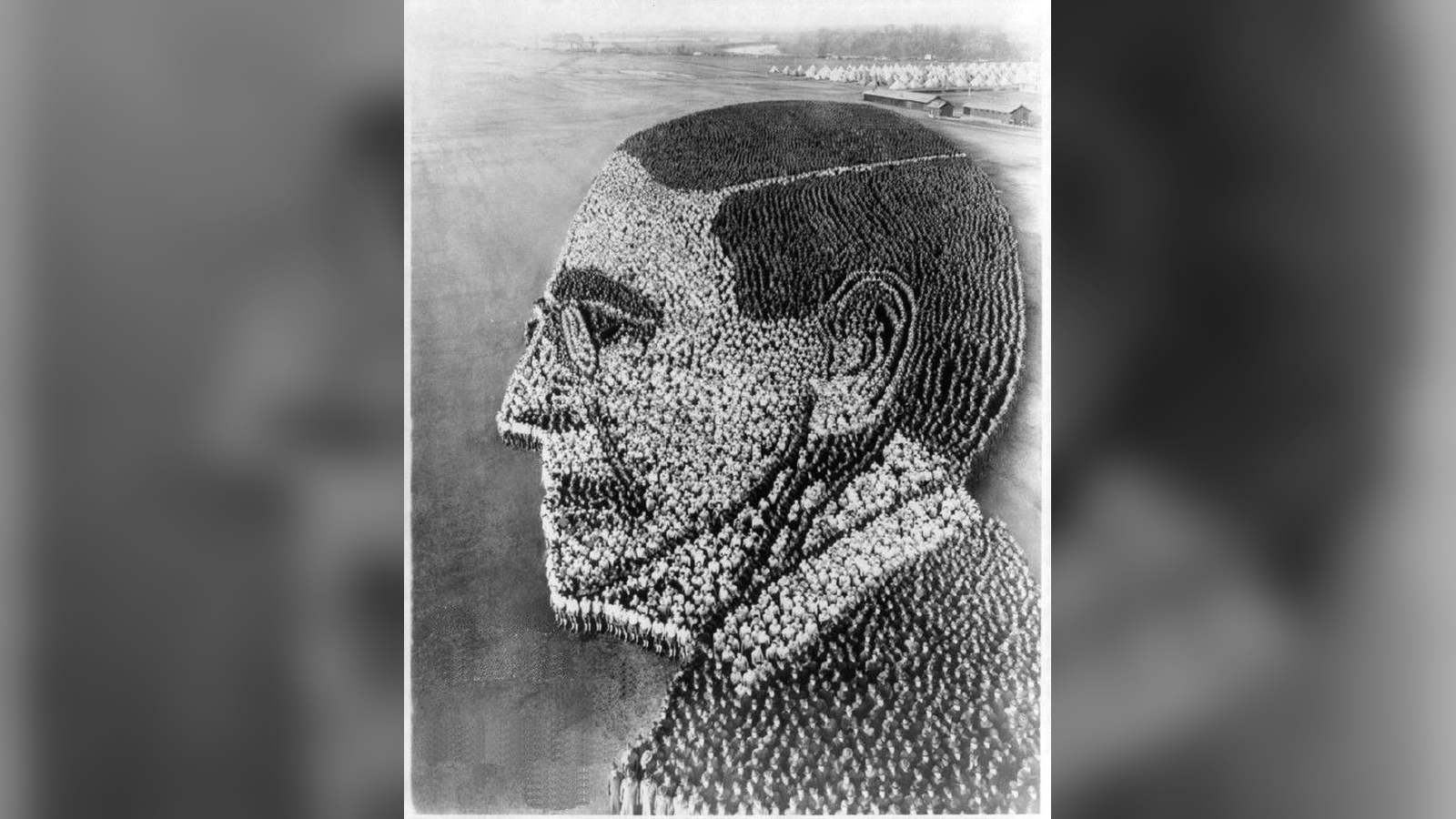
The photograph is a true marvel of human geometry: a massive silhouette of the 28th U.S. President, Woodrow Wilson, created not with ink, but with the bodies of 21,000 soldiers and officers. Viewed from a high vantage point, the ranks reveal the precise facial features of the President. The depth of shadows was achieved through the density of uniforms and the strategic spacing between the men. This vast crowd, which appears as tiny dots from afar, forms a recognizable profile of a global leader at a pivotal moment in history. It is not just a photo, but a product of precise mathematical calculation, requiring perfect discipline for soldiers to align with a pre-drawn grid on the field.
The moment behind the frame
Taken in 1918 at Camp Sherman, this image was part of a series of ‘living photographs’ produced during WWI. With the U.S. having entered the war in 1917, military camps were bustling with recruits preparing for the front lines. Photographers Arthur Mole and John Thomas spent hours positioning the 21,000 men. Soldiers had to remain perfectly still while the photographers, perched on high towers, captured the scene. This was more than a gimmick; it was a display of military order and national unity designed to inspire troops and solidify their connection to the state.
The photographers and history
The photo is the work of the duo Arthur Mole and John Thomas, who specialized in such complex, large-scale compositions. During the patriotic fervor of 1918, they visited various camps to create ‘living’ symbols, including the Statue of Liberty. Using large-format cameras and special lenses from 70-80 feet in the air, they captured images that were widely distributed as postcards and in newspapers, serving as a testament to American military might.
Historical context
Woodrow Wilson was the central figure of American war policy at the time, aiming to ‘make the world safe for democracy.’ In 1918, as the war reached its peak, this massive, unified display of soldiers was intended to boost morale and support the President’s peace initiatives, showing the public that the army was a disciplined force under a singular command.
Why it matters today
This photograph remains one of the most vivid examples of early 20th-century large-scale photography. It serves as a bridge between the individual soldier and the abstract concept of national leadership. Unlike a standard portrait, this image was ephemeral—it existed only as long as the soldiers held their positions. It stands as a monument to American mobilization and human ingenuity during a time when national spirit was amplified by powerful visual tools.