


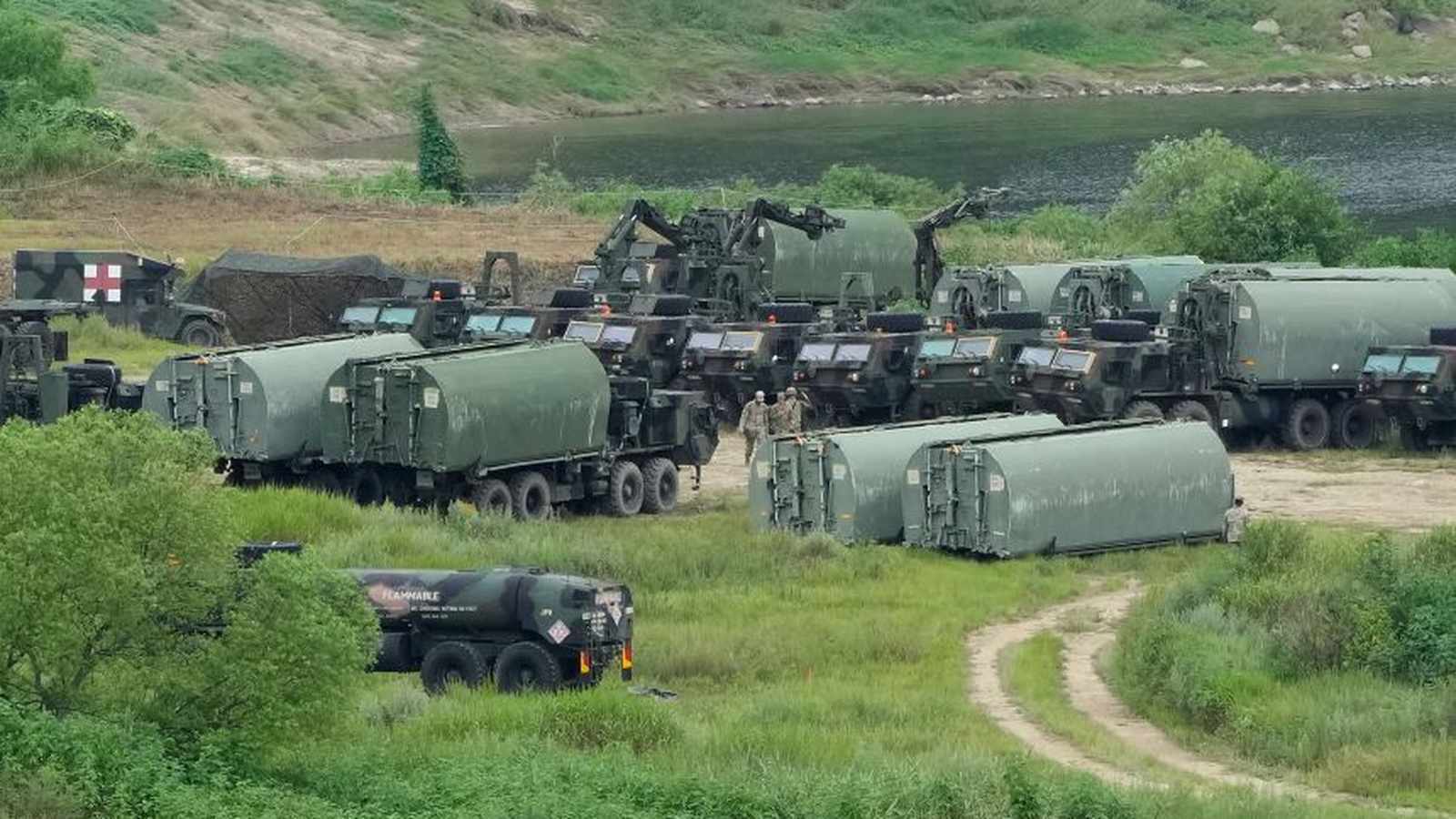
A sudden unilateral decision by US President Donald Trump to scale back joint military exercises with South Korea has triggered a major strategic realignment in Seoul. In response to the sudden disruption of the annual Ulchi Freedom Shield exercises, South Korean President Lee Jae-Myung on Tuesday issued a direct call for military independence, urging an accelerated transfer of wartime operational control (OPCON) from Washington to Seoul. The development, reported by CNN, The Guardian, and NBC News, represents one of the most significant ruptures in the US-South Korea security alliance since the signing of the 1953 armistice.
The friction erupted after President Trump announced on Sunday that the United States would curtail the long-planned military drills, citing the financial burden on Washington and South Korea’s refusal to participate in the US-led military campaign against Iran. Trump also indicated a desire not to upset North Korean leader Kim Jong Un, with whom he claimed to share a “special chemistry.” The decision, made without prior consultation with Seoul, caught South Korean officials off guard and forced an emergency meeting of the National Security Council (NSC) in Seoul on Tuesday.
Trump’s Transactional Doctrine and the Middle East Catalyst
According to administration officials and diplomatic sources, Trump’s decision to penalize South Korea is directly linked to his broader geopolitical frustrations in the Middle East. Trump lamented that despite the presence of approximately 28,500 US troops stationed in South Korea, President Lee’s administration chose not to commit forces to the conflict with Iran. “Well, why are we involved in helping you?” Trump remarked on Monday, framing the decades-old alliance not as a strategic asset but as a transactional arrangement where partners must actively support US operations globally.
This transactional approach has drawn sharp criticism from veteran US diplomats and military officials. Former US Ambassador Christopher Hill noted that while Trump’s first term was characterized by unpredictability, his second term is rapidly establishing a record of unreliability on the global stage. The decision to scale back the exercises is particularly controversial given that South Korea is projected to pay over $1 billion this year to support the US garrison, a contribution recently praised by US Defense Secretary Pete Hegseth as an exemplary model of burden-sharing.
Seoul Demands Sovereign Control and Advanced Capabilities
In Seoul, President Lee Jae-Myung did not back down. Convening the National Security Council on Tuesday, Lee asserted that South Korea must urgently build an independent defense capability. He declared that the planned transfer of wartime operational control (OPCON)—which would give Seoul command over its own forces during a conflict—must proceed without disruption and be completed during his presidential term. The now-curtailed Ulchi Freedom Shield exercises were specifically designed to help certify South Korea’s readiness to assume this command.
To support this push for military self-reliance, President Lee called for rapid progress on South Korea’s domestic nuclear-powered submarine program. He also emphasized the need to train military officers capable of leading integrated operations as the boundaries between modern battlefields become increasingly blurred. Despite the defensive nature of the civil defense drills held alongside the military exercises, Lee made it clear that South Korea can no longer rely solely on the fluctuating political will of Washington for its existential security.
The Rising Threat of the Pyongyang-Moscow Axis
The reduction in joint drills comes at a highly volatile moment for East Asian security. US and South Korean military commanders had designed this week’s exercises to address new battlefield realities, specifically incorporating countermeasures against drone tactics and hybrid warfare strategies that North Korean troops have reportedly been learning while deployed alongside Russian forces in Ukraine. Pyongyang has deepened its military alliance with Moscow, signing a comprehensive strategic partnership in June 2024 and dispatching over 10,000 troops and vast quantities of munitions to support Russia’s war effort.
Despite these developments, Trump has continued to downplay the threat posed by Kim Jong Un, reiterating his belief that his personal relationship with the North Korean dictator reduces regional tensions. However, defense analysts warn that North Korea’s nuclear and missile programs have accelerated significantly, and its alignment with Russia and China has provided Pyongyang with unprecedented geopolitical leverage, making the scaling back of allied deterrence measures highly risky.
A Delicate Diplomatic Balancing Act
While President Lee focused on defense autonomy, South Korean diplomats attempted to manage the immediate fallout. National Security Adviser Wi Sung-lac expressed hope that Trump’s personal rapport with Kim Jong Un could eventually lead to meaningful bilateral dialogue between Washington and Pyongyang, potentially restarting broader peace discussions. Simultaneously, the South Korean presidential office stated it would continue to coordinate closely with Washington to maintain a robust combined defense posture, even as the operational foundations of that posture are being actively redrawn.