


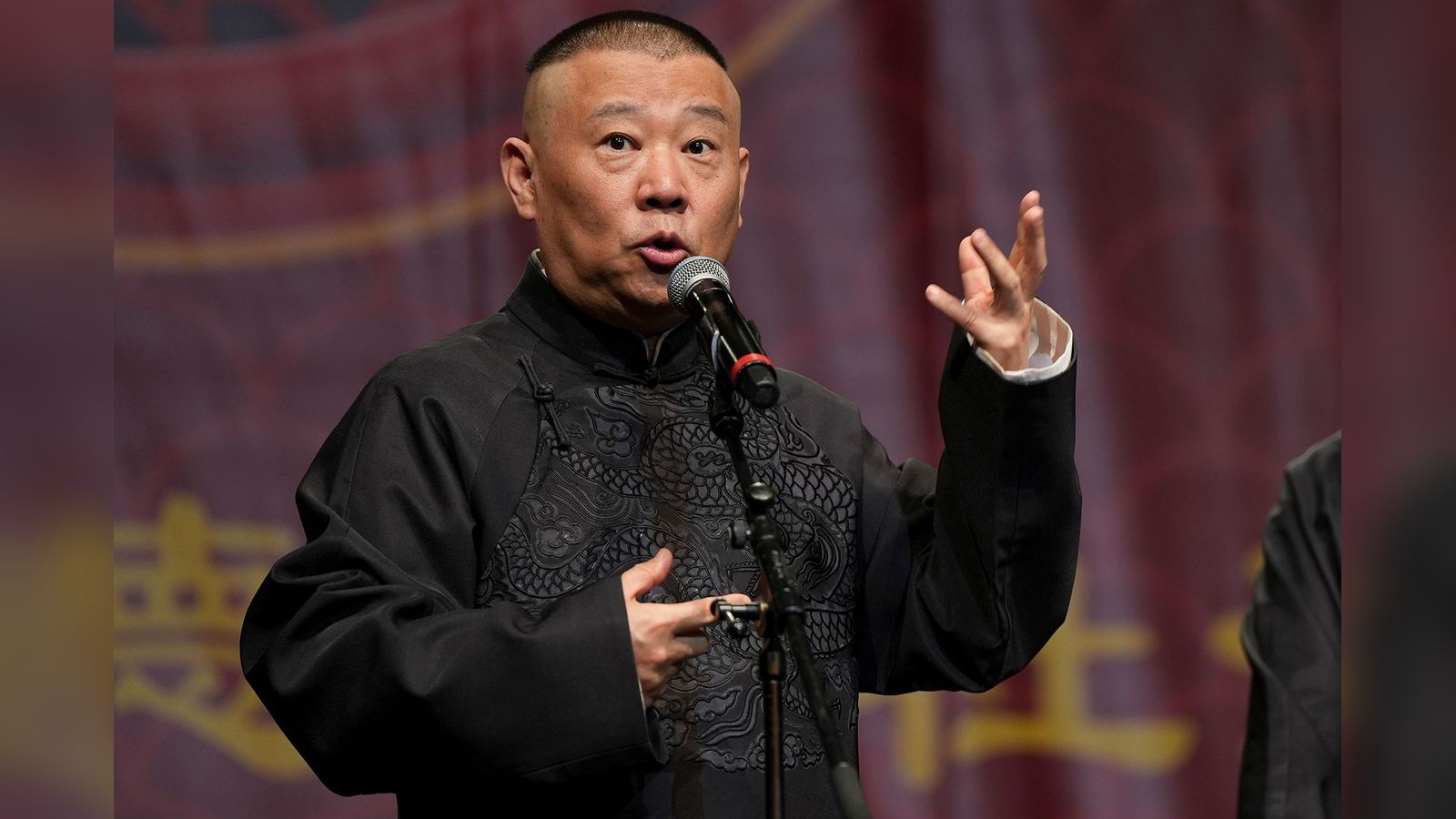
A formal government investigation has been launched against stand-up comedian Guo Degang, widely considered one of China’s most influential cultural figures, after he improvised the lyrics to a famous communist revolutionary song during a live performance. The incident has led to the immediate cancellation of several of his upcoming tour dates and has reignited intense public debate surrounding the limits of artistic expression and the tightening of political censorship in China.
According to reports from state-affiliated media outlet thePaper and confirmed by CNN, the investigation was initiated by the Wuhan Culture and Tourism Bureau. The bureau acted on a formal complaint submitted by an audience member who accused Guo of “distorting and vulgarizing a classic revolutionary work,” as well as violating public morals and accepted standards of conduct. The investigation remains ongoing, and authorities have not yet specified when the final findings or potential penalties will be announced.
The Parody and Its Political Sensitivity
The controversy centers on Guo’s performance in Wuhan at the end of July, during which he adapted the lyrics of “Playing my beloved pipa.” The song, which originated in the famous 1950s Chinese film Railroad Guerrillas, celebrates the resilient spirit of communist guerrilla forces fighting Japanese troops during the Sino-Japanese War. In 2019, it was officially selected as one of the 100 songs to mark the 70th anniversary of the founding of the People’s Republic of China, cementing its status as a highly protected patriotic cultural asset.
In the original version of the song, the opening lyrics state: “The sun is about to set in the west; all is quiet on Weishan lake.” During his performance, Guo changed the second clause to say “all is quiet in the Forbidden City,” delivering the line in a traditional comedic style. The Forbidden City, a sprawling palace complex in the center of Beijing, served as the seat of imperial power for centuries. In modern China, references to this historic site in a satirical or comedic context are treated with extreme political sensitivity due to its historical association with supreme national authority and those who hold power.
Regulatory Violations and Tour Cancellations
The Wuhan Culture and Tourism Bureau stated that the improvised portion of the song performed by Guo was not included in the official materials submitted for prior administrative approval. As a result, authorities suspect the performance violated the strict Regulations on the Administration of Commercial Performances, which mandate that all content in public commercial shows must receive government clearance beforehand.
The fallout from the investigation was immediate. Guo, who was in the middle of a nationwide tour celebrating the 10th anniversary of his Qilin theatre company, has seen several of his upcoming shows canceled. A representative from the Xi’an Chanba Poly Grand Theater, where Guo was scheduled to perform, confirmed to reporters that the show has been called off with no rescheduled date planned, and all ticket holders will receive automatic refunds.
A Shrinking Space for Chinese Comedy
Guo Degang is credited with single-handedly reviving “crosstalk” (xiangsheng), a traditional form of Chinese comedic performing art, making him a household name across the country. Alongside prominent Peking opera artists, he established the Qilin theatre company to popularize traditional performing arts among younger audiences. However, his current predicament highlights the increasingly narrow path that Chinese performers must navigate under the ideological doctrines of “Xi Jinping’s Thought,” which demand that cultural outputs align strictly with party values.
This is not the first time a major comedian has faced severe consequences for political missteps in China. In 2023, stand-up comic Li Haoshi was banned from performing indefinitely and his management company was fined 14.7 million yuan ($2 million) after he made a joke referencing a slogan associated with the People’s Liberation Army (PLA). Similarly, in 2022, comedian Li Bo was fined 50,000 yuan ($7,400) for joking about the Covid-19 lockdowns in Shanghai. The swift enforcement against Guo signals that even the country’s most established cultural icons are not immune to ideological policing.