


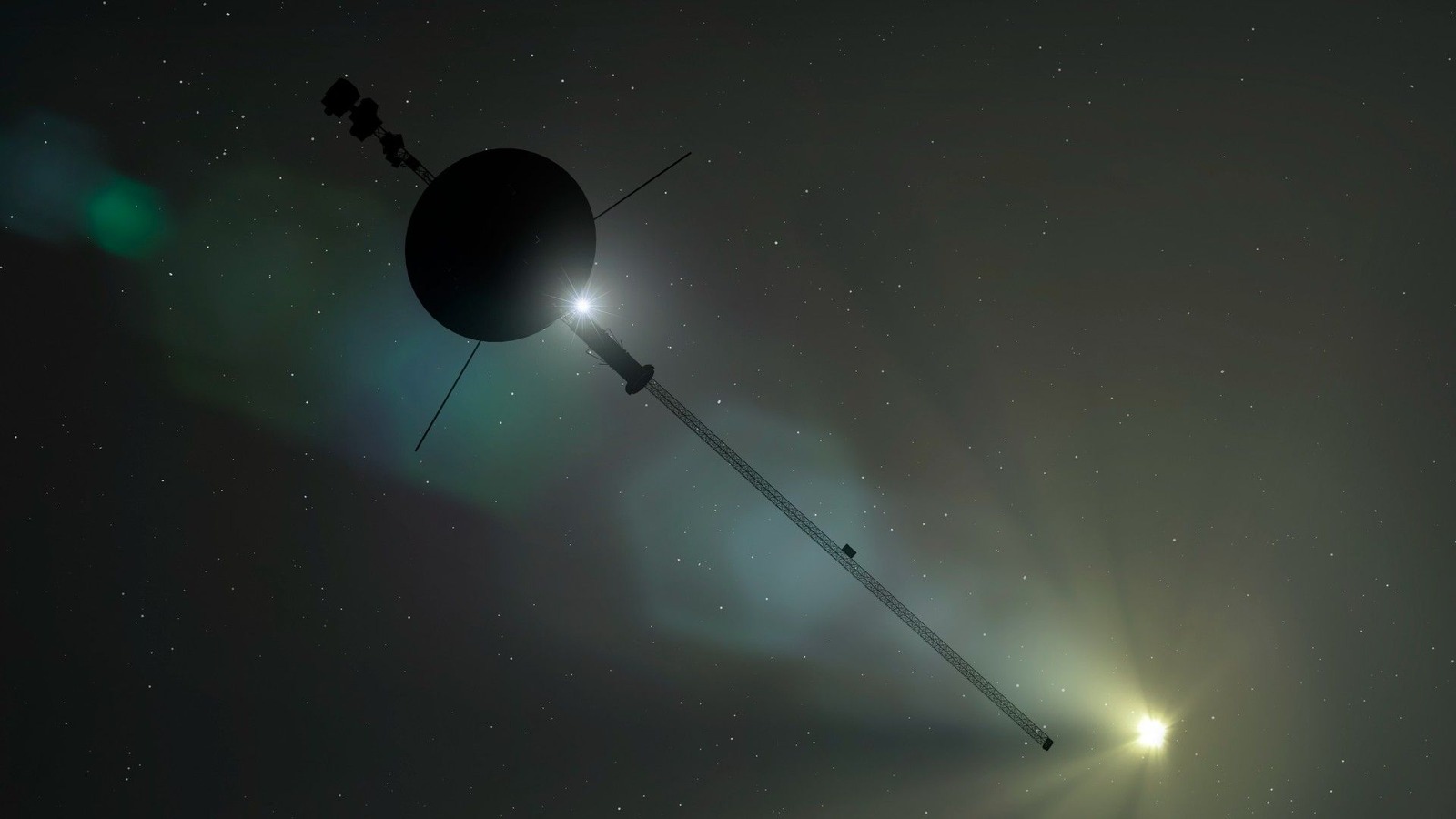
A Record-Breaking Distance
On November 18, 2026, NASA’s Voyager 1 spacecraft officially reached the distance of one light-day from Earth, marking a significant milestone for the 49-year-old mission. This distance, approximately 16.1 billion miles (26 billion kilometers), represents the space that a particle of light travels in a 24-hour period. As reported by Space.com, the probe achieved this position at 5:16 a.m. EST, solidifying its status as the most distant human-made object in history. The milestone is more than just a numerical curiosity; it serves as a sobering reminder of the vast, cold reaches of interstellar space and the incredible endurance of technology launched in the late 1970s.
This achievement introduces a new operational reality for the mission team. Because radio signals travel at the speed of light, it now takes 24 hours for a command sent from Earth to reach the probe, and another 24 hours for the telemetry response to travel back. This 48-hour communication cycle requires extreme precision and patience, as engineers must wait two full days to confirm that a command has been received and executed by the aging spacecraft. As Voyager project manager Suzanne Dodd noted, interacting with the probe now feels less like a real-time conversation and more like a long-distance correspondence where every exchange requires total focus and anticipation of potential system faults.
Engineering Longevity in Interstellar Space
Voyager 1, which launched on September 5, 1977, has long outlived its original design specifications. Since crossing the heliopause in 2012, the probe has been navigating the interstellar medium, gathering data that was previously only available through theoretical models. The mission’s continued operation is a testament to the ongoing innovation of NASA engineers, who have had to manage power constraints by systematically shutting down non-essential scientific instruments over the decades. The recent “Big Bang” energy conservation project, which replaced power-hungry hardware with more efficient alternatives, highlights the creative engineering required to keep the probe alive as its radioisotope thermoelectric generators slowly decay.
Despite these power limitations, the probe continues to transmit vital data. Voyager Project Scientist Linda Spilker noted that the team prioritizes keeping at least one of each type of instrument operational to ensure the mission remains scientifically relevant. The data returned by Voyager 1 and its twin, Voyager 2, continues to reshape our understanding of the sun’s influence, with recent measurements identifying complex ripples and cosmic ray activity deep within interstellar space. These observations, which often contradict previous theoretical models, underscore why NASA continues to pour resources into maintaining the aging craft despite the immense distance and the logistical challenges of managing a system that was built nearly half a century ago.
The Reality of Interstellar Communication
The 48-hour latency is not merely a theoretical constraint; it is a hurdle that complicates every aspect of mission management. Following a recent mysterious 48-hour communication blackout in October 2026, the mission team was forced to rely on the spacecraft’s autonomous fault-protection systems. When the probe stopped responding to the Deep Space Network, it automatically switched to backup thrusters and entered a safe state. The relief felt by the mission team when the signal returned on October 20 was palpable, highlighting the vulnerability of a craft operating so far beyond the reach of human intervention. Mission manager Kareem Badaruddin stated that while the team expects the unexpected, the reality of managing such a distance requires a unique blend of historical knowledge and modern adaptability.
To support this, the mission team remains multigenerational. The small core group of eight to 10 flight controllers often consults with retired engineers who helped design the original systems, bridging the gap between 1970s hardware and 2020s computational needs. This collaborative approach allows the team to troubleshoot issues that might otherwise be impossible to resolve, given that current documentation for some of the onboard systems is as old as the engineers themselves.
A Legacy of Discovery
The mission’s impact extends far beyond its current interstellar findings. Early observations of the Jovian and Saturnian systems provided the foundational knowledge for subsequent missions, including the upcoming Europa Clipper. Cynthia Phillips, a scientist for the Europa Clipper mission, emphasized that researchers still rely on Voyager’s original imagery for certain regions of Europa, as they remain the highest-quality data available nearly five decades later. The fact that data collected in the 1970s remains the gold standard for current flagship missions speaks to the sheer scientific ambition of the original Voyager program.
As Voyager 1 travels at approximately 38,000 mph through the interstellar medium, the team remains focused on the unknown. The primary challenge moving forward is maintaining the health of the spacecraft’s legacy systems while navigating the extreme latency of deep space. Every piece of data returned is treated as a unique insight into a region of space that humanity has never before accessed, with the mission team continuously monitoring the probe for potential surprises as it moves further into the cosmic void. With the 50th anniversary of the launch approaching in 2027, the team is already looking toward the next set of milestones, including the date when Voyager 1 will be one light-day from the sun, proving that even at the edge of human reach, the drive for discovery remains undiminished.
Reporting source: space.com.