


Christopher Nolan’s 2026 cinematic adaptation of Homer’s epic poem, The Odyssey, represents a massive milestone in filmmaking history. According to production details compiled by Movie-Locations, it is the first feature film shot entirely in the IMAX format, utilizing newly developed, lighter, and quieter cameras designed specifically for this production. True to Nolan’s signature style, the production largely eschewed digital green screens in favor of practical, real-world filming locations spanning six countries—Morocco, Italy, Greece, Scotland, Iceland, and Malta—alongside major studio work in Los Angeles.
The narrative begins immediately after the sacking of Troy, tracking Odysseus (Matt Damon) and his crew on their perilous decade-long journey back to Ithaca. Meanwhile, his wife Penelope (Anne Hathaway) and son Telemachus (Tom Holland) navigate the political dangers of a palace overrun by aggressive suitors. To bring this ancient world to life, Nolan’s team undertook massive logistical and engineering challenges across some of the world’s most rugged landscapes.
Morocco and the Western Sahara Controversy
The legendary city of Troy was brought to life in Morocco, where the production focused heavily on Odysseus’s atonement for defying the law of Zeus with his famous wooden horse. Rather than a wheeled prop, Nolan reimagined the Trojan Horse as an offering to the sea god Poseidon, left mired in the sand. These beach scenes were filmed at Essaouira, a historic port on Morocco’s Atlantic coast. While Essaouira’s famous ramparts were kept off-screen, the location has a rich cinematic history, having hosted Orson Welles’s 1949 Othello and serving as Astapor in Game of Thrones.
For the fortified city of Troy itself, the production moved inland to the UNESCO World Heritage Site of Aït Ben Haddou, a traditional Berber earthen clay village near Ouarzazate. The crew constructed over 60 temporary structures, including a massive, pillared Temple of Athena and towering city gates, covering 2.5 acres (110,000 square feet). Cinematographer Hoyte van Hoytema rigged these structures with portable LED banks to supplement carefully controlled fires during the spectacular burning of the city. Additional city scenes were filmed in the market town of Tahanaout in El Haouz.
However, the production faced intense political backlash when filming moved to Dune Blanche (the White Dune) near Dakhla in Western Sahara to represent Calypso’s (Charlize Theron) island of Ogygia. Because Western Sahara has been administered by Morocco since 1975 and is claimed by the Sahrawi independence movement, a high-profile open letter signed by industry figures, including Javier Bardem and Pedro Almodóvar, condemned the shoot as whitewashing Moroccan colonialism. Despite calls to cut the Dakhla scenes, they remained in the final film.
Italy’s Volcanic Coasts and the Palace of Ithaca
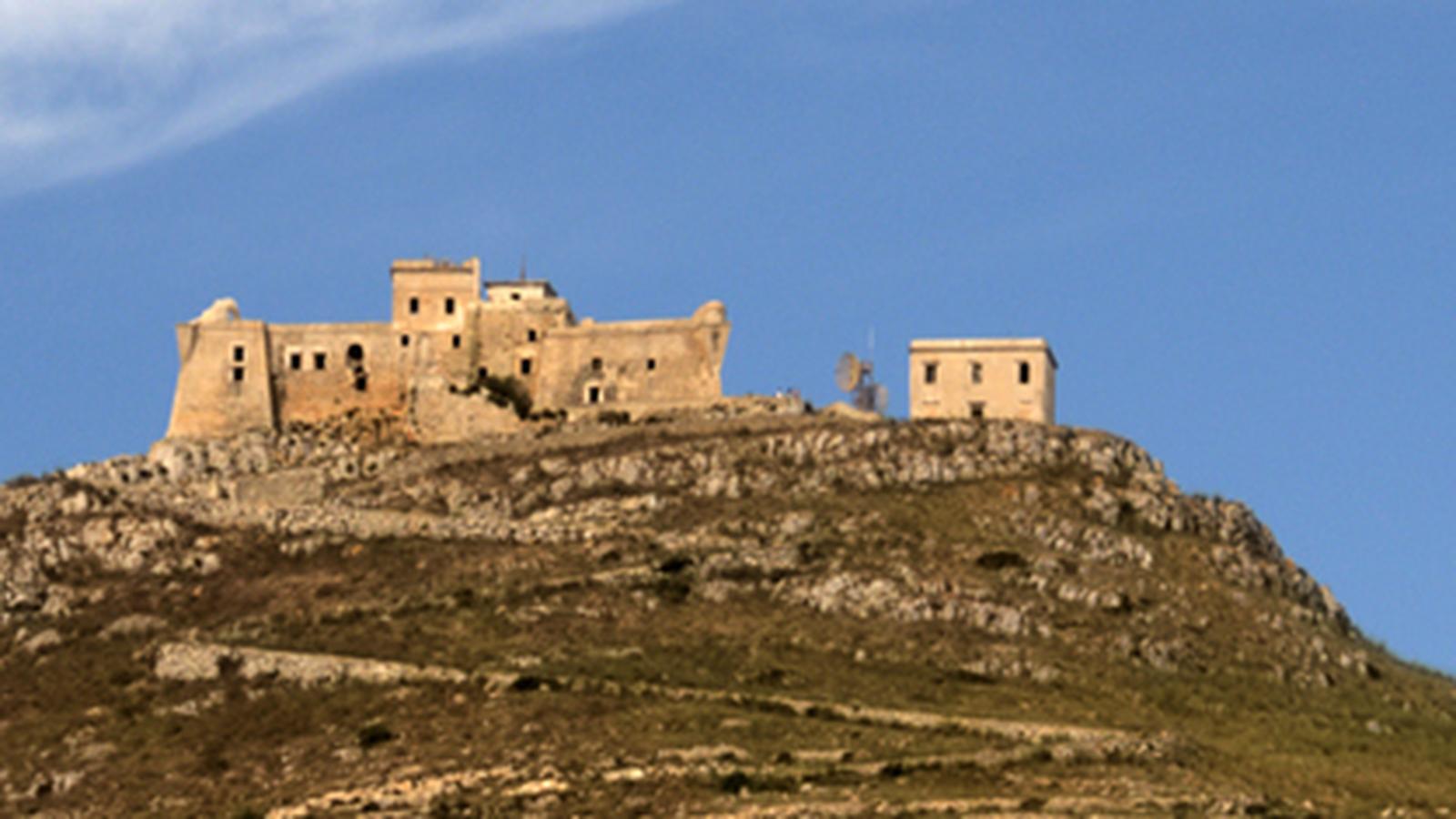
The home of Odysseus, Ithaca, was filmed off the western coast of Sicily. The exterior of the royal palace was staged at Castello di Santa Caterina, a historic castle crowning Monte Santa Caterina on the island of Favignana. Because local authorities denied permission to build an access road, the production had to construct a temporary funicular lift to transport heavy IMAX equipment, while the cast and crew hiked 30 to 45 minutes up the steep, rocky terrain daily during the two-week shoot. The loyal swineherd Eumaeus’s (John Leguizamo) pig farm was built adjacent to this castle, while the palace interiors were constructed on soundstages in Los Angeles.
The mythological island of Aeolia, where Poseidon unleashes his wrath, was filmed around the volcanic Aeolian Islands of Vulcano, Basiluzzo, and Lipari. The “Wandering Rocks” were represented by the Faraglioni di Lipari—two natural volcanic rock spines known as Pietra Lunga and Pietra Menalda. The Pietra del Bagno shoal off Lipari’s west coast served as the setting for the Sirens’ encounter, while the treacherous channel between Basiluzzo and the jagged rock of Scoglio Spinazzola was utilized for the terrifying passage between Scylla and Charybdis.
Greece: Mythological Horrors in the Peloponnese
The crew’s encounter with the Cyclops Polyphemus (Bill Irwin) was filmed in the Peloponnese region of southern Greece. The gorgeous, horseshoe-shaped Voidokilia Beach in Messenia served as the Island of the Cyclopes. Rather than using a soundstage, Nolan filmed the interior cave scenes inside the actual Nestor’s Cave, a cold, echoing cavern located high above the beach that dates back to 6,000 BC. The horrifying design of the Cyclops, realized through a mix of puppetry, animatronics, and physical performance, was directly inspired by Francisco Goya’s dark painting Saturn Devouring His Son.
To the south, the 16th-century Methoni Castle and its octagonal Bourtzi tower served as the palace of King Menelaus of Sparta (Jon Bernthal) and Helen (Lupita Nyong’o). Flashbacks to Agamemnon’s (Benny Safdie) tragic return to Mycenae and his confrontation with Clytemnestra (also played by Nyong’o) were filmed at the fortified castle of Acrocorinth, overlooking the ancient city of Corinth.
Scotland and Iceland: The Mist of Aeaea and the Black Sands of Hades
To contrast the sun-drenched Mediterranean, Nolan shifted the production north. The island of Aeaea, home to the witch Circe (Samantha Morton), was filmed along the Moray Firth coast of Scotland. The vast pine groves of Culbin Forest hosted the attack of the giant Laestrygonians, brought to life using forced-perspective and wirework rather than CGI. Circe’s cliffside home was constructed near the ruins of Findlater Castle, east of Cullen. To protect the site’s unique archaeology, the production built the structure on the approach to the promontory, avoiding any contact with the ancient surviving walls.
For the underworld of Hades, the crew traveled to southern Iceland, filming during the eerie “midnight sun” of June. Odysseus’s ship—the Draken Harald Hårfagre, a modified Viking longboat moored in Landeyjahöfn—sailed along the black sands of Hjörleifshöfði, an isolated volcanic headland east of Vík. The use of a Viking longboat instead of an ancient Greek galley drew minor criticism from archaeological scholars, but Nolan prioritized the vessel’s seaworthiness and imposing visual presence in the rough Icelandic waters.
Studio Craft: Malta’s Deep Tanks and Los Angeles Soundstages
While the film relies heavily on natural landscapes, complex water sequences and interior sets required specialized facilities. All underwater photography, shipwrecks, and close-range naval battles were captured at the Mediterranean Film Studios in Kalkara, Malta, utilizing some of the largest deep-water tanks in the world. Finally, the massive, highly detailed interior of the Palace of Ithaca—where Penelope weaves her shroud and the suitors meet their fate—was built on Stage 12 at Universal Studios Hollywood in Los Angeles, seamlessly blending with the practical exterior shots captured on the Sicilian cliffs of Favignana.