


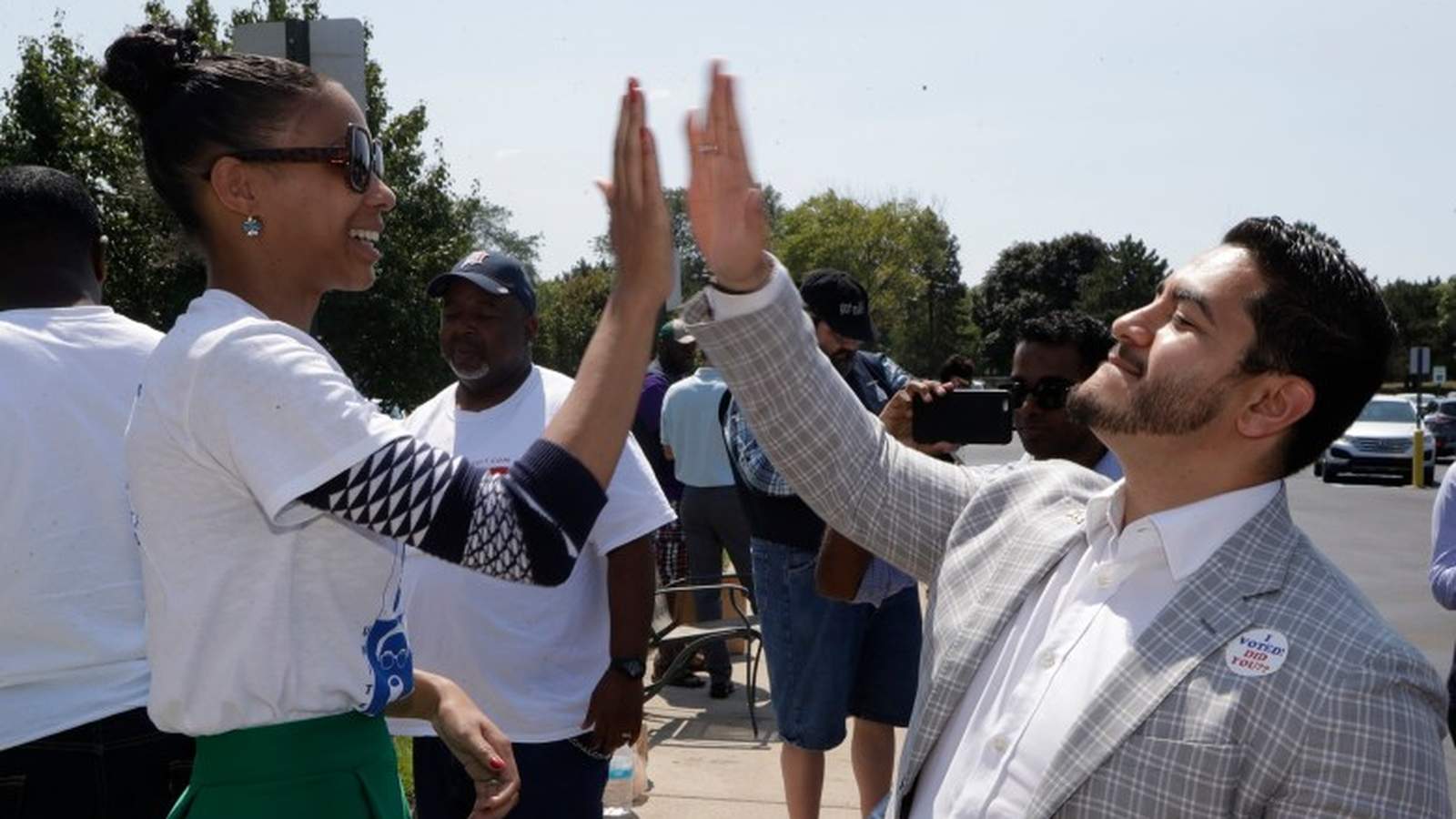
With less than a week remaining before Michigan’s high-stakes Democratic primary to succeed retiring Senator Gary Peters, the race has transformed from a conventional primary battle into a high-stakes ideological referendum. According to recent polling data published by The American Prospect and regional tracking surveys, progressive health technocrat Abdul El-Sayed has surged to a commanding double-digit lead over establishment-backed U.S. Representative Haley Stevens. A late-July poll places El-Sayed at 46% to Stevens’ 36%, with 14% of voters remaining undecided. With more than 800,000 ballots already cast via early voting, this double-digit margin has triggered what party insiders describe as a “collective mass panic” among institutional Democrats, prompting a frantic multi-million dollar counter-offensive to halt El-Sayed’s momentum.
A Transformed Candidate and a Shifting Electorate
El-Sayed’s current front-runner status marks a dramatic evolution from his first statewide bid in 2018, when he ran an unsuccessful, highly intellectualized campaign for governor against Gretchen Whitmer. In that race, Whitmer secured a decisive victory, winning every county and capturing 52% of the vote to El-Sayed’s 30%. Strategists from that era note that while El-Sayed’s 2018 campaign was praised as an exceptional “policy think tank,” it lacked the disciplined, populist messaging required to win a statewide race. Whitmer’s pragmatic, hyper-focused “Fix the Damn Roads” slogan ultimately resonated more deeply with working-class voters than El-Sayed’s lofty, state-level single-payer healthcare proposals.
Eight years later, El-Sayed has returned as a significantly matured and politically formidable candidate. Between his campaigns, he served as the health director for Wayne County, hosted a prominent national podcast, and maintained high visibility on national media outlets. His 2026 campaign has traded the idealistic, policy-heavy lectures of his youth for a highly focused, disciplined stump speech centered on three core pillars: “money out of politics, money in your pocket, Medicare for All.” By embracing a modern, highly accessible media strategy—including appearances on popular podcasts and even adversarial news platforms—El-Sayed has successfully cultivated an authentic, accessible “populist” persona that resonates with a broad coalition of progressive and working-class voters.
The Financial Divide: Grassroots vs. Corporate PACs
The primary battle has laid bare a profound financial and structural divide within the Democratic Party. El-Sayed has built his campaign on a strict rejection of corporate PAC contributions, leveraging this stance to secure the highly coveted endorsement of the United Auto Workers (UAW). UAW President Shawn Fain has publicly championed El-Sayed’s authenticity, contrasting his grassroots approach with the corporate-backed campaigns of his establishment rivals. Fain noted that El-Sayed’s refusal to accept corporate PAC money was a decisive factor for union members, who have grown increasingly skeptical of highly choreographed, corporate-funded politicians.
In contrast, Representative Haley Stevens has relied heavily on outside spending to sustain her candidacy. While Stevens’ official campaign raised approximately $12 million and spent $9 million, outside groups and corporate political action committees have poured an estimated $30 million to $60 million into the race to boost her candidacy and attack El-Sayed. This massive influx of independent expenditure has funded a relentless wave of television and digital advertisements, transforming the primary into one of the most expensive and polarized Senate races in Michigan’s history. For progressives, the race is a crucial test of whether a grassroots campaign can withstand an unprecedented onslaught of dark money.
Populist Policy and Demographic Realities
Beyond traditional healthcare and economic platforms, El-Sayed has tapped into emerging populist issues that cut across traditional ideological lines. A key example is his campaign’s aggressive advocacy for the strict regulation of data centers—a rapidly expanding industry that has drawn intense local opposition over energy consumption and environmental concerns. By framing data center expansion as an unregulated corporate exploitation of public resources, El-Sayed has successfully channeled local frustration into a broader critique of corporate influence in state government.
Furthermore, the primary is unfolding in a state with highly complex and shifting demographic realities. Michigan features a unique coalition of industrial working-class communities, affluent suburbs, and some of the largest Arab-American, Muslim, and Jewish populations in the United States. These demographic dynamics have made the primary particularly sensitive to international policy debates, most notably regarding conflicts in the Middle East. While El-Sayed’s rivals previously attempted to damage his candidacy by linking him to controversial foreign policy statements made by prominent progressive surrogates—such as Twitch streamer Hasan Piker—the attacks failed to stick. Instead, the exchange consolidated El-Sayed’s progressive base while causing his third-party rival, State Senator Mallory McMorrow, to bleed support and ultimately withdraw from the race.
National Implications and the Establishment’s Panic
The outcome of the Michigan primary will carry profound implications for the national Democratic Party as it prepares for the 2026 midterm elections and beyond. High-profile national progressives, including Representative Pramila Jayapal of Washington, have traveled to Michigan to stump for El-Sayed, framing his potential victory as a clear mandate for a populist, anti-corporate platform. “Everybody is watching this race!” Jayapal declared at a recent rally, emphasizing that El-Sayed’s nomination would send a powerful signal to the Democratic establishment regarding the viability of progressive policies in critical swing states.
Conversely, moderate and establishment Democrats fear that nominating an outspoken progressive like El-Sayed could jeopardize the party’s ability to hold the crucial Senate seat in the general election, particularly in a swing state that has repeatedly proven to be highly competitive. Political strategists note that Michigan remains highly inconsistent, having narrowly backed Bernie Sanders in the 2016 primary before flipping to Donald Trump in the general election, and remaining a razor-thin battleground ever since. As Election Day approaches, the intense mobilization of both grassroots volunteers and corporate-funded PACs ensures that the final days of this primary will serve as a defining battleground for the future direction of the Democratic Party.