


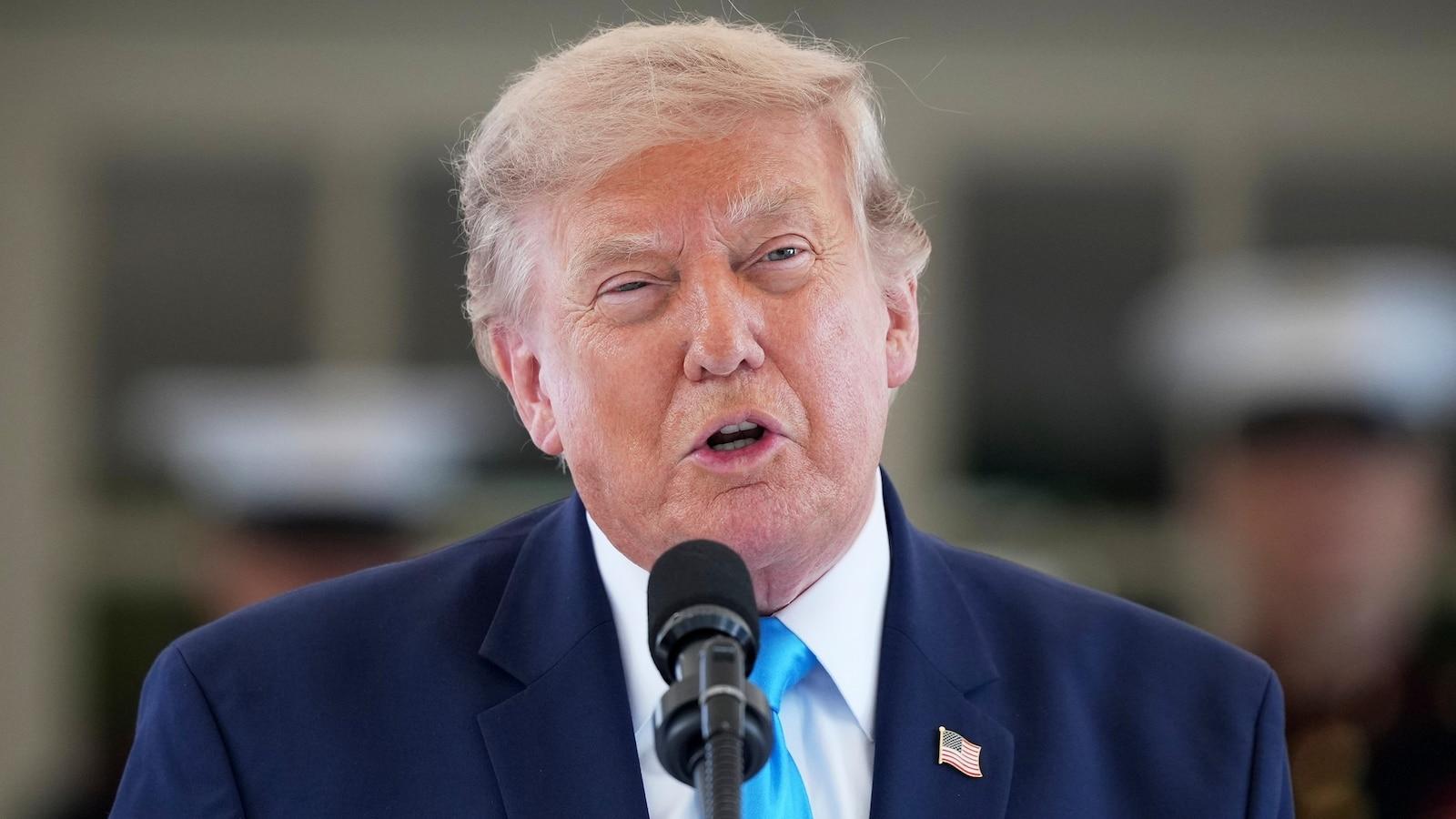
U.S. President Donald Trump has announced that Hamas and other Palestinian factions have agreed to a framework document establishing a phased plan for their disarmament in the Gaza Strip. Framing the development as a “monumental step” toward regional stability, Trump credited the breakthrough to the Board of Peace—the international body established to oversee Gaza’s post-war governance. However, despite the high-profile announcement from Washington, the agreement faces immense skepticism, with critical details regarding implementation, international enforcement, and Israeli consent remaining unresolved.
The announcement, which comes nine months after a U.S.-brokered ceasefire was initially signed, attempts to break a long-standing deadlock over the second phase of the peace roadmap. While the initial October ceasefire halted large-scale hostilities, negotiations had stalled over the dual challenges of Hamas’s disarmament and the reconstruction of the devastated enclave. According to a copy of the agreement obtained by Al Jazeera, the document stipulates that a precise disarmament roadmap must be drafted within 14 days, subject to extensions approved by an international verification body and agreed upon by all active parties.
The Phased Roadmap and the “Board of Peace”
Under the proposed framework, the disarmament process is structured to occur in carefully calibrated phases rather than an immediate surrender of weapons. The process is slated to begin with the entry of a newly established National Committee alongside an International Stabilisation Force into Gaza. The National Committee—envisioned as a technocratic, apolitical governing body designed to replace both Hamas and the Palestinian Authority—will oversee the physical “inventory and storage” of weapons. This process will be monitored by an international verification committee with the participation of Palestinian factions.
According to a Board of Peace official who spoke to Al Jazeera, the decommissioning of weapons will follow a strict sequence. Weapons held by the local police forces will be transferred first, followed by the systematic decommissioning of heavy weaponry. Crucially, the agreement specifies that no weapons are to be handed over to Israel or any non-Palestinian entity. Instead, the National Committee is designated as the sole authority permitted to hold and secure the weapons within Gaza.
Nickolay Mladenov, the Board of Peace’s high representative for Gaza, acknowledged the intense diplomatic effort required to secure the document, noting that negotiations had nearly collapsed on multiple occasions. “Implementation and verification have to be real,” Mladenov stated publicly on Friday, emphasizing that the physical withdrawal of Israeli forces must move “in lockstep with decommissioning.”
Conditional Assents and Internal Palestinian Fractures
Despite the optimistic framing from the White House, Hamas has made its compliance strictly conditional. Ghazi Hamad, a senior member of Hamas’s negotiating delegation, confirmed to Al Jazeera that the group would not implement any portion of the agreement if the Israeli military failed to fulfill its reciprocal obligations. “These negotiations were difficult and hard,” Hamad stated, emphasizing that disarmament is structurally tied to the complete withdrawal of Israeli forces from Gaza and the rapid commencement of reconstruction efforts.
Military analysts have also pointed to crucial linguistic and operational distinctions within the text. Nidal Abu Zaid, a military analyst, observed that the agreement’s reliance on the phrase “inventory and storage” represents a deliberate compromise. “From a military standpoint, inventory and storage is carried out by a third party, but that party does not need to be an enemy force,” Abu Zaid explained. “But disarmament is typically carried out by an enemy force, and the Palestinian factions will never agree to that form of disarmament.”
Furthermore, consensus among Palestinian militant groups remains elusive. Palestinian Islamic Jihad (PIJ), the second-largest armed faction in Gaza, swiftly disputed reports of a finalized agreement. PIJ representatives characterized the circulating reports as inaccurate and expressed severe reservations regarding the specific wording of the draft, highlighting the internal political hurdles that could derail the plan before implementation even begins.
The Israeli Equation: Silence and Territorial Realities
A primary source of uncertainty is the official stance of the Israeli government. At the time of publication, neither Prime Minister Benjamin Netanyahu’s office nor Israel’s United Nations Mission had issued a formal comment on the disarmament announcement. The silence is particularly notable given that Trump and Netanyahu met face-to-face at the White House on Tuesday—their first in-person meeting since the escalation of regional tensions—without disclosing substantial details regarding their discussions on Gaza’s security architecture.
The reality on the ground in Gaza presents a stark contrast to the diplomatic roadmap announced in Washington. The Israeli military currently controls more than half of the Gaza Strip, and Netanyahu has previously stated Israel’s intention to expand its security control to up to 70% of the territory. This ongoing military presence directly contradicts Hamas’s demand for a complete withdrawal as a prerequisite for weapon storage.
Moreover, local monitoring groups and health officials note that the security situation remains highly volatile. Despite the ceasefire framework, sporadic military operations have continued, and the humanitarian crisis remains severe. Gaza’s Health Ministry reports that the total death toll since the beginning of the conflict has surpassed 73,000 Palestinians, including casualties sustained during the ceasefire period due to localized skirmishes and ongoing restrictions on the movement of essential goods.
Geopolitical Oversight and the Search for Alternatives
The diplomatic push behind the agreement has relied heavily on regional mediators, including Egypt, Qatar, and Turkiye. Hamas leaders have spent the past week in Cairo coordinating with these regional actors to secure commitments for the second phase of the ceasefire roadmap. Egypt is expected to host another round of high-level talks in Cairo, bringing together representatives from the U.S., Qatar, and Turkiye to formalize the deployment of the International Stabilisation Force.
The inclusion of Turkiye and Qatar on the Board of Peace had previously drawn sharp criticism from Israeli officials. However, U.S. officials defended the decision, arguing that the involvement of these regional powers was essential to securing Hamas’s initial consent. “Right now, there is finally an alternative to the PA and Hamas,” a U.S. official told reporters, describing the proposed National Committee as a “technocratic, apolitical government” capable of managing Gaza’s recovery.
While the announcement represents a notable diplomatic milestone for the Trump administration, international observers remain cautious. Without explicit, binding commitments from the Israeli government to withdraw its forces, and without a finalized list of nations willing to contribute troops to the International Stabilisation Force, the 20-point peace plan remains a highly fragile framework whose implementation faces extraordinary logistical and political challenges on the ground.