


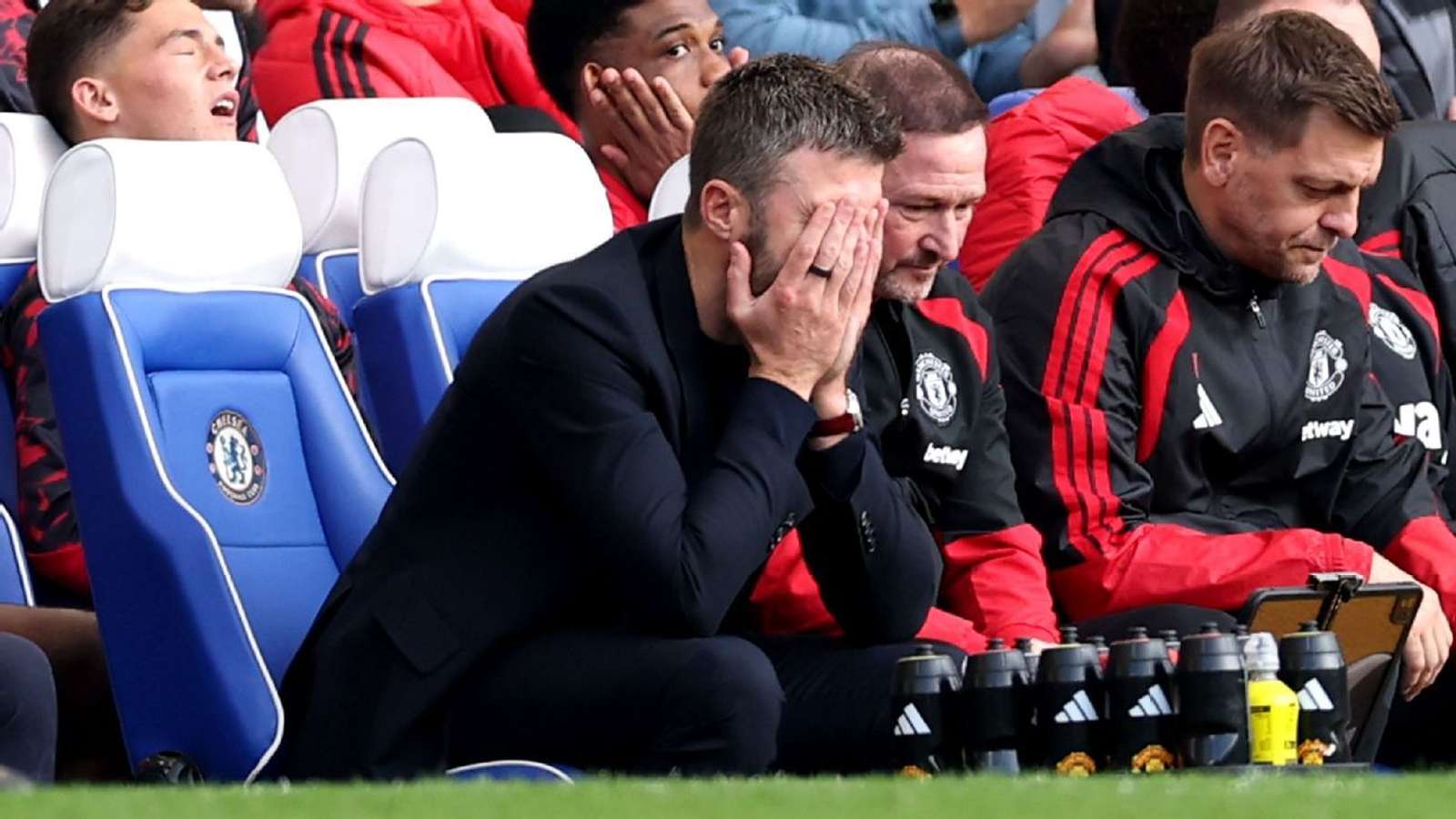
LONDON (Azat TV) – Manchester United head coach Michael Carrick faced escalating pressure on Saturday, October 31, 2026, as his side suffered a 2-0 defeat against Chelsea at Stamford Bridge. Reported by ESPN, the result extended United’s winless run across all competitions to nine matches and plunged the club into a genuine relegation battle with only seven points from their opening nine Premier League fixtures.
United had held their own during an end-to-end first half in west London, where Matheus Cunha and Estêvão both saw goals disallowed for offside. However, the visitors completely unraveled after the interval against Xabi Alonso’s side. Morgan Rogers broke the deadlock just five minutes into the second half, dribbling straight through a static United defence before dinking his finish over goalkeeper Senne Lammens.
Red Card and Second Goal Seal Defeat
The contest slipped further away from the visitors when defender Lisandro Martínez was shown a red card. The Argentine defender received a second yellow card three minutes and 30 seconds after his first when VAR spotted his elbow make contact with Wesley Fofana during a Chelsea corner. Walking straight down the Stamford Bridge tunnel without acknowledging his manager, Martínez left his side with 10 men.
Cole Palmer subsequently converted from the penalty spot to double Chelsea’s lead. Although Lammens got two hands to the penalty, the ball squirmed in off the post. Chelsea later had another goal from Estêvão chalked off for offside, while home goalkeeper Mike Penders tipped a powerful Bryan Mbeumo effort onto the crossbar during stoppage time to preserve the clean sheet.
A Historic Slump and Boardroom Dilemma
The defeat compounds a miserable sporting period for the Old Trafford hierarchy, who had granted Carrick a temporary stay of execution following a high-level evaluation earlier in the week. Many observers expected Carrick to be dismissed following a 3-0 home defeat by Bournemouth, but club chiefs had initially opted to give him additional time.
Captain Bruno Fernandes returned to the starting lineup in west London after missing the Bournemouth match due to a disciplinary benching following public tactical friction. Despite the return of senior figures, United have now gone 10 matches without a win only twice in their entire history—previously doing so in the 1977-78 and 1961-62 campaigns. With a daunting Champions League fixture against Roma looming on Tuesday, the club faces immediate, high-stakes decisions regarding the leadership of the squad.
Tactical Analysis and Underlying Squad Realities
The broader analytical context surrounding Manchester United highlights structural vulnerabilities that extend far beyond a single afternoon at Stamford Bridge. Analysts examining the club’s trajectory note that Carrick inherited a squad carrying significant structural deficiencies, compounded by a restrictive summer transfer window. While clubs like Chelsea and Tottenham Hotspur heavily invested in youthful dynamism—exemplified by Chelsea fielding a starting eleven with an average age of just 23 years and 89 days—United’s recruitment was constrained by the financial parameters set by CEO Omar Berrada and director of football Jason Wilcox.
Under the stewardship of minority shareholder Jim Ratcliffe’s regime, the club has sought to re-establish financial equilibrium following years of historical overspend under the Glazer family. However, this strategy left key areas of the pitch exposed. The failure to secure primary midfield targets such as Elliot Anderson or Mateus Fernandes forced the club to pivot toward alternatives like Youri Tielemans, Andrey Santos, and the injured Carlos Baleba. Consequently, Carrick has been left navigating a demanding fixture list with a squad lacking sufficient depth, pace, and creative spark in critical areas.
The defensive frailties exposed by Morgan Rogers’ surging run and the subsequent disciplinary lapse by Lisandro Martínez underscore a team suffering from acute psychological fatigue. Martínez, who had previously voiced public frustration regarding the club’s lack of transfer market investment following a 2-0 Champions League defeat at Atlético Madrid on October 13, completely lost composure in west London. His swift dismissal extinguished any realistic prospect of a tactical recovery.
As United prepare for their pivotal European encounter against Roma at Old Trafford, the boardroom dilemma intensifies. While supporters voiced their discontent with chants aimed at the dugout, internal evaluations must weigh whether a managerial change alone can resolve deep-seated squad deficiencies or if the structural limitations demand a more patient, multi-window overhaul.