


What the photograph shows
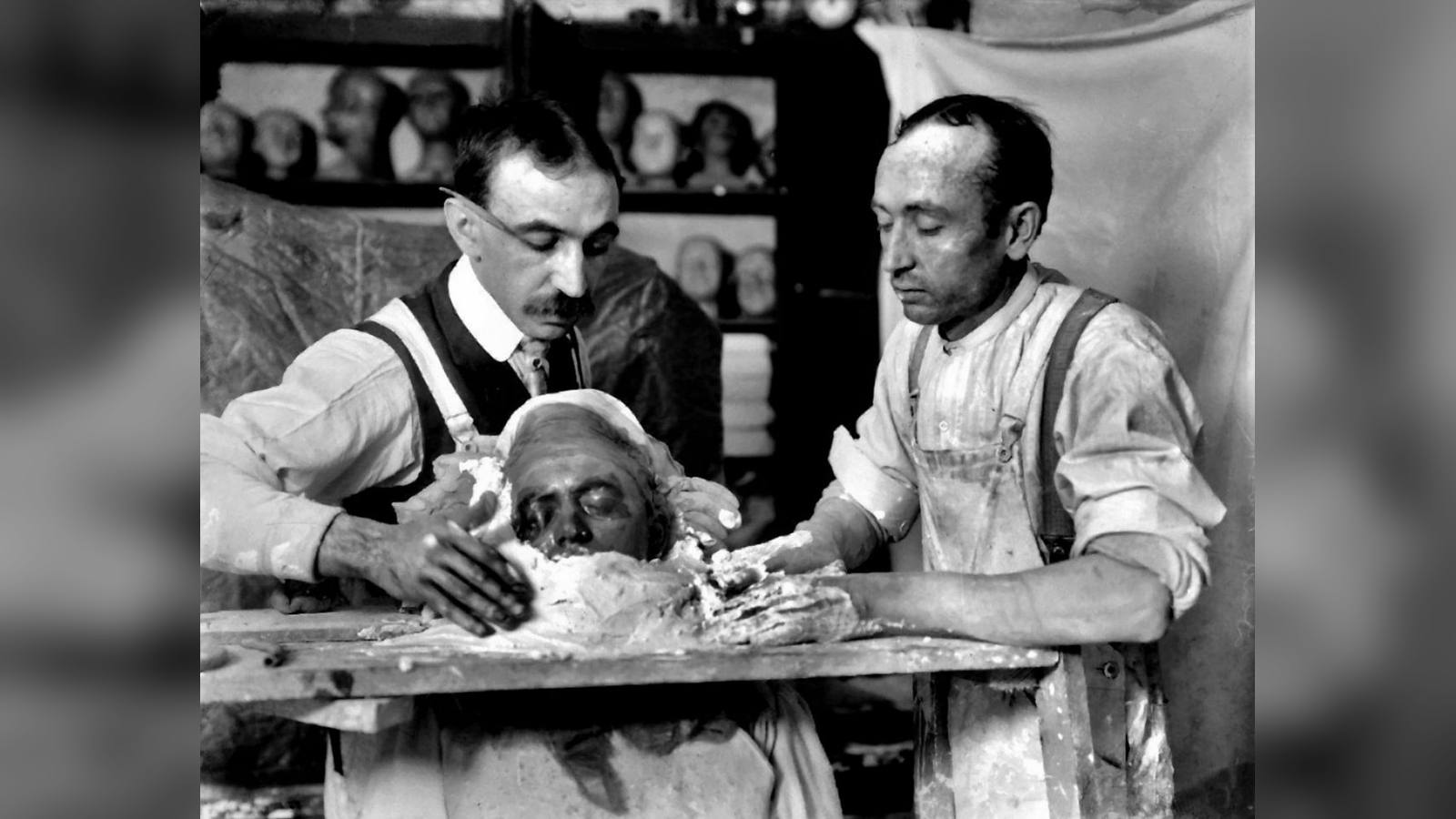
In this striking archival photograph from the 1920s, the viewer is confronted with an intimate, sobering tableau set at the intersection of sculpture, science, and mortality. Centered in the frame is the pale, motionless face of a recently deceased individual resting flat on a padded table or mortuary slab. Hovering directly above the subject are the working hands of a specialist—likely a professional sculptor, medical technician, or specialized mortician—methodically smoothing a layer of wet plaster or protective separating grease across the closed eyelids, cheeks, and jawline. The lighting is stark and directional, typical of a workshop or studio interior, casting soft shadows that accentuate the anatomical contours of the nose, brow, and lips. The technician’s fingers are captured mid-gesture, demonstrating absolute concentration and steady control to avoid disturbing the delicate skin. Every visible detail in the frame emphasizes a quiet, methodical reverence: the absence of clutter, the solemn stillness of the room, and the stark contrast between the warm, living hands of the artisan and the absolute stillness of the subject. Rather than a scene of overt grief, the composition presents a clinical workshop reality, treating the human countenance as both a sacred legacy and a physical template destined for permanent casting.
The moment behind the image
The photograph catches the casting at its most delicate stage. Two craftsmen stand on either side of a plank laid across the work table. The man on the left, moustached, in a waistcoat and tie with his sleeves rolled up and a pencil tucked behind his ear, presses wet plaster into place with the flat of his hand. His partner, in a collarless shirt, braces and a plaster-spattered apron, smooths the mass from the other side. Only the face is still visible, eyes closed, inside a thick collar of plaster that is about to close over it.
The background shows where we are. The shelves behind the two men are lined with rows of finished heads and faces, most likely earlier casts, and a cloth hung across the back wall gives the scene an even, pale backdrop. Everything points to a professional casting workshop rather than a hospital ward or a funeral parlour.
Who the subject was, and for whom the mask was being made, is not recorded in the sources available to us.
Photographer and provenance
The exact provenance of this specific photograph remains partially shrouded in the anonymity typical of early-to-mid 20th-century documentary and trade archives. While individual creator attribution is unrecorded in the surviving catalog, images of this nature were frequently produced by commercial photographers documenting specialized crafts, medical procedures, or institutional archival practices during the interwar era. In the 1920s, universities, medical academies, and specialized mortuary supply houses occasionally commissioned or collected photographic records of traditional techniques that were rapidly vanishing. Academic repositories, such as the historic death mask collections housed at Princeton University or McDaniel College—noted for holding extensive plaster casts of prominent historical figures—document how such objects were preserved, studied, and cataloged. The photographer of this scene likely operated with a heavy, tripod-mounted plate camera, utilizing available or supplemental studio lighting to capture high-contrast details of the casting process. The survival of this print points to its circulation within professional trade portfolios, medical journals, or educational archives, where it served as a technical reference rather than a piece of sensationalist journalism.
Historical context
For centuries, the creation of death masks served as a crucial cultural and evidentiary tool across Western society, bridging the gap between life and memory long before photography became universally accessible. Historically, masks of figures ranging from Dante Alighieri and William Shakespeare to Napoleon Bonaparte and Ludwig van Beethoven provided artists, anatomists, and historians with an indisputable three-dimensional record of facial geometry. By the 1920s, however, the cultural utility of death masks was undergoing a profound transformation. The rapid proliferation of studio portraiture, dry-plate photography, cinematography, and newspaper photojournalism meant that society no longer depended on plaster casts to remember what prominent individuals looked like. Consequently, the practice retreated from general public custom into specialized niches: elite academic collections, forensic anthropology, high-end memorialization for public figures, and select artistic enclaves. This photograph captures the practice precisely at this historical crossroads—retaining its ancient, tactile gravity even as modernity rendered its primary purpose increasingly obsolete.
Why it still matters
Decades after the shutter clicked in that quiet 1920s studio, this photograph continues to arrest the modern viewer because it confronts our deepest anxieties regarding mortality, preservation, and remembrance. In an era dominated by fleeting digital pixels, cloud storage, and infinite virtual reproductions, the death mask represents an extreme physical manifestation of humanity’s desperate urge to hold onto the tangible presence of another person. The image forces us to look past the macabre associations of the craft and recognize the profound tenderness inherent in the artisan’s touch. It serves as a visual bridge to an era when preserving a face required manual labor, physical materials, and direct contact with the dead—leaving behind an enduring testament to our collective refusal to let the human form vanish entirely from memory.