


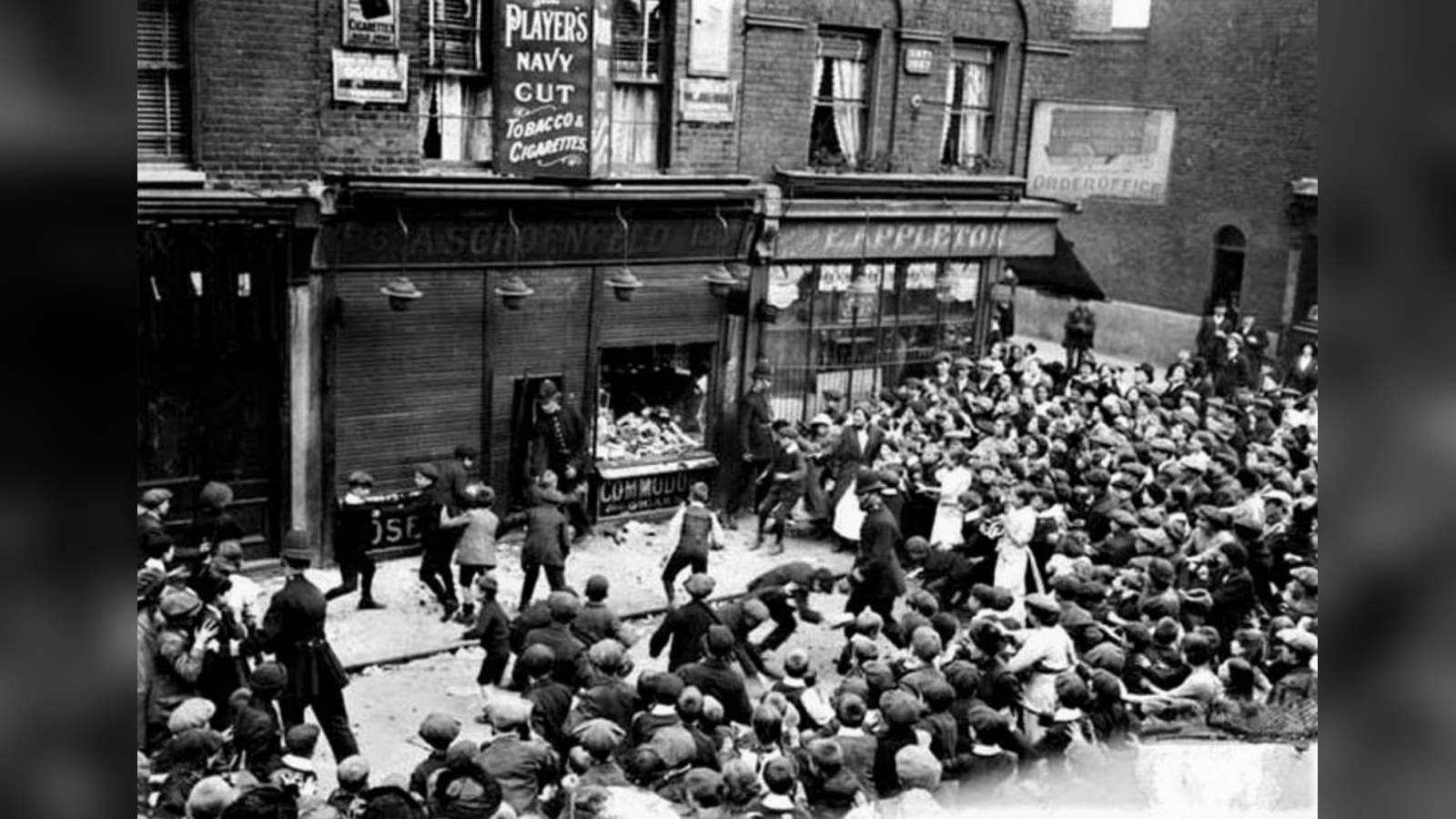
What the photograph shows
The photograph presents a stark, visceral record of a ransacked shopfront in London, captured in the immediate aftermath of civil unrest. The display window has been smashed, with jagged glass shards still clinging to the frame, while the interior is a scene of utter disarray—shelves stripped, goods discarded, and the physical remnants of a merchant’s livelihood strewn across the pavement. The composition emphasizes the total violation of a private, once-secure commercial space. We observe the debris of everyday life—broken crates, scattered produce, and the hollowed-out shell of a storefront—which stand in sharp contrast to the surrounding street, which carries the unsettling stillness of the moments after a riotous mob has moved on to the next target. Every detail, from the splintered wood to the remnants of stock left behind, serves as a testament to a collective frenzy that stripped away the veneer of urban civility. The framing of the image, focused on the ruin, forces the viewer to confront the tangible cost of wartime hatred, where the target was not a foreign army but a neighbor.
The moment behind the image
This image captures the volatility of the British home front in May 1915. Following the German U-boat torpedoing of the RMS Lusitania on May 7, which resulted in the deaths of nearly 1,200 civilians, the United Kingdom experienced a sudden, volcanic eruption of collective rage. By May 12, the center of this agitation moved from northern industrial hubs like Liverpool and Manchester down to the dense, working-class districts of London. The photograph documents a moment of unbridled mob rule. Contemporaneous accounts suggest that these disturbances often began spontaneously—a small demonstration by local women or children against a neighbor suspected of German heritage would rapidly swell as men joined in, leading to the systematic looting and destruction of shops. Before the camera shutter clicked, the street likely echoed with the sounds of glass shattering and shouting; after the moment was immortalized, the rioters moved on to the next target, leaving behind the empty shell visible in this frame. The police, often overwhelmed, arrived only to find the damage already done, unable or unwilling to intervene in the face of such widespread ferocity.
Photographer and provenance
The specific provenance of this photograph remains elusive, a common trait for many images documenting the 1915 riots. During this period, photography of street disturbances was often captured by news agency photographers or amateur press observers working under the constraints of wartime censorship. There was no centralized reporting system for these incidents, and many such images were circulated in local newspapers or through syndication agencies like the Topical Press Agency. The lack of a clear attribution reflects the chaotic nature of the events themselves; photographers were often in the streets alongside the police and the rioters, attempting to document a rapidly changing situation where they risked being targeted themselves if their motives were questioned by the mob. The survival of the image is largely due to the intense public interest in the riots at the time, which led press outlets to archive these scenes as graphic illustrations of the ‘home front battle.’ Because the events were so rapid, the negative likely sat in a newspaper morgue for decades, only resurfacing as a historical document in modern archival projects.
Historical context
The riots of May 1915 were not merely random acts of hooliganism but were symptomatic of a wider, state-sanctioned xenophobic panic. As the conflict in Europe reached a stalemate, the British public’s fear of ‘internal enemies’ intensified. The government’s failure to differentiate between recent immigrants, naturalized citizens, and those of German descent who had lived in Britain for decades led to widespread discrimination. In London districts near the East India Docks, the situation was particularly dire, with over sixty shops targeted in a single night. The violence was indiscriminate; shopkeepers of Russian, Austrian, and even neutral backgrounds were frequently attacked simply because they were perceived as ‘foreign.’ The destruction was often performative, designed to purge the neighborhood of any perceived German influence—as evidenced by accounts of pianos being dragged into the street for public ‘patriotic’ performances. The authorities, struggling to maintain order, often found themselves forced to prioritize public safety over the protection of the ‘alien’ population, sometimes even resorting to the mass internment of those whose shops were being looted.
Why it still matters
This photograph is a chilling artifact of how wartime propaganda can transform neighbors into enemies overnight. It captures the reality that the ‘total war’ of 1914–1918 was not fought exclusively in the trenches of France; it was also fought in the small, crowded streets of London, where the civilian population turned upon itself. By framing the human cost of xenophobia, this image challenges us to look beyond the grand narratives of military victory and defeat to acknowledge the domestic scars left by intolerance, reminding us of the fragility of community cohesion when subjected to the pressures of nationalistic fervor. It stands as an enduring warning against the dehumanization of ‘the other,’ particularly during times of acute national crisis, and serves as a vital reminder of the long-term social damage caused by mob justice.