


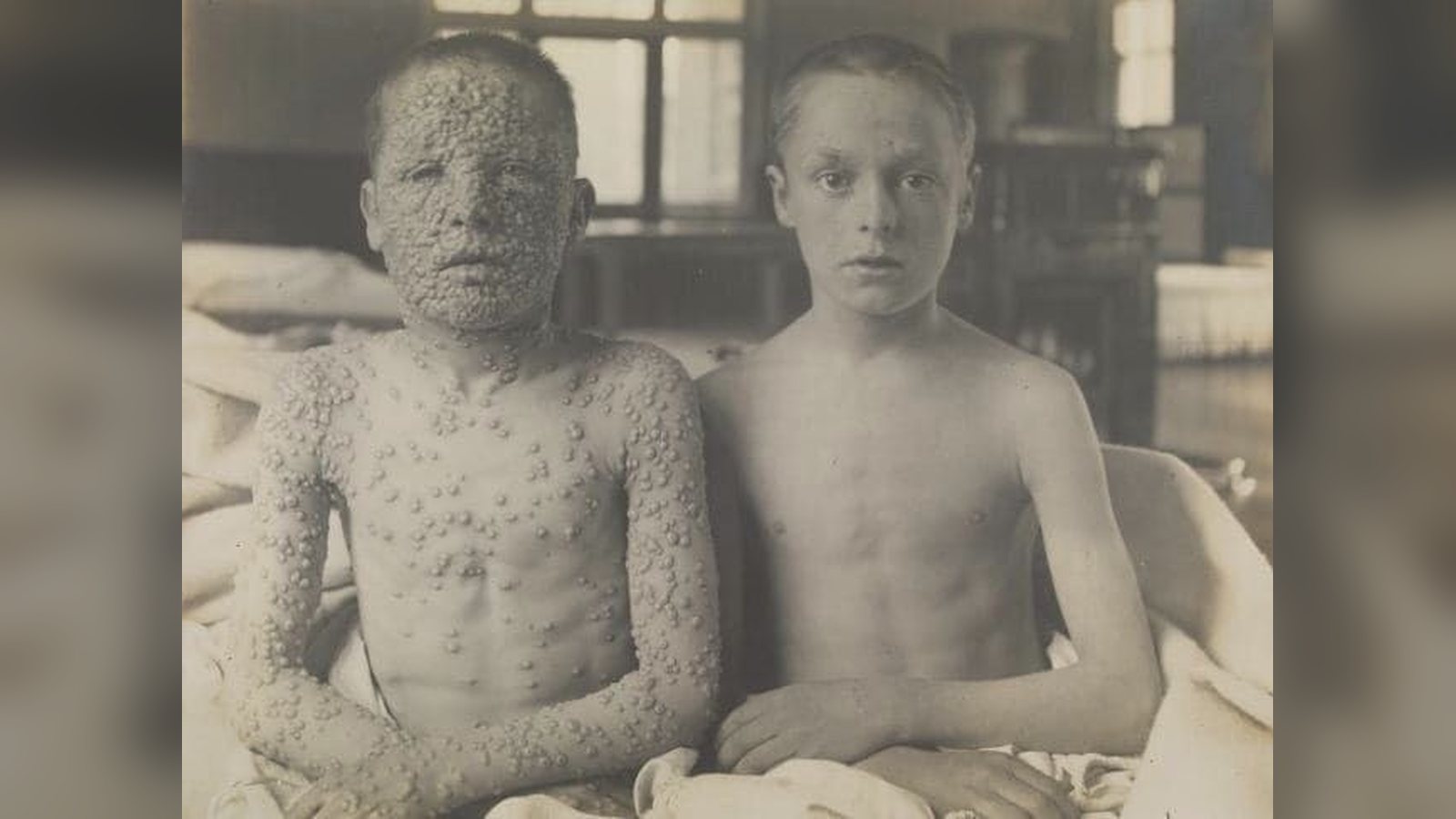
This stark, black-and-white photograph captures one of the most undeniable visual arguments in the history of medicine: two thirteen-year-old boys standing side-by-side, infected with the same deadly smallpox virus on the very same day. Taken in 1901, the image presents a terrifying contrast. The boy on the left is covered from head to toe in dense, painful, and disfiguring pustules, his face swollen and his eyes barely able to open. The boy on the right stands calmly, his skin smooth and virtually clear, showing only a couple of minor spots that have already aborted and scabbed over. This instant, frozen in time by a British physician, remains a haunting testament to the power of immunization. Why did these two classmates, exposed to the exact same threat, experience such vastly different fates? The answer lies in a single medical intervention—and the political fervor that denied it to one of them.
What the photograph shows
Looking closely at the frame, the physical toll of smallpox is laid bare in agonizing detail. The boy on the left is in the fully pustular stage of the disease. His face, hands, and arms are heavily congested with deep-seated, fluid-filled lesions, characteristic of classic smallpox (Variola major). His posture suggests immense discomfort, and his features are distorted by the severe swelling of his skin. In stark contrast, the boy on the right looks healthy and unaffected. A closer examination reveals only two small, faint marks on his skin—aborted pustules that never fully developed and have already begun to heal. Both boys wear simple, dark-colored clothing of the early Edwardian era, standing against a plain, dark background that offers no distractions, forcing the viewer’s gaze entirely onto their contrasting physical states.
The moment behind the image
The two boys were classmates in Leicester, England, who encountered the same ‘index case’—an individual actively shedding the smallpox virus—on the exact same day in 1901. Because they shared the same classroom environment, their exposure to the pathogen was identical. However, their medical histories were entirely different. The boy on the right had been vaccinated against smallpox during his infancy. The boy on the left had not. When the virus took hold, the vaccinated boy’s immune system, primed by the Jennerian vaccine years prior, easily neutralized the infection, resulting in only two minor spots. The unvaccinated boy’s body had no such defense, leaving him to battle a severe, potentially life-threatening case of confluent smallpox. While the ultimate survival of the boy on the left is not explicitly detailed in the hospital records, patients with such extensive pustular eruptions faced a high mortality rate and, if they survived, lifelong scarring and potential blindness.
Photographer and provenance
The photograph was taken by Dr. Allan Warner, the resident medical officer at the Isolation Hospital at Groby Road in Leicester, UK. Dr. Warner was a pioneer in using clinical photography to study the progression of infectious diseases. He systematically photographed smallpox patients at various stages of the illness to create a visual record for medical education. This specific photograph was first published in the prestigious Atlas of Clinical Medicine, Surgery, and Pathology in 1901. In 1906, the Scottish Medical and Surgical Journal praised Warner’s work, noting that his method of showing side-by-side individuals infected from the same source was ‘of the greatest use to those who give popular lectures on vaccination.’ Today, the original prints and negatives are preserved in historical medical archives, serving as a cornerstone of public health iconography.
Historical context: The Leicester anti-vaccination movement
To understand why the boy on the left was left unprotected, one must look at the unique socio-political climate of Leicester at the turn of the twentieth century. Although smallpox vaccination had been made compulsory in the United Kingdom by the Vaccination Act of 1853, Leicester became the global epicenter of the anti-vaccination movement. Following a major smallpox outbreak in the 1870s, local citizens and politicians rebelled against mandatory inoculation, culminating in the famous Leicester Demonstration of 1885, where tens of thousands of people marched in protest. Local Members of Parliament and community leaders actively campaigned against the vaccine, promoting instead the ‘Leicester Method’—a system of strict quarantine and sanitation. Swept up by this intense political and anti-vaccine fervor, the parents of the boy on the left actively refused to immunize their son, with devastating consequences when the disease inevitably returned to the community.
Why it still matters
More than a century after Dr. Warner pressed the shutter, this photograph remains one of the most powerful and widely circulated images in public health history. Long after smallpox was officially declared eradicated by the World Health Organization in 1980, the image continues to resurface on social media, in medical textbooks, and in debates surrounding vaccine hesitancy. Its enduring power lies in its absolute simplicity: it bypasses complex medical jargon and statistical data to deliver an immediate, undeniable visual proof of vaccine efficacy. It stands as a timeless reminder of the human cost of political misinformation, showing how the choices made by parents under the influence of ideological campaigns are written directly onto the bodies of their children.