


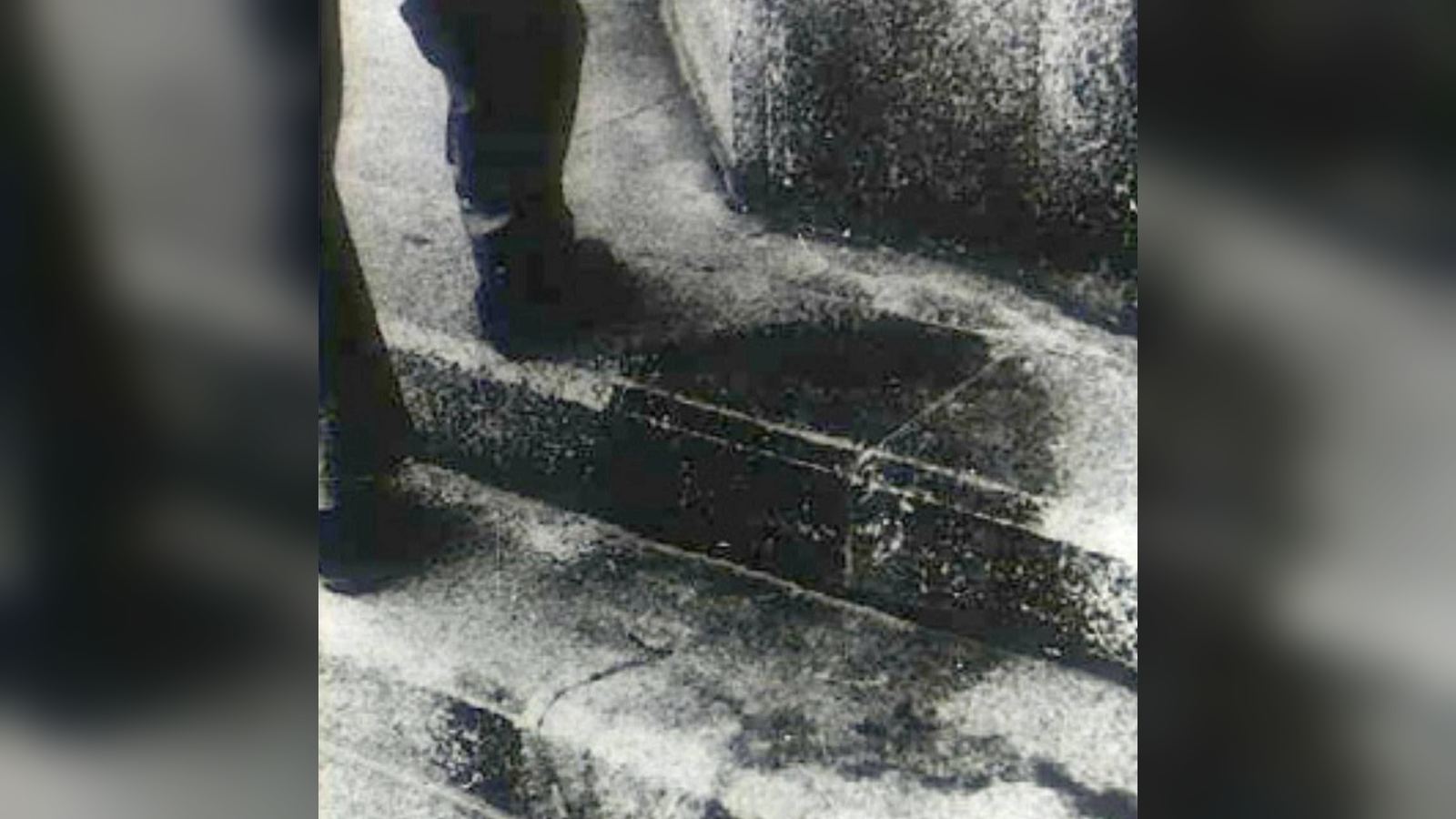
In the stark monochrome of post-blast imagery from Hiroshima, a single flight of stone stairs presents one of the most chilling visual documents of the nuclear age. On the surface of the granite steps, a dark, human-shaped silhouette stands out sharply against the discolored, bleached stone around it. The outline reveals a person seated on the steps, slightly bent forward, with the faint impression of a walking stick or cane resting beside them. This photograph captures not a painted mark or a simple shadow of light, but a physical thermal imprint left at the exact millisecond when the first atomic bomb used in warfare detonated over the city.
What the photograph shows
The visual details of the frame demand a slow, careful reading. The photograph focuses on the exterior entrance steps of the Sumitomo Bank, Hiroshima Branch. The stone surface displays a dual coloration: the exposed granite surrounding the silhouette appears unusually pale and rough, stripped of its natural polished hue, while the central shadow area remains noticeably darker and smoother. This contrast was produced because the individual sitting on the third step absorbed the intense thermal rays emitted during the explosion. Their body acted as a momentary shield, protecting the stone directly beneath and behind them while the surrounding unshielded granite was scorched, eroded, and chemically discolored by temperatures reaching several thousand degrees Celsius.
The moment behind the image
The moment frozen in this frame took place at approximately 8:15 AM on Monday, August 6, 1945. The United States Army Air Forces B-29 bomber Enola Gay released the atomic bomb code-named Little Boy over central Hiroshima. The weapon detonated roughly 600 meters (1,900 feet) above the ground near the Aioi Bridge. The Hiroshima branch of the Sumitomo Bank, located in the Kamiyacho district, stood approximately 260 meters from the hypocenter (ground zero).
Because the bank was scheduled to open its doors at 9:00 AM, visitors and staff had begun arriving early. An unidentified individual sat down on the stone entrance steps to wait. Seconds later, the flash of nuclear detonation swept across the city. The thermal heat wave instantly killed the person sitting on the steps, vaporizing organic tissue and leaving behind only the shielded shadow on the stone. The blast wave that followed crushed nearby structures, but the reinforced stone foundation of the bank survived the shockwave.
Photographer and provenance
Following Japan’s formal surrender in September 1945, joint survey teams comprising Japanese photographers, American military personnel, and scientific research units documented the physical destruction of Hiroshima. Among the earliest photographers to record the ruins were Japanese press photographers and members of the U.S. Army Signal Corps and the Manhattan Project’s survey teams. The physical imprint on the Sumitomo Bank steps quickly caught the attention of surveyors and photojournalists due to its striking legibility.
Over the subsequent decades, exposure to rain, wind, and atmospheric erosion caused the shadow on the exposed stone to gradually fade. Recognizing its immense historical and human significance, the Sumitomo Bank preserved the section of the building during postwar renovations. In January 1971, the bank officially excised the stone steps containing the shadow and donated them to the Hiroshima Peace Memorial Museum. Today, the physical artifact is permanently preserved indoors behind protective glass, where environmental conditions are strictly controlled.
Historical context
The atomic bombing of Hiroshima resulted in an estimated 70,000 to 80,000 immediate deaths, with the casualty toll rising to approximately 140,000 by the end of 1945 due to severe burn injuries, blast trauma, and acute radiation sickness. The phenomenon of the nuclear shadow was observed across multiple locations in Hiroshima and Nagasaki, occurring where intense flash radiation changed the color of paint, asphalt, timber, and stone surfaces, leaving behind dark outlines wherever objects or human bodies intercepted the light ray.
While historical researchers have proposed possible identities for the person on the steps—including bank customers or local residents who lived nearby—the museum and official municipal archivists maintain that the individual’s identity cannot be definitively proven. The shadow stands as both a specific, personal tragedy and a collective visual symbol for thousands of victims whose remains were never recovered.
Why it still matters
This photograph remains a vital anchor in the visual history of modern conflict because it bridges the gap between abstract physics and human reality. Rather than displaying grand Mushroom clouds or wide aerial panoramas of urban destruction, the frame compels the viewer to look down at a precise human scale. It anchors the immense power of nuclear technology to a quiet, mundane moment—a person sitting on a doorstep on a Monday morning—offering an indelible warning about the human cost of total war.