


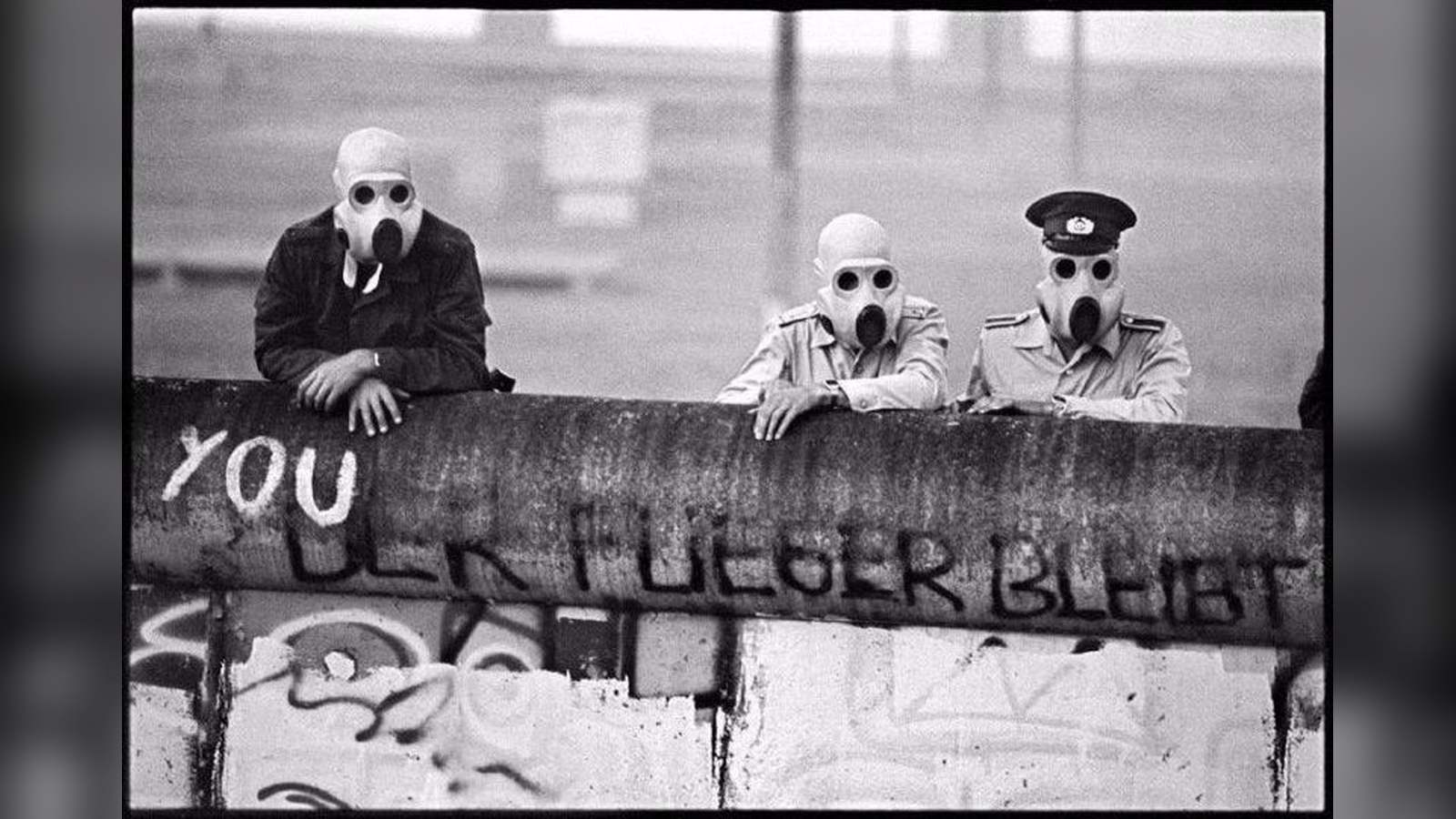
In this stark, high-contrast monochrome image, three individuals are captured from the chest up, positioned along the summit of a thick concrete wall. Their identities are entirely obscured by standard-issue, full-face rubber gas masks, creating an unsettling sense of anonymity that is as clinical as it is frightening. Their hands rest firmly on the top edge of the barrier—a threshold between two worlds. The guard on the left is dressed in a dark, nondescript jacket. In the center, an individual wears a light-colored button-up shirt, while the guard on the right is uniformed, complete with epaulets and a structured, military-style peaked cap. The graffiti on the concrete face, including the clearly visible text “YOU” and the phrase “DER FUEGER BLEIBT,” adds a layer of gritty visual texture that underscores the decay and ideological weight of the barrier during the final years of the Cold War.
What the photograph shows
The frame is a medium shot, horizontally composed to capture the claustrophobic vantage point of these men. Behind them, the background is softly out of focus, suggesting a cleared or open buffer zone—the infamous ‘death strip’—within the eastern sector. The lighting is diffuse and overcast, characteristic of a gloomy day, which removes any dramatic shadows and instead bathes the scene in a flat, clinical uniformity. The masks are the undeniable focal point; they serve as both practical protective gear against the drift of tear gas and as visual barriers that strip the men of their individual humanity. Their posture is rigid yet expectant, suggesting that the event occurring on the other side of the wall is significant enough to warrant their full, masked attention, even as they remain officially detached from the unrest in the West.
The moment behind the image
This photograph was taken on June 20, 1988, amid the volatile standoff at the Lenne Triangle—a small, triangular patch of land near Potsdamer Platz. While technically located in the East, the territory had been under West Berlin jurisdiction since a border adjustment in 1972. In late May 1988, activists occupied this site to protest a controversial motorway construction project that threatened local community space. The protests devolved into recurring, violent clashes with West Berlin police, who deployed tear gas to disperse the occupants. As the gas drifted toward the wall, the GDR border guards on the other side were forced to adapt to the environmental impact of Western police tactics. This image captures that specific, bizarre transition from routine, bored border surveillance to a tense, frontline observation of neighboring civil unrest, highlighting how the ‘Iron Curtain’ was never truly an airtight barrier. The guards were essentially trapped in the fallout of a system they were meant to be policing from the opposite side.
Photographer and provenance
The provenance of this image is typical of late Cold War press documentation. While the specific photographer is not credited in common circulation, the image is held in several historical archives specializing in German Democratic Republic (GDR) news reportage and international agency collections, such as Alamy. These agencies curated photographs that documented the ‘state of alert’ for the border troops, serving as both intelligence and propaganda. The photograph was likely captured by a staff photographer or a freelance journalist covering the ongoing Lenne Triangle conflict from the Eastern side. Because it documents a highly sensitive security zone, the photograph exists due to a rare moment of temporary access or a strategic decision by East German authorities to document Western police behavior during the crackdown, perhaps to mock the ‘democracy’ of their neighbors. The lack of a specific name reflects the anonymity typical of GDR state-sanctioned media, where the institution—not the individual—held authority.
Historical context
The Lenne Triangle was a unique geographic and political anomaly. It served as a flashpoint for the frustrations of 1980s West Berlin, where environmental, social, and anti-authoritarian sentiments were peaking. For the GDR regime, the spectacle of the West Berlin police fighting their own citizens was a source of ideological amusement and strategic observation. However, the photograph reveals a deeper, more awkward truth of the time: the two sides were inextricably linked by the very wall that kept them apart. The ‘Iron Curtain’ was not merely a static divider; it was a theater where the policies of one side directly affected the daily reality and physical safety of the guards on the other. The act of wearing gas masks against a Western-made chemical cloud illustrates the fluidity of the border’s danger. The persistence of these guards, watching the ‘other’ with covered faces, mirrors the decay of the state they represented, which would fall less than eighteen months later.
Why it still matters
This image remains a powerful historical record because it strips away the grand, abstract geopolitical narratives of the Cold War and focuses on the human and tactical experience of the border. It captures the intersection of protest, police force, and the rigid, artificial silence maintained by the wall. The masks function as a visual metaphor for the ideological barriers of the era—protective for the wearer, yet profoundly dehumanizing to the observer. It reminds us that behind every wall, there are individuals forced to watch a world that they are physically denied access to, yet cannot help but acknowledge as the storm brews on the other side. This image survives as a testament to the fact that even the most formidable walls cannot isolate regimes from the social currents of their neighbors, capturing a moment where the binary of East vs. West was briefly blurred by the shared necessity of survival in a volatile environment.