


What the photograph shows
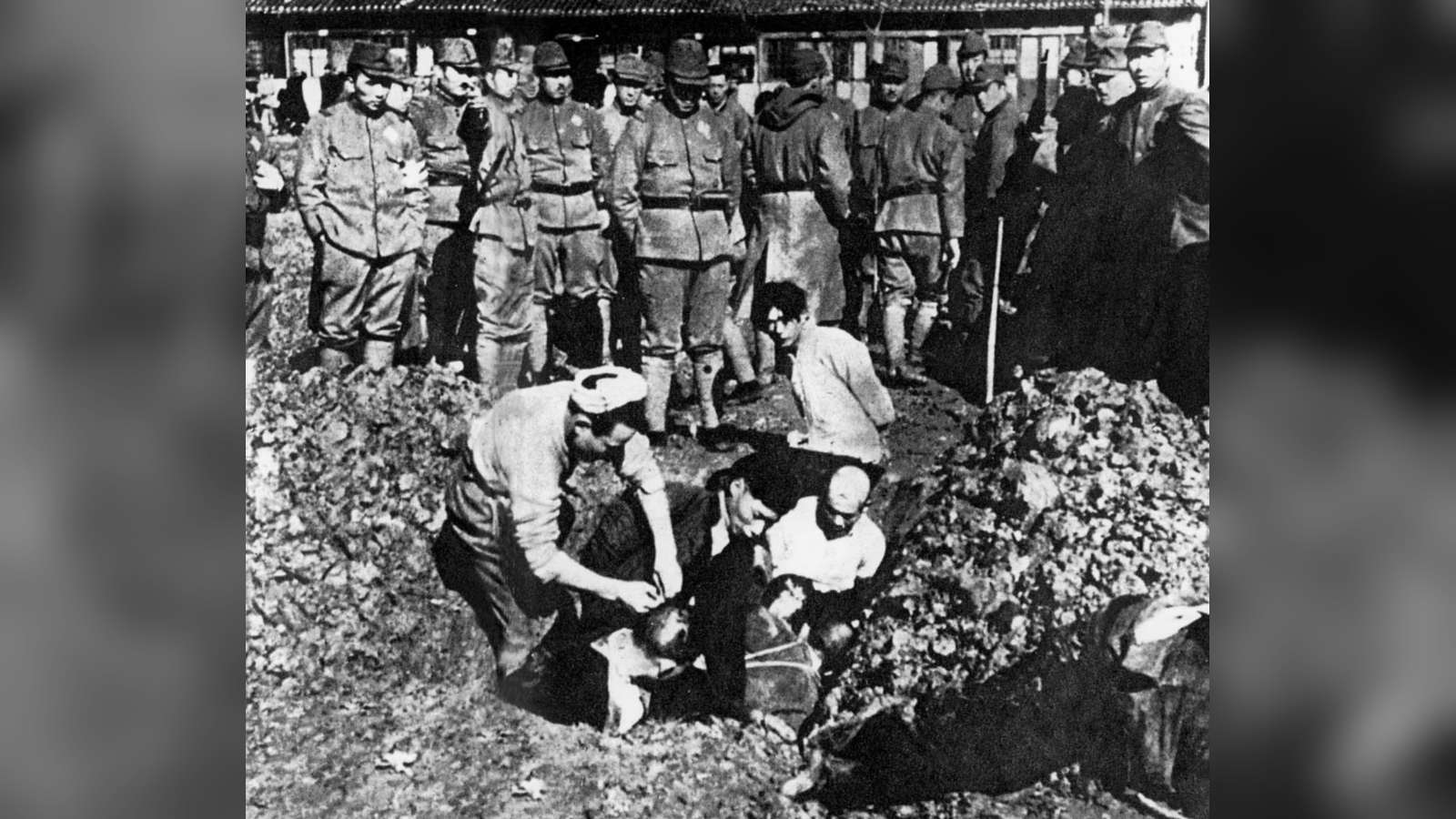
This stark, grainy black-and-white documentary photograph captures an outdoor scene set within an earthen terrain, likely a trench, ditch, or excavation site surrounded by shifting mounds of loose dirt and rubble. In the background, a low building structure featuring simple windows or structural openings anchors the upper portion of the frame. A large, disciplined contingent of soldiers, clad in mid-20th-century military uniforms, caps, and web belts, stands in orderly rows. They look down into the lower clearing, acting as passive observers to the grim proceedings. Near the center of the frame, a soldier is captured leaning forward over a seated individual, with his arms and hands extended outward. Below him, a person wearing a light-colored shirt sits on the ground with their hands restrained or positioned behind their back. Additional figures and indistinct forms are partially visible scattered on the dirt around the main group. The composition relies on high-contrast natural daylight, emphasizing the harsh realities of the outdoor setting without dramatic stylistic embellishment.
Every visual element within the frame contributes to an unmistakable atmosphere of coercion and captivity. The physical posture of the seated individual—slumped yet contained—contrasts sharply with the rigid, upright stances of the armed onlookers standing in tiered rows in the background. The earthen walls of the ditch enclose the scene, effectively cutting off escape and emphasizing isolation. The lack of active struggle suggests a moment of exhaustion or absolute despair, where the captive has already been subdued, awaiting a final determination by the occupying force. The stark lighting casts sharp shadows across the dirt mounds, highlighting the texture of military canvas, leather straps, and disturbed earth with unflinching clarity.
The moment behind the image
The exact micro-second captured by the shutter reveals an intense, asymmetrical confrontation. While the surrounding soldiers stand in watchful silence, the central figures are locked in a tense physical interaction on the earthen floor. The visual evidence points to a captive being handled, coerced, or assaulted by an occupying soldier under the watchful eyes of an armed unit. The surrounding landscape of rubble and excavated earth underscores the disruption of war, suggesting a temporary holding area, execution site, or makeshift camp in the immediate wake of urban combat. The photograph does not record the names of the individuals or the precise GPS coordinates of the ditch, but its visual elements align precisely with the documented conditions of captivity and abuse that characterized the fall of major Chinese urban centers during the 1937 campaign.
Leading up to this shutter moment, thousands of disarmed Chinese soldiers and civilians had been rounded up across the city following the collapse of defensive lines. The immediate aftermath of such encounters typically involved mass executions, forced marches to peripheral execution grounds, or immediate interrogation under extreme duress. The onlookers in the background are not casual passersby but members of the occupying military apparatus, whose disciplined formation indicates an institutionalized, normalized routine of violence rather than an isolated outburst of rogue aggression. The camera preserves a fleeting second of this systemic brutality, freezing an ephemeral act of subjugation into an eternal historical indictment.
Photographer and provenance
The provenance of such documentary imagery from this era is frequently tied to the harrowing efforts of foreign residents, relief workers, and neutral observers who risked their lives to record the unfolding humanitarian catastrophe. During the Japanese occupation of Nanking, individuals such as American missionary John Magee, German businessman John Rabe, and members of the International Committee for the Nanking Safety Zone used hidden cameras and film equipment to document the violence. While this specific print circulates within historical archives dedicated to the atrocities of 1937 and 1938—such as documentation projects hosted by academic and preservation bodies like Yale University—exact individual camera attribution for every field frame remains complex. Many negatives were smuggled out of China under extreme duress, later serving as crucial visual evidence before the International Military Tribunal for the Far East.
The preservation of these negatives involved immense personal risk. Foreign missionaries and neutral expatriates operating inside the Nanking Safety Zone understood that possessing photographic evidence of war crimes meant facing severe retaliation from the occupying military authorities. Cameras were often concealed within everyday objects or hidden beneath clothing, while developing chemicals and photographic paper had to be rationed and managed in secret. Consequently, many surviving prints lack formal photographer signatures or agency stamps, existing instead as anonymous fragments of truth rescued from total destruction.
Historical context
The backdrop to this frame is the Nanking Massacre, often referred to as the Rape of Nanking, which began following the capture of the Chinese capital by the Imperial Japanese Army on December 13, 1937. Over a period of six weeks, invading forces subjected the city and its environs to mass executions, systematic looting, arson, and widespread sexual violence against civilians and disarmed Chinese soldiers. International witnesses established a Safety Zone to shelter hundreds of thousands of refugees, yet atrocities regularly spilled across its borders. The visual record left behind by contemporary cameras remains one of the primary historical bulwarks against historical denialism, capturing the mechanical efficiency and casual brutality of the occupation forces in stark detail.
The geopolitical and social collapse of Nanking in late 1937 represented one of the darkest chapters of the Second Sino-Japanese War. As Imperial forces breached the walled city, organized resistance dissolved into chaotic retreats and wholesale surrender. The subsequent breakdown of military discipline and the deliberate implementation of terror policies by high command turned the capital into an open slaughterhouse. International committees, operating makeshift hospitals and refugee camps, fought daily to save lives while documenting the relentless tide of violence that defied every convention of civilized warfare.
Why it still matters
Decades after the shutter clicked, photographs of this nature retain an undeniable evidentiary and moral weight. They transcend passive historical illustration to function as direct historical witnesses of human rights violations during wartime. By fixing the anonymous gaze of the observing soldiers and the vulnerability of the captive in silver halide, this frame resists the erasure of memory. It challenges viewers to confront the raw mechanics of state-sponsored violence and underscores the enduring responsibility of documentation in the face of absolute catastrophe.
In an era where visual documentation is constantly scrutinized and historical revisionism attempts to sanitize past state crimes, archival photographs serve as unyielding anchors of truth. They bridge the generational divide, forcing modern audiences to look directly into the faces of perpetrators and victims alike. This frame does not merely record a tragedy from 1937; it issues an ongoing challenge to humanity, reminding us of the fragility of civilization and the absolute necessity of preserving historical memory against all attempts at obfuscation.