


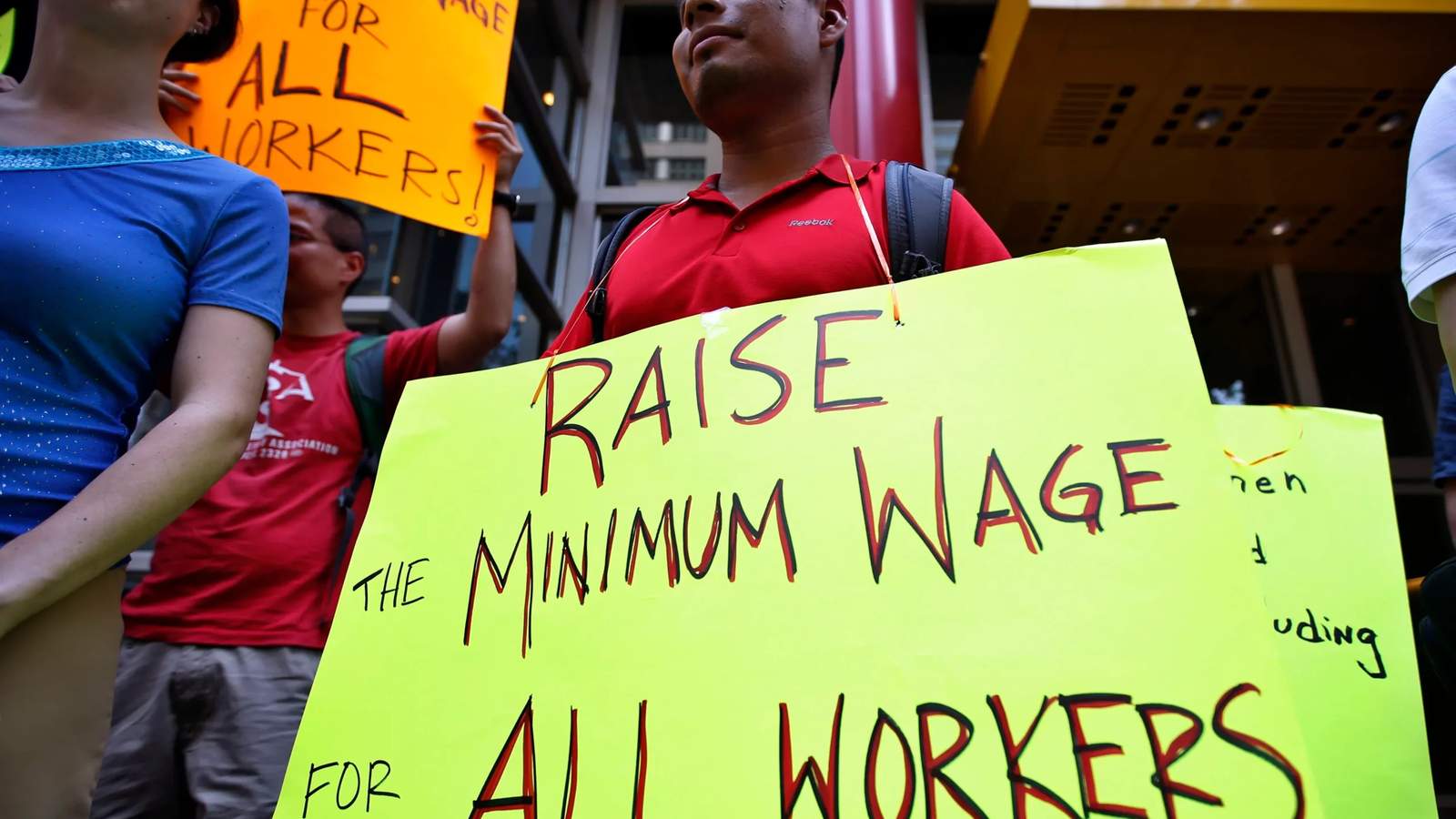
A Seventeen-Year Freeze
As the United States observes Labor Day on Monday, September 7, 2026, millions of low-wage workers face a historic and sobering milestone. The federal minimum wage remains frozen at $7.25 per hour—a rate last updated in 2009. According to data tracked by the U.S. Department of Labor, this 17-year stretch represents the longest period in American history without a federal wage increase, persisting through a severe affordability crisis that has sharply inflated the costs of housing, food, healthcare, and transportation.
For a full-time worker earning the federal minimum, a 40-hour workweek across 52 weeks yields an annual pre-tax income of just $15,080. Economists and labor advocates point out that the purchasing power of this baseline wage has eroded dramatically. According to the U.S. Bureau of Labor Statistics Inflation Calculator, the federal minimum wage actually peaked in buying power in 1968, when it was worth the equivalent of $15.62 in 2026 dollars. Today, millions of American workers earn far below that historical benchmark.
This report draws on information published by floridapolitics.com and courier-journal.com.
The Human Scale of Low-Wage Labor
The scale of the wage gap is quantified by the Economic Policy Institute’s (EPI) Low Wage Workforce Tracker. Nationally, more than 12 million workers earn less than $15 an hour, 18 million make less than $16, and 23 million earn less than $17, including overtime, tips, and commissions. This wage stagnation stands in stark contrast to broader economic indicators; while workers’ share of national income has hit historic lows, corporate profits have reached record highs, and the number of U.S. billionaires has expanded from 357 to 989 over the same period.
The burden of the frozen federal rate is not distributed evenly across the country. Twenty states still maintain minimum wages no higher than the federal $7.25 baseline. These states include Alabama, Georgia, Idaho, Indiana, Iowa, Kansas, Kentucky, Louisiana, Mississippi, New Hampshire, North Carolina, North Dakota, Oklahoma, Pennsylvania, South Carolina, Tennessee, Texas, Utah, Wisconsin, and Wyoming. Among them, Alabama, Louisiana, Mississippi, South Carolina, and Tennessee have no state-mandated minimum wage at all, while Georgia and Wyoming have state minimums set at a nominal $5.15, meaning the federal $7.25 rate applies by default.
A Fragmented Map of State-Level Wages
This statutory stagnation has created stark regional disparities, as documented by local reporting from the Courier-Journal and other regional outlets. In states where the $7.25 minimum applies, substantial portions of the workforce remain trapped in low-wage brackets. For instance, the share of workers earning less than $15 an hour stands at 25% in Mississippi, 22% in Oklahoma, 20% in Louisiana, and 16% in Texas.
The contrast is particularly visible along state borders. Kentucky, which remains at the $7.25 federal level, is bordered by Illinois (where the minimum wage is $15 per hour), Missouri ($15), Virginia ($12.77), and Ohio ($11), while neighboring Indiana and Tennessee remain stuck at $7.25. These disparities directly affect essential service sectors. In Mississippi, the median hourly wage for childcare workers was recently recorded at just $10.60, while home health aides in Texas earned a median of $11.65, and short-order cooks in Pennsylvania took home a median of $9.57—meaning half of the workers in these critical roles earn even less than those modest figures.
The Business Case for Higher Pay
The ongoing freeze has fueled a robust policy debate between corporate lobbies and advocate networks. Holly Sklar, CEO of Business for a Fair Minimum Wage, argues that raising the baseline is not only a matter of worker dignity but a critical driver of local economies. “Raising the minimum wage is a very effective way to boost small businesses and the economy because it puts more money in the pockets of people who need it most,” Sklar noted, adding that fairer pay reduces costly employee turnover and enhances productivity.
To support this view, advocates frequently point to the foundational economic principles of Adam Smith. In his 1776 work *The Wealth of Nations*, Smith argued that those who feed, clothe, and lodge the entire population should earn a share of their labor sufficient to be tolerably well-fed, clothed, and lodged themselves. Meanwhile, several states are taking independent action to bypass federal inaction. On July 1, 2026, Alaska and Oregon implemented scheduled minimum wage increases, while California enacted a targeted minimum wage for healthcare workers. Florida is also expected to raise its rate before the end of the year, further widening the legislative gap between progressive state policies and the frozen federal baseline.