


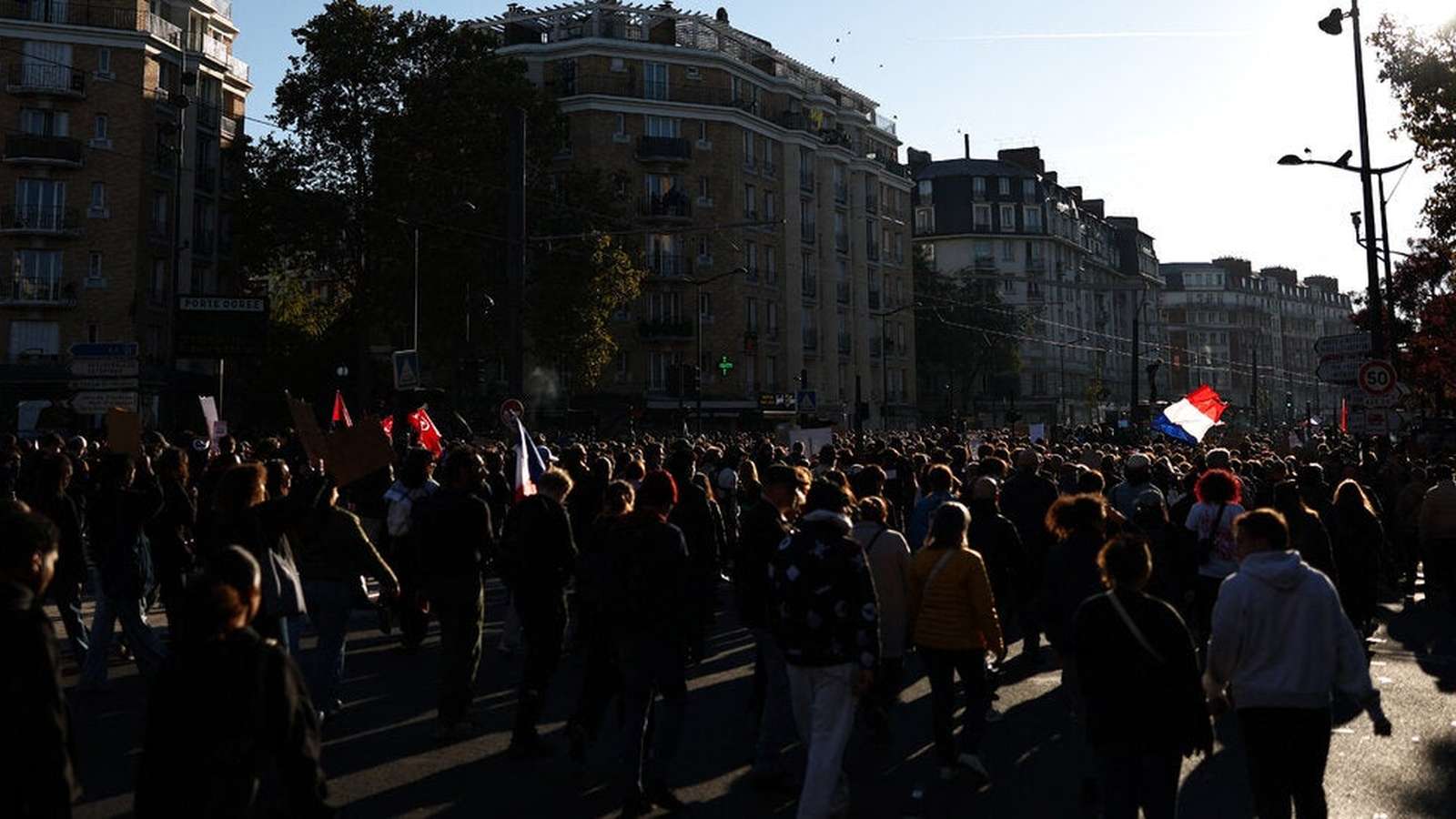
PARIS (Azat TV) – Thousands of protesters took to the streets in cities across France on Saturday, Oct. 31, 2026, marking another weekend of national mobilization that combined student grievances, public worker demands, and anti-government sentiment with Halloween festivities. The New York Times reported that the demonstrations, now in their second month, proceeded under a massive security operation as authorities braced for potential unrest and clashes after dark.
French Interior Minister Laurent Nuñez deployed 70,000 police officers nationwide to counter risks of arson, looting, and violence. Authorities had expressed heightened concern over online calls for insurrection and masked gatherings timed to coincide with Halloween celebrations. Despite the heavy security presence and restrictions on march routes, early afternoon turnout figures indicated a lower participation rate than in previous weeks.
Security Measures and Early Turnout Estimates
By midafternoon on Oct. 31, the French interior ministry estimated that 15,000 people were participating in 65 demonstrations across the country. Those figures marked a significant drop compared with previous weekends; ministry data showed 37,000 participants by the same hour on the preceding Saturday and 67,000 on Oct. 17. Law enforcement agencies reported 27 arrests by midafternoon, a sharp decrease from the 217 arrests recorded by the same time a week earlier.
In Paris, authorities rerouted the official march to the city’s eastern periphery, barring access to central locations such as the Place de la Bastille. Police officers equipped with shields and helmets patrolled restricted squares, enforcing bans backed by fines of 135 euros for unauthorized gatherings. While the daytime atmosphere in Paris featured festive elements, including brass bands and participants in costumes aiming to counter the narrative of earlier destructive riots, police deployed tear gas and water cannons in cities including Marseille, Lyon, Toulouse, and Rennes.
Grievances and Institutional Response
The persistent unrest stems from a coalition of high school and university students, public sector workers, and participants inspired by the yellow vest movement. Students, preparing to return to classes after a two-week break, maintained their protests despite initial government concessions. The Education Ministry had previously agreed to cap certain class sizes, offer low-interest loans for building repairs, and phase out an unpopular online college admissions platform.
Beyond labor and educational demands, officials highlighted the growing influence of digital platforms in mobilizing crowds and inciting disorder. While President Emmanuel Macron dismissed speculation regarding a temporary suspension of popular websites, he noted in a YouTube interview that online platforms would face strict legal requirements to remove illegal content and prevent misuse by individuals organizing looting or violence.
Evolution of the Nationwide Movement
The nationwide unrest in France began with a handful of student demonstrations at high schools in suburban Paris, starting at a high school in the working-class Parisian suburb of Créteil. Students initially objected to inadequate resources, crumbling infrastructure, overcrowded classrooms, and flaws in the higher education admissions system. Within weeks, the demonstrations spread to around 400 schools, with participants blockading entrances using e-bikes and setting fire to trash cans.
By early October, the movement expanded rapidly to encompass university students, public sector workers, and veterans of the yellow vest movement that convulsed France from 2018 to 2020. Marches grew substantially in size, culminating on Oct. 17 when official estimates placed turnout above half a million people, while the C.G.T. union estimated up to 800,000 participants. Those large-scale mobilizations saw severe clashes, including the burning of cars, the smashing of storefronts, and the destruction of the 19th-century City Hall in Limoges, where the building’s spire collapsed in flames.
Digital Mobilization and Political Fallout
As demonstrations entered their second month, the French government focused heavily on the digital infrastructure facilitating the protests. Reports indicated that Prime Minister Sébastien Lecornu’s office had considered measures involving telecommunications operators regarding major platforms, though the government denied plans for outright temporary suspensions. President Macron emphasized that tech companies must actively prevent the misuse of features by groups intending to coordinate looting.
Political divisions intensified regarding the management of public order. Human rights groups and a major union of French judges and prosecutors criticized law enforcement for employing disproportionate force, pointing to incidents involving minors as young as 14. Meanwhile, security officials noted that while far-left networks and radicalized online groups drove much of the insurrectionary rhetoric, small bands of young men linked to the far right also infiltrated demonstrations, ostensibly to protect shopkeepers but frequently engaging in street skirmishes with opposing factions.