


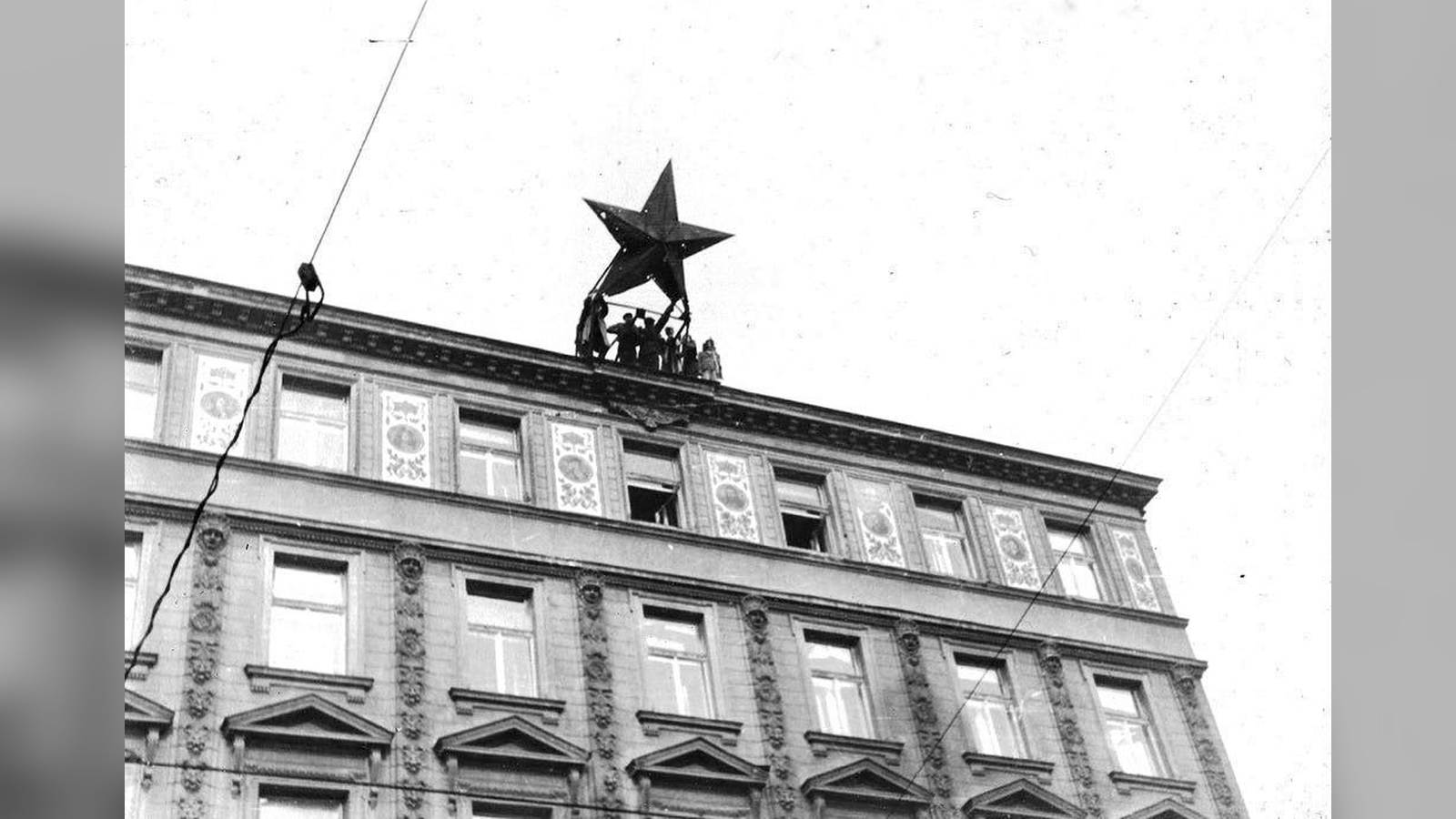
In this dramatic photograph from the autumn days of 1956, the camera looks upward toward the roofline of a Budapest public building, where human figures are silhouetted against a pale sky as they dislodge a towering five-pointed red star. The metal star, once an unyielding emblem of Soviet hegemony bolted high above daily life, leans awkwardly off-kilter, stripped of its majesty by ropes, crowbars, and sheer physical labor. The frame captures an electric threshold in modern European history: the exact second when an oppressed populace discovers that the physical monuments of totalitarian power can be dismantled by ordinary hands.
What the photograph shows
The composition is defined by verticality and collective action. Several men have hauled themselves onto the parapet and sloping roof, working precariously close to the ledge without safety harnesses or official equipment. Some pull on rigged lines while others pry at the rusted steel supports anchored into the masonry. Below them, visible along the edge of the street, spectators gather to watch the descent, their heads tilted upward in collective disbelief and quiet triumph.
Every visual detail reinforces the improvised nature of the rebellion. The insurgents are dressed in everyday civilian attire—heavy wool coats, work jackets, and flat caps characteristic of mid-century Hungarian workers and students. The red star itself, designed to dominate the skyline with ideological permanence, appears hollow and fragile under mechanical assault. There is no choreographed state ceremonialism here; the shutter caught raw kinetic friction, dirt, and gravity turning an imposing political idol into scrap metal.
The moment behind the image
The scene unfolded between late October and the first days of November 1956, during the brief, euphoric interlude when the Hungarian Revolution appeared to have succeeded. Following student-led demonstrations on October 23, spontaneous resistance swept across the capital. Almost immediately, the visual landscape of the regime became a primary target of popular wrath.
While crowds in the City Park famously sawed through the bronze knees of the eight-meter Stalin monument, smaller detachments of workers, youths, and soldiers turned toward municipal buildings, railway terminals, and party offices. The red stars—which had been installed atop prominent facades across Hungary after the communist consolidation of power in the late 1940s—were torn down one by one. Taking down the star visible in this frame required sustained ingenuity: these markers were heavily counterweighted and wired for electrical illumination, making their removal an arduous engineering task carried out under the threat of sniper fire from the Hungarian State Protection Authority (ÁVH).
Photographer and provenance
The provenance of images from the 1956 Hungarian Revolution reflects the fluid, dangerous media ecosystem of those twelve days. Western photojournalists representing agencies like Magnum, Black Star, and Associated Press rushed into Budapest via the open Austrian border, while local Hungarian photographers, students, and photojournalists from state outlets like MTI documented events from within the crowds.
Many street-level negatives were created anonymously by citizens using handheld cameras such as Leicas or medium-format Rolleiflexes. After the Soviet military reconquest of November 4, possessing or publishing such pictures exposed families to severe retribution, secret police interrogation, and prison sentences. As a result, hundreds of rolls were buried, hidden behind floorboards, or smuggled abroad in diplomatic pouches. In subsequent decades, collections preserved by emigré organizations and later digitized by open archives such as Hungary’s Fortepan restored these anonymous and semi-attributed testimonies to the historical record.
Historical context
The dismantling of the star went hand in hand with the creation of the revolution’s most famous heraldic symbol: the national tricolor with the communist coat of arms cut cleanly out of the center. In factories and ministries, citizens systematically expunged the signs of Soviet satellite status. Prime Minister Imre Nagy announced the abolition of the one-party monopoly, the withdrawal of Hungary from the Warsaw Pact, and a declaration of national neutrality.
Yet the euphoria atop the rooftops proved tragically brief. Even as crowds celebrated the removal of Soviet insignia, Nikita Khrushchev’s Politburo in Moscow was mobilizing Operation Whirlwind. On November 4, 1956, a massive mechanized invasion force comprising hundreds of tanks rolled into Budapest, crushing armed defense groups, shelling residential districts, and driving more than two hundred thousand Hungarians into exile across Western borders.
Why it still matters
This image endures because it encapsulates the fragility of authoritarian iconography. Totalitarian regimes depend upon the illusion of absolute permanence, projecting dominance through monuments erected far above the sightlines of the governed. When citizens climb the parapet and pull that iconography down into the street, the spell of inevitability breaks irrevocably.
Decades before the dismantling of the Berlin Wall in 1989 or the removal of Soviet monuments across Eastern Europe after 1991, this rooftop in Budapest established the visual grammar of popular de-Sovietization. The photograph remains not just a record of a single metal fixture tumbling toward the pavement, but a testament to the brief, courageous moment when an unarmed society reclaimed its own skyline.