


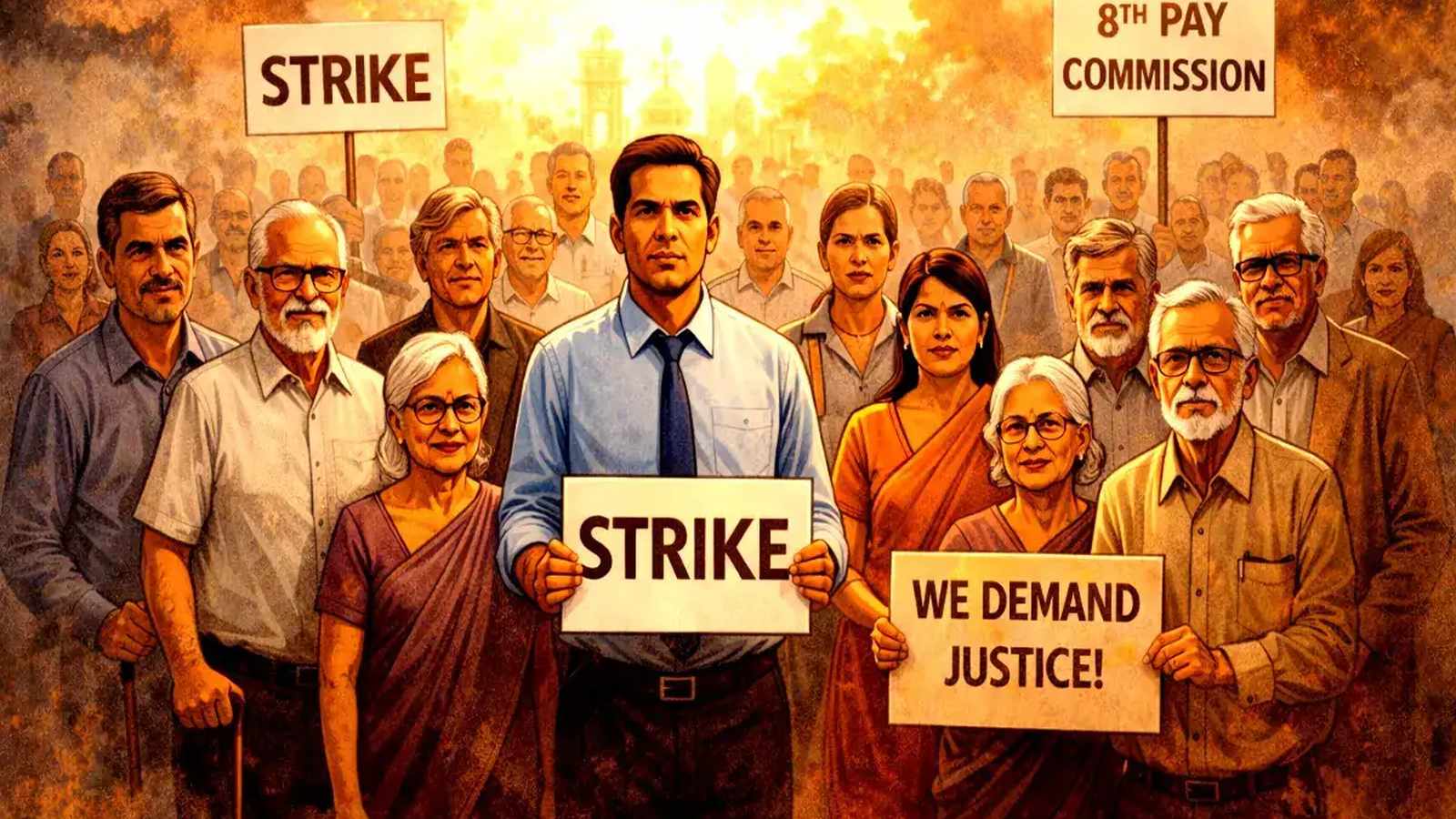
NEW DELHI (Azat TV) – Central government employees across India are preparing for a one-day strike on February 12, 2026, in response to calls from the Confederation of Central Government Employees and Workers (CCGEW). The planned industrial action stems from a comprehensive list of demands, primarily focusing on the newly constituted 8th Pay Commission, which was established in November 2025 and has an 18-month deadline to submit its recommendations. Employees are urging immediate interim relief and significant modifications to the commission’s terms of reference.
According to CCGEW Secretary General SB Yadav, employees affiliated with the confederation’s member organizations will participate in the strike. Yadav conveyed to ET Wealth Online that the organization is resolute in its decision to proceed, emphasizing the critical need for their 8th Pay Commission-related demands to be integrated into the commission’s Terms of Reference (ToR).
Key Demands for the 8th Pay Commission
The CCGEW has outlined several specific demands directly related to the 8th Pay Commission, aiming to ensure fair emoluments and benefits for employees and pensioners. These include:
- A request to the Cabinet Secretary to modify the ToR of the 8th Pay Commission. This modification would incorporate suggestions and views provided by the confederation and the National Council (Staff Side) of the Joint Consultative Machinery (NC-JCM) regarding the revision of emoluments for both active employees and pensioners.
- A demand for a 20% interim relief on pay and pension, effective from January 1, 2026, to bridge the gap until the 8th Pay Commission’s final recommendations are implemented.
- The merger of 50% dearness allowance (DA) and dearness relief (DR) with basic pay and pension, respectively.
These demands highlight the employees’ desire for a proactive approach to their financial well-being, especially given the current economic climate and the time it takes for pay commission recommendations to materialize.
Broader Labor Reforms and Pension Concerns
Beyond the immediate scope of the 8th Pay Commission, the CCGEW has put forth a range of other significant demands addressing long-standing concerns for central government employees and the broader labor force. These include:
- The complete scrapping of the National Pension System (NPS) and the Unified Pension Scheme (UPS), advocating for the restoration of the Old Pension Scheme (OPS) for all central government employees.
- An insistence that there should be no distinction among pensioners based on factors such as the date of retirement or the accepted recommendations of previous Central Pay Commissions, ensuring equitable treatment.
- A request for the central government to release the three installments (equivalent to 18 months) of dearness allowance (DA) and dearness relief (DR) that were frozen during the Covid-19 pandemic.
- The restoration of the commuted portion of pension after 11 years, reducing the current waiting period of 15 years.
- The removal of the 5% ceiling imposed on compassionate appointments and the granting of such appointments in all eligible cases to the wards or dependents of deceased employees.
- A call for the government to fill vacant posts across all cadres and departments, alongside a halt to outsourcing and corporatization within government departments.
- The regularization of casual, contingent, and contractual laborers, as well as Gramin Dak Sevaks (GDS) employees, and the granting of equal status to employees of autonomous bodies at par with central government employees.
Additional demands extend to broader labor rights, such as scrapping the four labor codes, implementing equal pay for equal work for contract workers, ensuring a minimum pension of Rs 9,000 per month with social security for all categories of workers, and making the right to work a fundamental right.
Anticipated Rollout and Economic Impact
While the 8th Pay Commission’s recommendations are still pending, several states are already positioning themselves for a swift implementation once approved. Uttar Pradesh, Maharashtra, Gujarat, Tamil Nadu, and Assam are identified as some of the likely early adopters. Officials suggest that Maharashtra’s robust financial health will aid in fast-tracking the process in that state. Once implemented, the new pay structure is expected to apply to all grades of central government employees, with lower grades potentially seeing the most significant gains if a higher fitment factor is set. Pensioners are also anticipated to receive relief under the new structure.
The need for a rise in salaries is highlighted as imperative to restore purchasing power for citizens, who continue to grapple with inflation. Beyond personal benefits, the new pay structure is also widely expected to stimulate the economy by injecting increased purchasing power into the market. Despite parliamentary procedures and final approvals still being awaited, trade unions are pressing the government for the swiftest possible implementation.
The impending strike notice underscores the growing impatience among central government employees regarding their emoluments and working conditions, signaling a potential flashpoint between labor groups and the government even as the 8th Pay Commission is still in its early stages. This action could pressure the government to expedite the commission’s process or address interim demands, highlighting the immediate economic concerns of public sector workers against the backdrop of broader national economic planning.