


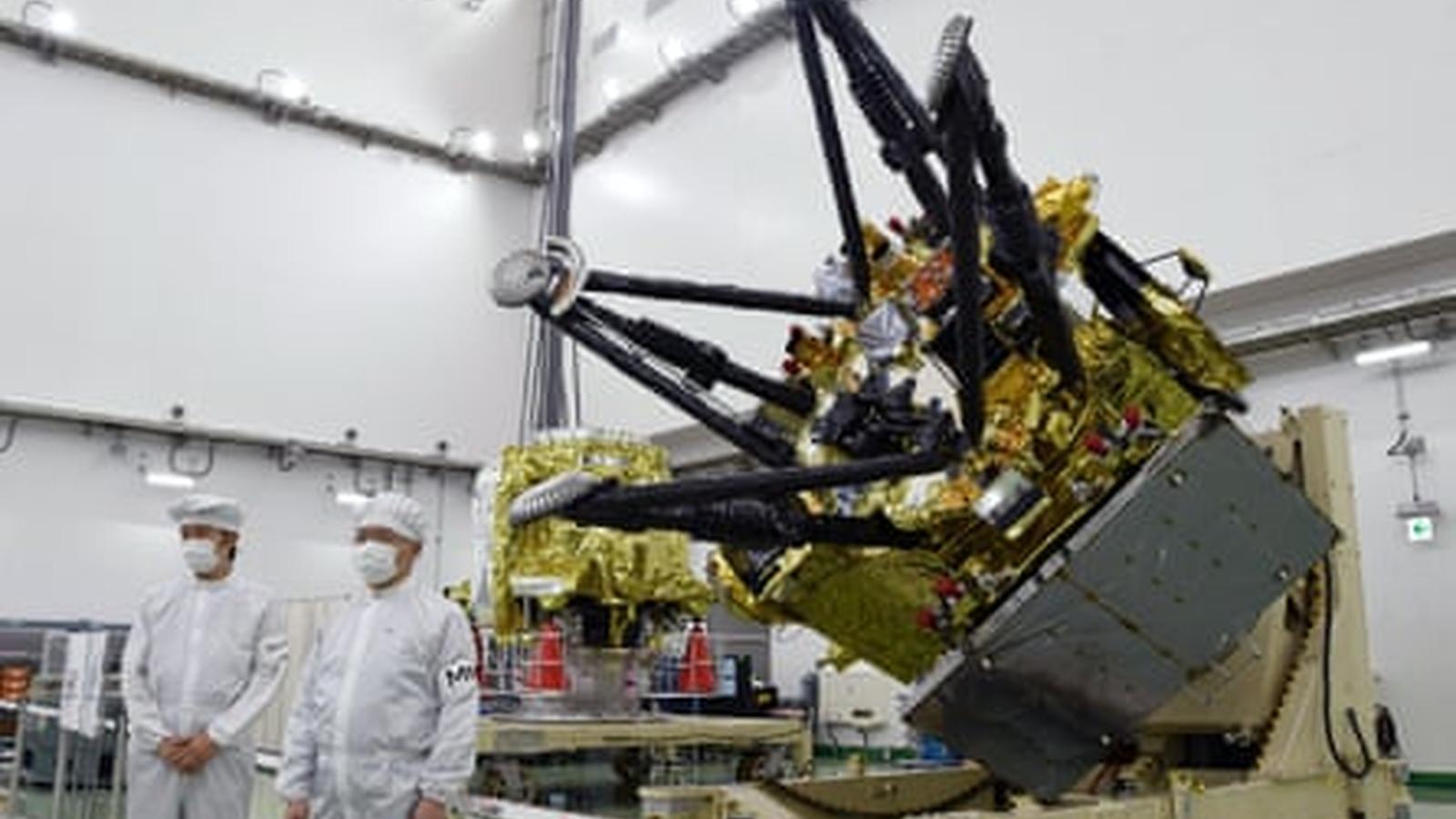
The Japan Aerospace Exploration Agency (Jaxa) is preparing to launch a spacecraft on Tuesday on a new Japanese mainstay H3 rocket, initiating the world’s first mission to bring back physical samples from Phobos, one of Mars’ two small moons. According to The Guardian, the ambitious Martian Moons eXploration (MMX) mission is expected to take five years, with the return capsule scheduled to touch down in Australia in 2031 before being transferred to Japan. The total development cost for the project stands at 55.3 billion yen, or roughly 350 million dollars, with the launch scheduled to lift off from the Tanegashima Space Center in the southwestern prefecture of Kagoshima.
Scientists hope the mission will clarify whether Phobos and its smaller sibling Deimos formed from debris after a massive impact on Mars or if they are captured asteroids from elsewhere in the solar system. Kiyoshi Kuramoto, the principal investigator on the mission, noted that analyzing soil samples will almost certainly provide definitive answers regarding their origin and composition. Phobos and Deimos take their names from the Greek mythological personifications of fear and terror, sons of the war god Ares, whose Roman counterpart is Mars.
International Collaboration and Mission Architecture
Japan is leading the international effort, which integrates critical equipment and communications support from NASA, the European Space Agency, and space agencies in France and Germany. The spacecraft will carry 13 distinct instruments, including a joint French-German rover named Idefix, a NASA sampling device and an instrument to measure gamma rays, an ESA deep space communication system, and a Japanese radiation monitor alongside two super hi-vision cameras jointly developed by NHK and Jaxa.
Following its launch on the H3 rocket, the spacecraft is projected to reach the Martian region around August 2027. It will then spend three years operating near and around Phobos. The MMX spacecraft is made up of three modules dedicated to propulsion, exploration, and return, with only the third module scheduled to return home to Earth with the samples. The Idefix rover is scheduled to land on the moon first for a 100-day surface exploration phase in 2029, gathering topographical data to guide the main spacecraft’s subsequent touchdown on a relatively smooth and level site.
Sampling Strategy and Future Exploration Stakes
Project manager Yasuhiro Kawakatsu emphasized that the Martian moons have never been fully investigated despite their scientific importance, describing them as the “most important unclimbed mountains in the solar system.” Jaxa aims to collect at least 10 grams of soil across two landing attempts utilizing both US pressurized gas methods and Japanese coring tools designed to extract samples from a depth of about 2 centimeters or more.
Landing on the pockmarked moon, which has just one two-thousandth of Earth’s gravity, presents significant operational challenges. To minimize bouncing at touchdown, the MMX exploration module is equipped with four-legged landing gear featuring shock absorption capabilities. Beyond deciphering planetary formation and potential traces of past microbial life, data from the mission will help scientists evaluate whether Phobos can serve as a staging base for future crewed missions to Mars. The collected material is also expected to contain roughly 0.1% Martian material blasted from the planet’s surface over millennia.