


What the photograph shows
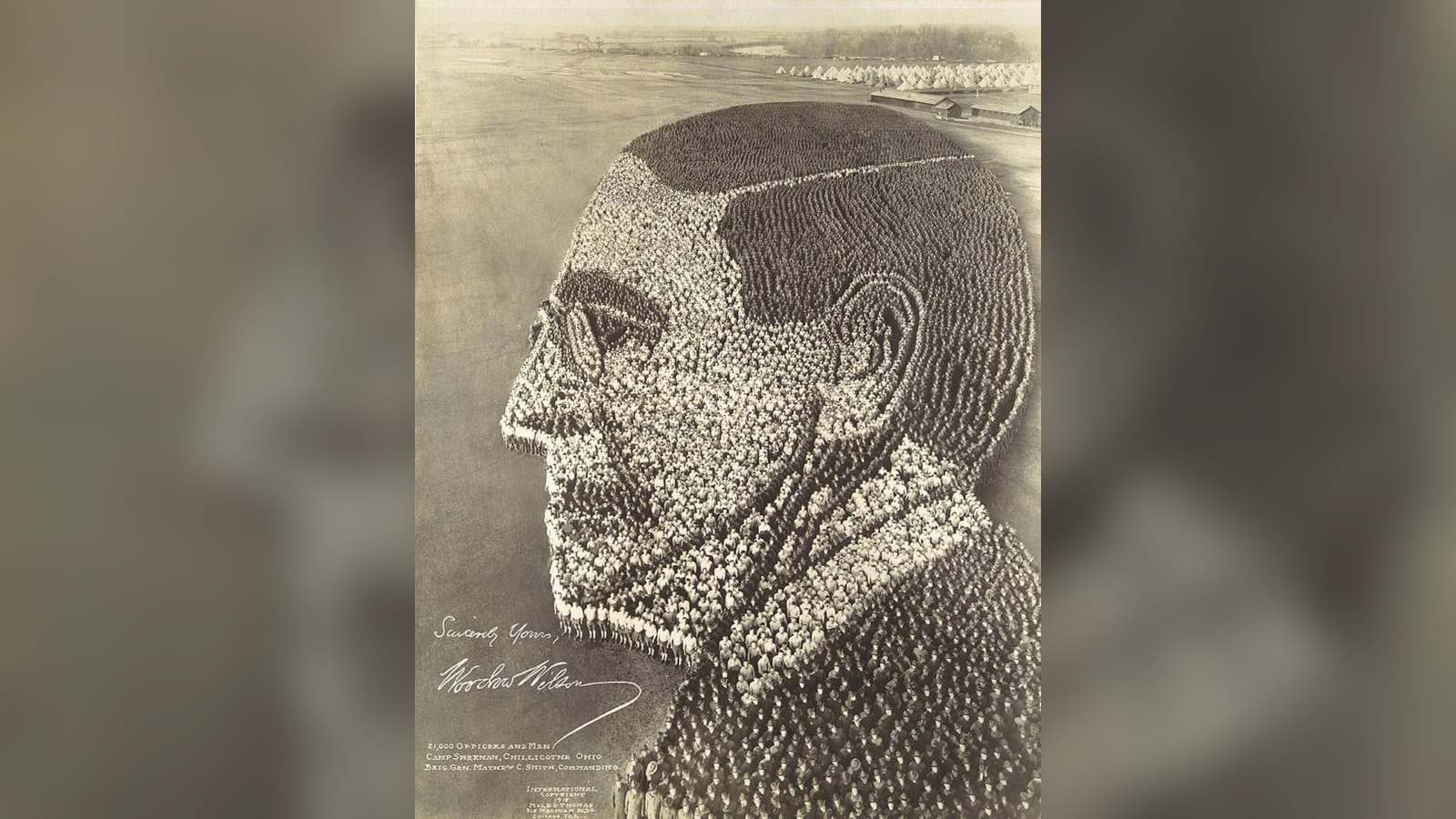
Captured from an elevated vantage point high above the dusty parade grounds, this striking black-and-white photograph transforms a massive assembly of more than 20,000 individuals into the unmistakable, spectacles-wearing profile of U.S. President Woodrow Wilson. The sheer scale of the human canvas requires meticulous planning and precise geometry. Thousands of soldiers clad in standard dark military wool uniforms and civilian personnel standing in lighter attire are arranged shoulder-to-shoulder across the expanse of the camp. Their positions are deliberately calculated to create varying degrees of light and shadow, mapping out the contours of the president’s hair, the thick frames of his glasses, the sharp line of his jaw, and the distinct folds of his necktie. Every individual human figure functions as a single pixel in an analog mosaic, dissolving their individual anonymity into a singular, monumental icon of wartime leadership.
The moment behind the image
Taken in 1918 at Camp Sherman in Chillicothe, Ohio, this photograph captures a nation at the very apex of its mobilization for World War I. Just months before the armistice that would end the hostilities on the Western Front, military cantonments across the United States were churning out fresh troops via the Selective Service Act at an astonishing rate, sending thousands of soldiers toward European battlefields daily. Before the shutter clicked for this exposure, hours of exhausting preparation took place. Thousands of men had to march into position, listen closely to megaphone-wielding directors, and settle into chalk-marked coordinates on the earth under a punishing sun. The physical tension of holding absolute stillness under the watchful eye of military commanders underscored a moment of intense national unity, wartime anxiety, and overwhelming patriotic fervor.
Photographer and provenance
This image belongs to a fascinating genre of mass-formation photography that gained immense popularity in the United States during the early 20th century, particularly during the First World War. Often commissioned for military morale, base documentation, and public relations, these photographs were frequently captured by specialized studio photographers or military documentation units working alongside organizations like the U.S. Signal Corps. While individual creator attribution for these massive group shoots was frequently lost or credited broadly to studio syndicates, the resulting prints circulated widely in newspapers, magazines, and patriotic postcards across the country. They were carefully orchestrated visual artifacts designed to project an image of unstoppable organizational discipline and collective devotion to the commander-in-chief.
Historical context
In 1918, Woodrow Wilson’s second presidential term was entirely consumed by the administration of America’s war effort and his visionary push for a peaceful postwar world through his newly announced Fourteen Points. Domestically, the American home front was heavily regimented under sweeping wartime legislation, including the Lever Act and the Espionage and Sedition Acts, which sought total conformity and suppressed anti-draft activities or dissent. Public spectacles such as this colossal living portrait served as visual proof of the mobilization machine at work, blending patriotic pageantry with the unprecedented reach of federal power under Wilson’s progressive administration. The era was marked by an intense push for ideological conformity, making public symbols of devotion to the president potent tools of statecraft.
Why it still matters
Today, living photographs offer a captivating window into the analog era of mass choreography and collective public performance, long before digital manipulation or drone photography made aerial imaging effortless. This remarkable surviving frame from Camp Sherman preserves not only the likeness of the 28th president but also the physical reality of the thousands of ordinary citizens and soldiers whose lives were swept up in the global currents of the First World War. It remains a powerful historical testament to how mass human assembly could be harnessed to forge a visual language of unity, power, and national purpose.