


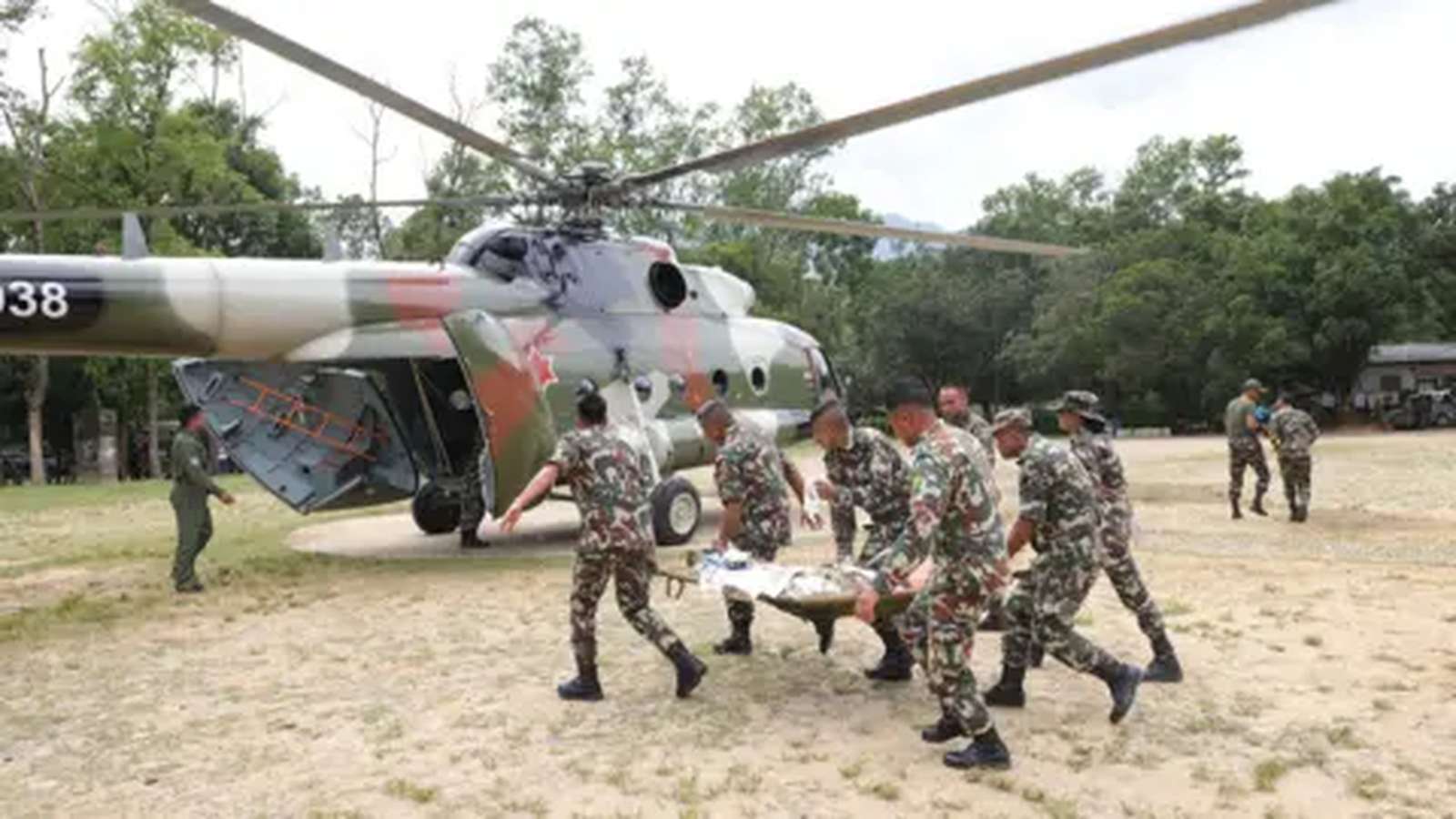
A catastrophic flash flood and debris flow originating near the Nepal-Tibet border has claimed at least 472 lives and left more than 1,500 people missing, according to figures released Friday by Nepalese authorities and Chinese state media. The disaster, triggered on Wednesday by a massive glacial collapse in the High Himalayas, dispatched a torrent of mud, ice, and rock along the Trishuli, Bhote Koshi, and Narayani river systems, obliterating key mountain infrastructure, submerging border checkpoints, and isolating thousands of local residents and international travelers.
Official updates confirmed 469 fatalities in Nepal, with bodies recovered as far downstream as Chitwan and Nawalparasi East districts. On the northern side of the frontier, Chinese officials in the Xizang Autonomous Region confirmed three deaths in Tibet’s Gyirong county. However, the casualty figure is expected to rise sharply as search-and-rescue teams struggle to access remote gorges cut off by destroyed bridges, swept-away highways, and severed telecommunication lines.
Anatomy of the Disaster: Glacial Collapse Over Seismic Misconceptions
Initial reports following the event suggested that a moderate earthquake had shaken the border zone, setting off secondary landslides. However, data published by the United States Geological Survey (USGS) clarified that the primary trigger was the structural failure and collapse of a massive glacier near the Langtang Lirung peak, approximately 15 kilometers west of the primary flood corridor.
According to USGS scientists and independent geologists, the physical impact of the collapsing glacier mass striking the valley floor was so tremendous that it generated a seismic signature equivalent to a magnitude 5.2 earthquake. The resulting avalanche of ice and debris entered mountain drainage channels, forming temporary natural dams before bursting in a violent wave downstream.
Dr. Simon Cook, a geoscientist at the University of Dundee, noted that satellite evidence points to the collapse of the lower section of a glacier near Langtang Lirung. He explained that permafrost, which historically cemented steep Himalayan mountain faces together, is increasingly thawing and degrading under rising temperatures. Geologist Daniel Shugar of the University of Calgary cautioned that while glacial thinning driven by regional climate trends increases systemic risk, detailed satellite analyses are currently underway to confirm the exact sequence of ice detachment and lake drainage.
Secondary Threats and the Emergency Suspension in Tibet
The disaster’s ongoing volatility forced Chinese authorities to halt rescue operations near the border town of Gyirong on Friday morning. A massive landslide dam formed a rising barrier lake along the frontier, which briefly overflowed early Friday. Fearing a sudden, catastrophic breach that could inundate downstream areas with a second wave of water and debris, emergency commanders ordered rescue teams to pull back one kilometer and stand by.
China’s state broadcaster CCTV reported that water levels at the barrier site are projected to rise further due to ongoing seasonal rainfall, peaking around September 1. State news agency Xinhua warned that a breach poses a direct hazard to Gyirong Port and civil infrastructure along the border corridor.
The International Centre for Integrated Mountain Development (ICIMOD) issued urgent warnings regarding potential secondary flooding in Nepal. ICIMOD specialists are actively evaluating satellite data to ascertain whether narrow channels of the Trishuli River remain impounded by debris dams. David Fisher, head of the International Federation of Red Cross and Red Crescent Societies (IFRC) delegation in Nepal, stated that the threat of secondary outburst floods has placed mountain communities and emergency personnel on high alert.
Hydropower Destruction and the Search for Foreign Tourists
The deluge severely damaged critical energy and transport infrastructure across central Nepal. At the Trishuli 3A hydropower project, rescue personnel from the Nepali Army successfully extracted 350 workers and residents, but teams continue efforts to reach more than 100 individuals who remain trapped in a flooded subterranean tunnel.
Because the disaster struck a major trans-Himalayan trekking and pilgrimage hub during peak operational season, foreign nationals represent a substantial proportion of the missing. The Nepal Tourism Board and police authorities report hundreds of missing foreign travelers, including:
- India: At least 288 Indian nationals are unaccounted for along border transit routes and sacred pilgrimage paths.
- China: Approximately 100 Chinese citizens are missing in Nepal, in addition to 260 foreign nationals reported missing by Chinese authorities on the Tibetan side of Gyirong county.
- United States: 65 American tourists confirmed missing by local authorities.
- Ukraine: 53 Ukrainian nationals reported missing by Ukraine’s Ministry of Foreign Affairs.
- Malaysia: 51 tourists traveling with a commercial tour operator remain unaccounted for.
- Australia, UK, and Canada: Dozens of travelers from Australia (39), the United Kingdom (33), and Canada (24) are missing, alongside visitors from South Korea, Portugal, the Netherlands, and New Zealand.
International Response and Diplomatic Mobilization
Nepal’s Prime Minister Balendra Shah described the crisis as a national tragedy and confirmed that state authorities are maintaining operational communication with Chinese counterparts to synchronize emergency measures across the border. In Beijing, Chinese Premier Li Qiang traveled directly to Gyirong to lead rescue oversight on the ground, while President Xi Jinping instructed civil defense agencies to deploy advanced monitoring systems to prevent secondary casualties.
Neighboring governments and international agencies have begun mobilizing emergency relief. Indian Prime Minister Narendra Modi declared New Delhi’s readiness to provide full humanitarian aid and search logistics to Nepal. United Nations Secretary-General António Guterres announced that UN field teams are deploying emergency supplies in coordination with Nepalese agencies. Furthermore, the United States pledged $500,000 in immediate emergency assistance for shelter, clean water, and sanitation, while the United Kingdom offered £5 million in aid alongside consular support for impacted citizens.
Broader Policy and Climate Stakes
The tragedy highlights the extreme vulnerability of the Hindu Kush Himalaya region, often referred to as the earth’s “Third Pole.” As rising global temperatures accelerate glacial retreat and degrade permafrost layers, the probability of compound disasters—where glacial collapses, landslide dams, and intense monsoonal rainfall intersect—is escalating across high-altitude river basins.
Regional policy experts stress that managing transboundary water hazards requires enhanced real-time data sharing between China, Nepal, and India. Establishing automated early-warning networks and reinforcing mountain infrastructure will be essential to mitigating similar catastrophic events as extreme weather events become more frequent throughout the Himalayan belt.