


An Unconventional Physics Experiment at UQ
Physicists at the University of Queensland have successfully demonstrated a proof-of-concept method for transmitting a binary message using gravity, sending data approximately 70 centimeters through a brick wall from an elevator shaft into an adjacent men’s bathroom. The Guardian reported on November 19, 2026, that the unusual setup relied on a snail-paced 1950s elevator moving up and down between floors in the university’s Parnell building. By tracking changes in the local gravitational field, researchers were able to encode and decode a single word in binary code without using traditional electromagnetic waves.
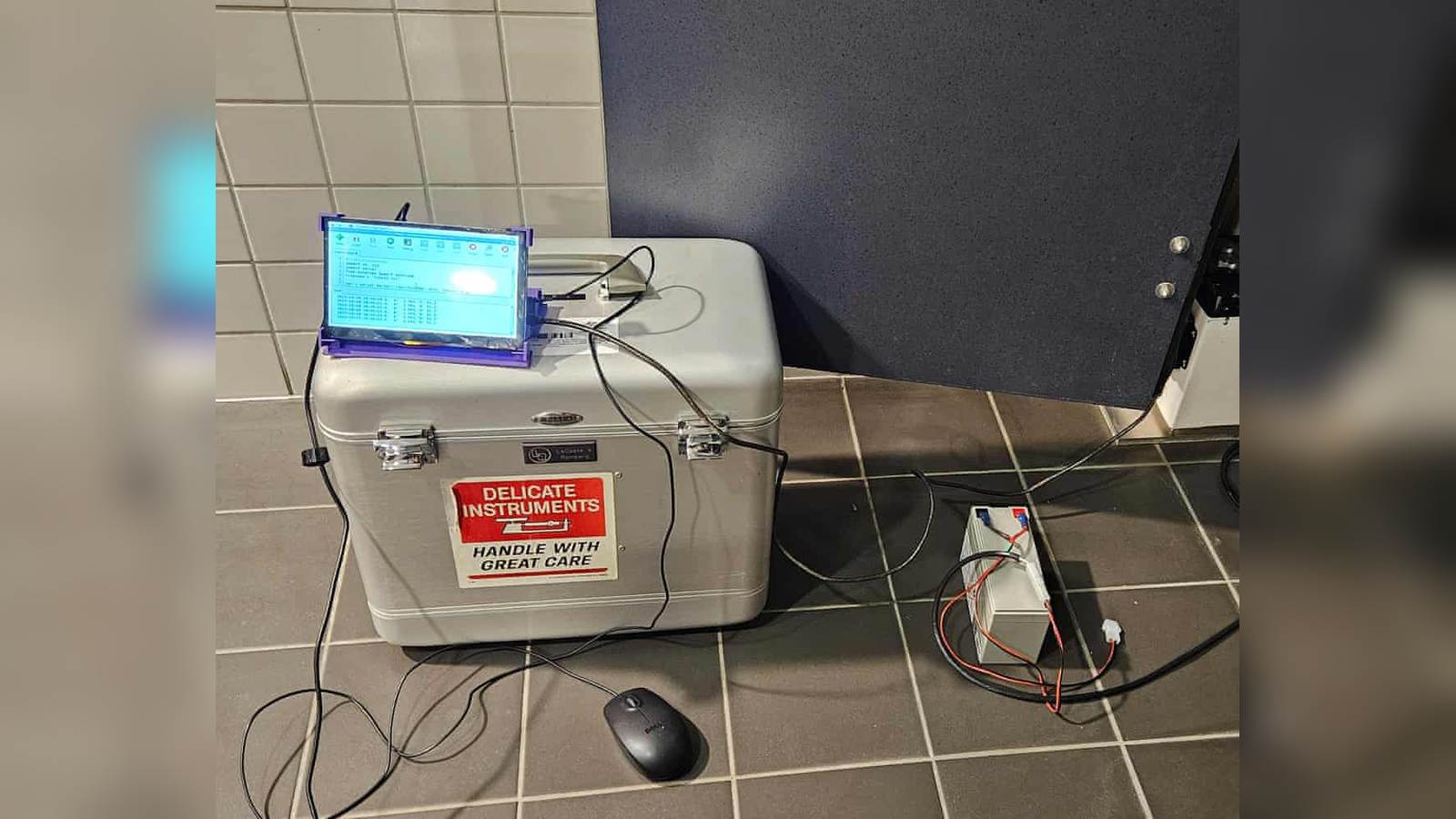
The experiment required a sensitive detection device known as a classical gravimeter, which was placed on the floor of the bathroom next to the lift shaft. As the elevator moved, its 1.8-tonne counterweight shifted between levels, acting as positions representing binary 0 and 1. The research team chose to transmit the word “gravity,” represented in binary code as 1000111 1110010 1100001 1110110 1101001 1110100 1111001. Because of the extremely low data transmission rate of one bit per minute, completing the single word took nearly an hour.
The Appeal of Unblockable Wireless Communication
While the current speed makes the technology impractical for everyday applications, the research establishes a new baseline for communication that bypasses the physical limitations of radio waves and Wi-Fi. Co-author Dr Charles Woffinden of UQ’s school of mathematics and physics noted that gravitational signals present a distinct advantage over standard wireless infrastructure. “Unlike the electromagnetic signals used in modern wireless communication, a gravitational signal cannot simply be screened out by placing ordinary material in its path,” Dr Woffinden said, in an article published by University of Queensland News. “Anyone who has lost phone reception in a tunnel or struggled with wifi through a solid wall will understand the appeal.”
Study co-author Prof Matthew Davis acknowledged the system’s current limitations, noting that Voyager 1, located light-days away from Earth, currently communicates at a faster data rate than the UQ gravity concept. Despite this, the team emphasizes that proving information can be encoded in a gravitational field and recovered reliably at a distance represents a significant fundamental milestone.
Origins in Contactless Weighbridges and Future Potential
The concept originated from an entirely different industrial application: developing a contactless weighbridge designed to determine the mass of large vehicles like passing trucks by measuring minute shifts in local gravity. Once the researchers demonstrated that classical gravity sensors could measure such changes accurately, they realized the underlying physics could be adapted for data encoding.
According to UQ modelling, future advancements could improve performance significantly. If more sensitive quantum sensors replace classical gravimeters, theoretical ranges could extend up to 500 meters with data rates reaching around 15 bits per minute. Although moving from a 1950s elevator counterweight to practical quantum-based systems will require substantial technological progress, the experiment successfully proves that practically unblockable gravitational signaling is scientifically viable.