


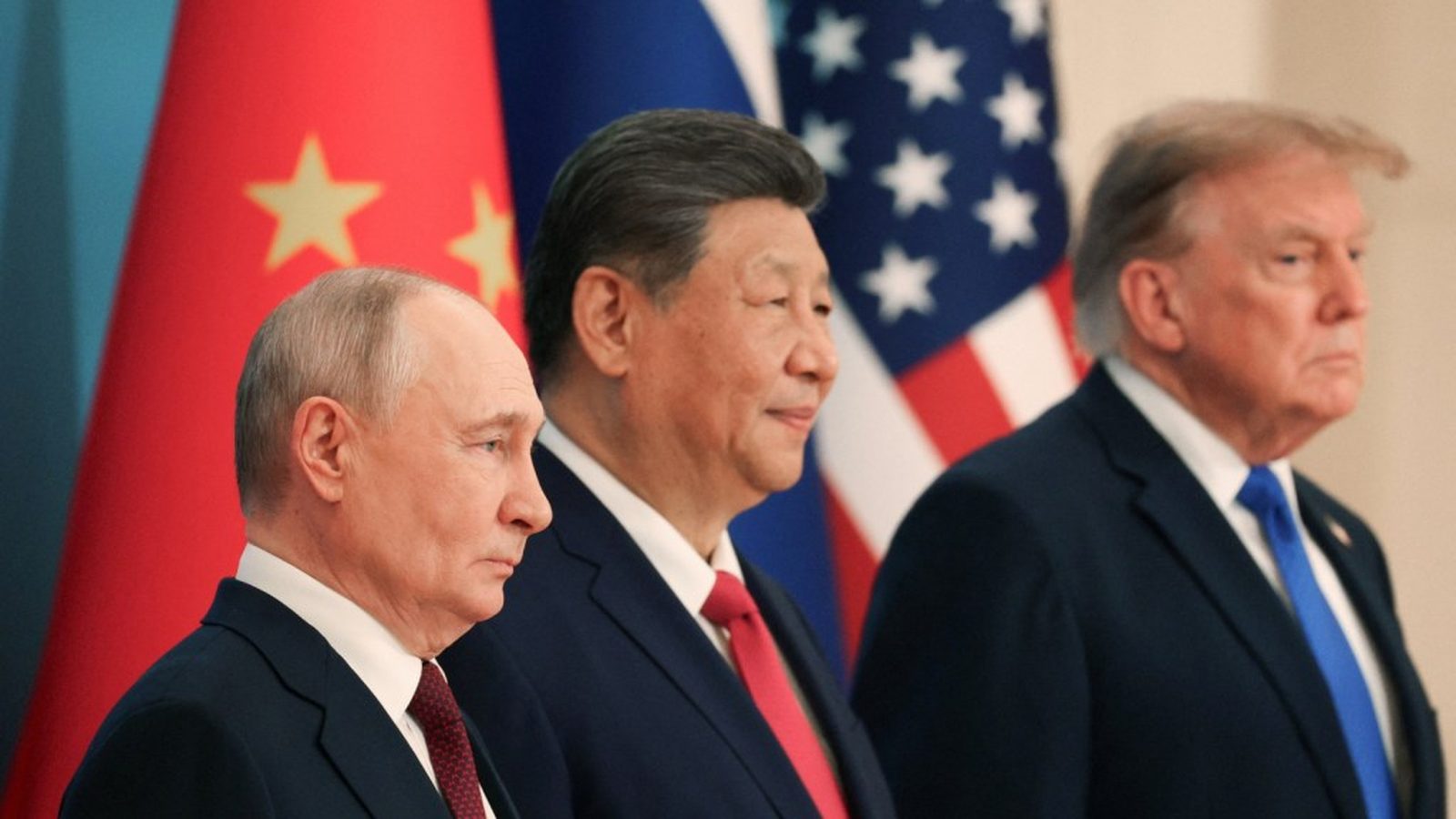
Historic Trilateral Talks in Shenzhen
U.S. President Donald Trump, Chinese President Xi Jinping, and Russian President Vladimir Putin convened for their first-ever trilateral summit in Shenzhen, China, on Thursday, November 19, 2026, on the sidelines of the APEC meetings. As reported by the Chicago Tribune, the historic gathering brought together the leaders of the world’s three largest nuclear powers for discussions that lasted over an hour, centering initially on shared responsibilities for global peace and nuclear risk reduction.
Despite the high-level optics and the symbolic framing of the meeting among World War II victors, post-meeting readouts revealed a distinct lack of substantive commitments regarding active international conflicts. The joint declarations and statements released after the talks omitted any mention of Russia’s war in Ukraine or the U.S.-led war in Iran, focusing instead on broad institutional reforms and diplomatic principles.
Immunity Agreement and Opposition to the ICC
Among the concrete takeaways from the summit was a joint agreement concerning international jurisdiction. The three sides agreed that state officials should enjoy immunity from prosecution, explicitly opposing what they termed “jurisdiction abuse” by the International Criminal Court. This challenge to the ICC’s authority formed a core element of the consensus reached by Washington, Beijing, and Moscow.
In addition to the immunity agreement, the leaders discussed the necessity of broader United Nations reforms, increasing oil supplies, and reducing global nuclear risks, although the joint statement did not detail the specific scope or timeline for these proposed U.N. changes. Furthermore, long-standing flashpoints such as Beijing’s position on Taiwan were absent from the broadly worded text, as China maintains that its policies toward the democratically governed island are an internal matter.
Diplomatic Optics and Global Stature
President Xi Jinping presided over the summit, using the platform to bolster China’s diplomatic stature as a mediator and global power. According to China’s Xinhua official news agency, Xi described the discussions as positive and fruitful, emphasizing that the three nations shared aligned views on safeguarding world peace through negotiation and cooperation.
Analysts noted that Beijing’s primary priority was steering the agenda away from specific geopolitical friction points, projecting an image of stable leadership. Ruby Osman, a senior policy adviser at London’s Tony Blair Institute for Global Change, observed that Beijing wanted to be seen as the adult in the room, positioning itself as a different kind of superpower that advocates for smaller states and avoids direct entanglement in foreign wars. Xi was quoted as saying that as long as dialogue continues and doors remain open, peace remains achievable. However, independent observers emphasize that the absence of binding commitments on active conflicts leaves the summit’s long-term diplomatic impact primarily symbolic.
Assessing Gains and Limitations for Global Powers
The trilateral summit delivered distinct outcomes for each leader, reflecting divergent strategic priorities and constraints. For Russian President Vladimir Putin, the gathering provided a vital diplomatic breakthrough. Largely isolated internationally since Russia’s full-scale invasion of Ukraine in February 2022, Putin arrived in Shenzhen with the lowest baseline for success. By attending his first APEC summit since 2017 and engaging directly with Trump and Xi, the Kremlin leader significantly reduced his diplomatic isolation.
Elizabeth Wishnick, an expert on Chinese-Russian relations at the CNA Corporation, noted that Putin emerged as the biggest winner regarding international optics. Sari Arho Havren, an associate fellow at the Royal United Services Institute, added that Putin’s standing was reinforced by the joint peace declaration and the shared pushback against the ICC, which holds an active arrest warrant for Putin for alleged war crimes in Ukraine. Prior to the summit, Russia underscored its military weight by dispatching nuclear-capable Tu-95 bombers to Vietnam and highlighting a nuclear briefcase accompanying Putin’s retinue.
For U.S. President Donald Trump, the meeting offered a public platform to pursue nuclear arms control discussions with major adversaries, fulfilling modest expectations set by the White House. Ross Darrell Feingold, a political risk analyst in Taipei, pointed out that Trump wanted to place on the record his pursuit of arms control with the other primary nuclear powers. Despite discussing regional crises such as Iran and Ukraine during bilateral sessions, Trump secured no binding agreements from Xi or Putin to help resolve those conflicts. Following the Shenzhen talks, Trump dialed into a separate meeting in Berlin involving U.S. envoys Jared Kushner and Steve Witkoff, Ukrainian President Volodymyr Zelenskyy, and over 40 European leaders supporting Ukraine.
For China, Xi Jinping successfully executed a high-stakes diplomatic event without overextending commitments. Yun Sun, director of the China Program at the Stimson Center, described the summit as well-choreographed and successful for Beijing, though she noted the trade-off was a lack of granular detail in the joint statements. China’s calculated choice to omit active conflicts like Ukraine from the official agenda allowed Beijing to preserve its economic ties with Europe while maintaining its stated posture as a neutral diplomatic mediator.