


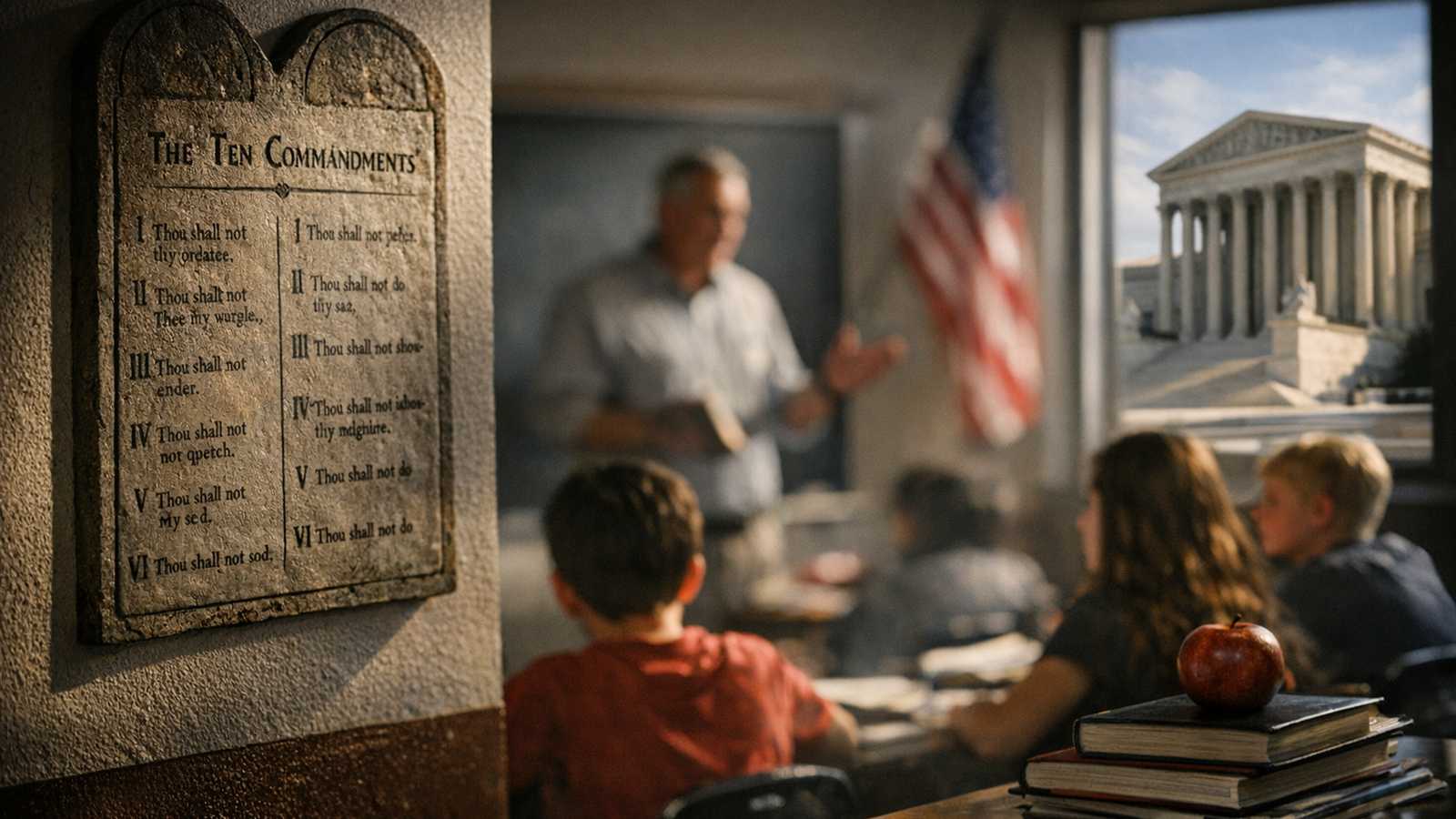
Legal Challenge Reaches Supreme Court
More than two dozen Texas families have formally petitioned the U.S. Supreme Court to review a state law that mandates the display of a Protestant version of the Ten Commandments in every public school classroom. The petition, filed on August 24, 2026, seeks to overturn a ruling by the 5th U.S. Circuit Court of Appeals that previously upheld the constitutionality of Texas Senate Bill 10.
The plaintiffs—a diverse coalition including Christian, Jewish, Hindu, Baha’i, Unitarian Universalist, and nonreligious families across 22 school districts—argue that the law violates the Establishment and Free Exercise Clauses of the First Amendment. They are represented by a legal team comprising the ACLU of Texas, the national ACLU, Americans United for Separation of Church and State, and the Freedom From Religion Foundation, with pro bono support from Simpson Thacher & Bartlett LLP.
Constitutional Stakes and Precedent
At the heart of the dispute is whether a state legislature has the authority to impose a specific religious text upon public school students. Senate Bill 10 requires that a “conspicuous” copy of the Ten Commandments be displayed in every classroom from kindergarten through 12th grade. Plaintiffs contend that this state-mandated display exerts pressure on children to conform to a specific religious tradition, thereby infringing on parental rights to guide the religious or nonreligious upbringing of their children.
The legal battle centers on the interpretation of the First Amendment, specifically the separation of church and state. Counsel for the families noted that the Supreme Court previously struck down a nearly identical Kentucky law in 1980. However, the 5th Circuit’s recent decision to allow the Texas law to proceed has created a significant legal conflict that the Supreme Court is now being urged to resolve.
Impact on Diverse Student Populations
The families involved in the suit emphasize that the law creates a exclusionary environment for students who do not subscribe to the specific Protestant version of the commandments selected by the state. Rabbi Joshua Fixler, a plaintiff and parent, stated that the mandate forces children to navigate a government-sanctioned religious environment that may contradict their home teachings. Similarly, plaintiffs like Nichole Manning, an atheist, argue that the public school system should remain neutral to ensure that all students, regardless of their background, are treated with equal respect.
Legal advocates contend that such displays risk stigmatization and bullying, as they effectively signal which religious beliefs are “favored” by the state. The petition argues that the role of public schools is to provide a high-quality education rather than to serve as a venue for religious proselytization.