


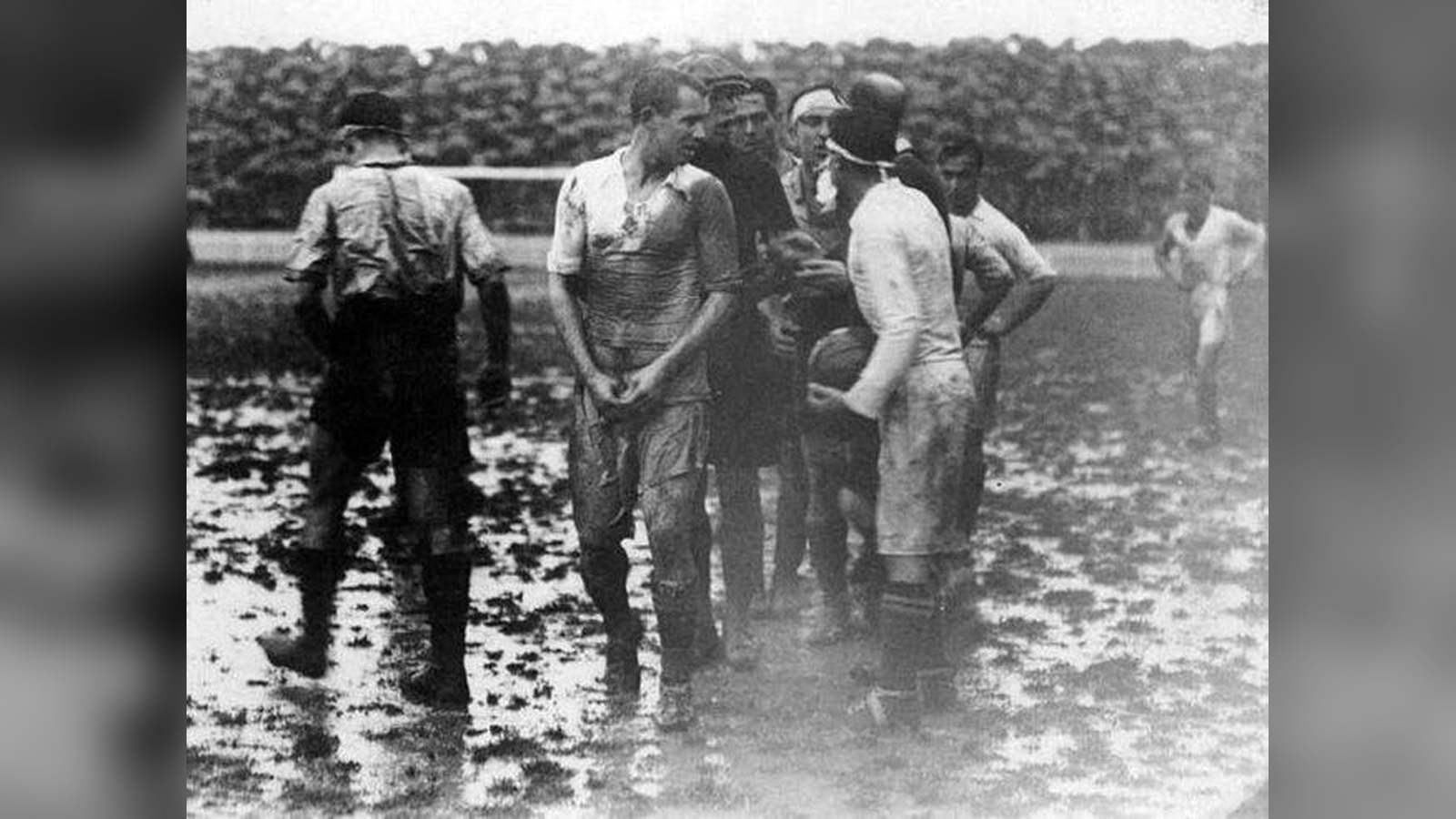
This historic archive photograph freezes a fleeting, high-tension instant on a sunlit pitch, capturing two rival players locked in a fierce duel during the opening skirmishes of Spanish football’s defining rivalry. Preserved across decades, the image serves as a visual gateway to February 1929, when Real Madrid and Barcelona met for the very first time in an official national league fixture. Looking closely at the frame, one is struck by the stark simplicity of the setting: a modest perimeter, the absence of towering corporate grandstands, and players wearing heavy, lace-up cotton jerseys devoid of commercial sponsorship. This photograph answers a fundamental question for modern observers: how did the legendary fixture look before it became a billion-dollar global spectacle, anchored instead in the raw, unpolished athleticism of the interwar era?
What the photograph shows
Within the rectangular boundaries of the archival frame, several distinct visual elements convey the athletic reality of 1929 football. The players wear loose-fitting long-sleeved shirts, knee-high wool socks, and heavy leather boots equipped with rudimentary protective elements. Their postures reflect intense exertion—muscles strained, bodies angled low against the turf as they contest a bouncing ball. The background reveals sparse crowds standing shoulder-to-shoulder directly near the touchline, shielded only by low wooden barriers rather than towering security fences. The natural light casts long, sharp afternoon shadows across the pitch, indicating an open-air stadium characteristic of Spanish sports architecture during the late 1920s. Every visible detail emphasizes a game played closer to the spectators, where the roar of the crowd mingled directly with the shouts of the players on the field.
The moment behind the image
The shutter moment captured here belongs to a rapidly evolving Spanish sporting landscape. In 1929, the Royal Spanish Football Federation launched the inaugural nationwide league championship, uniting regional powerhouses into a single competitive structure. Prior to this, encounters between clubs from the capital and Catalonia were largely restricted to regional tournaments or exhibition friendlies. Stepping onto the pitch for this historic league debut, both squads carried the immense weight of their respective civic and cultural identities. The atmosphere immediately preceding the match was charged with nervous anticipation, as fans and players alike realized they were charting completely unknown territory. When the referee blew the opening whistle, the players engaged in a hard-fought contest that set the competitive benchmark for decades of future encounters to come.
Photographer and provenance
While the exact individual who triggered the camera’s shutter on that February afternoon remains anonymous in many surviving archive entries, the image belongs to a vital period of early photojournalism when sporting events were increasingly recorded for metropolitan newspapers and illustrated magazines. Photographers working in Spain during the late 1920s faced considerable technical constraints: heavy glass-plate or early roll-film cameras, slow shutter speeds that required bright sunlight to avoid motion blur, and bulky equipment that restricted them to fixed positions along the sidelines. Despite these limitations, press photographers managed to secure iconic fragments of history. The survival of this specific frame is a testament to early archival preservation efforts by sports historians and national libraries, ensuring that the foundational visual proof of Spanish club football’s greatest rivalry was not lost to time.
Historical context
The year 1929 was a watershed moment for Spain, marked by rapid urbanization, political shifts under the dictatorship of Primo de Rivera, and the cultural awakening of mass spectator sports. Football quickly emerged as the ultimate arena for popular expression and regional pride. When Real Madrid (then known simply as Madrid Football Club) and Barcelona faced off in that inaugural league fixture, the socioeconomic backdrop of centralism versus regional autonomy subtly underpinned the sporting contest. Although the political undertones would sharpen dramatically in subsequent decades, particularly during the Spanish Civil War and the Francoist era, the 1929 fixture established the athletic bedrock upon which all future cultural narratives were built.
Why it still matters
Decades after the dust settled on that 1929 pitch, this photograph endures because it bridges the gap between myth and reality. El Clásico has since grown into a planetary broadcast event watched by hundreds of millions, dominated by multi-million-dollar superstars, high-definition broadcast technology, and colossal modern arenas. Yet, gazing at this grainy, century-old frame reminds contemporary fans of the sport’s humble, gritty origins. It demonstrates that the fierce passion, competitive pride, and dramatic tension defining Real Madrid and Barcelona today were already fully alive when the game was played in heavy cotton shirts under the Spanish sun.