


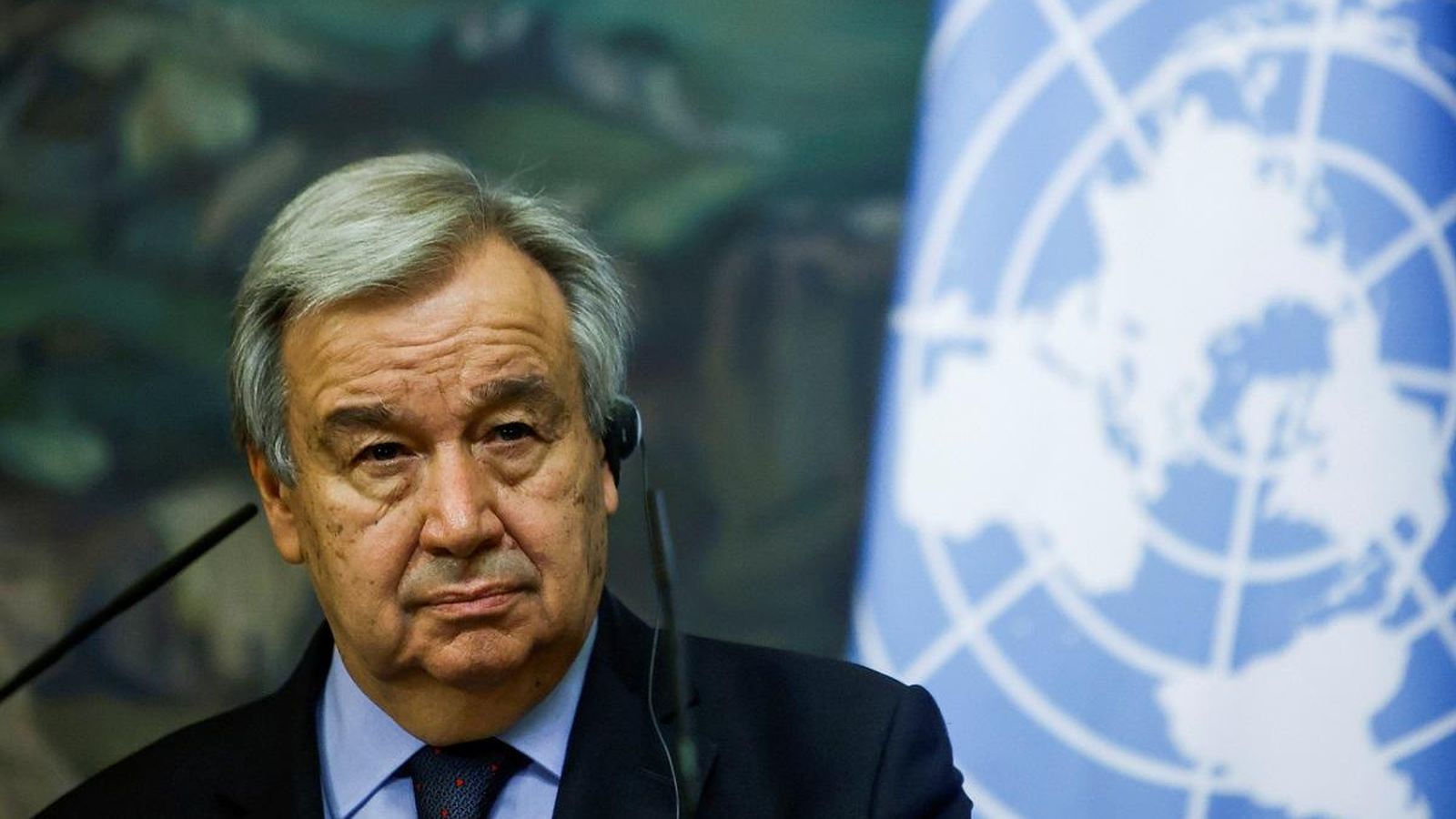
UNITED NATIONS (Azat TV) – United Nations Secretary-General Antonio Guterres declared on Thursday that complex global challenges will not be resolved by any single power dictating terms, nor by major powers dividing the world into rival spheres of influence. Speaking at a press conference marking the start of his tenth and final year in office, Guterres issued a stark warning that international law is being disregarded and cooperation is eroding, sentiments that implicitly critiqued recent moves by U.S. President Donald Trump.
Guterres’s remarks came a week after President Trump launched his ‘Board of Peace,’ an initiative initially designed to solidify the tenuous ceasefire in Gaza but which Trump envisions taking on a broader global role. This expanded ambition has reportedly caused concern among some international powers, reflecting a broader geopolitical tension that Guterres addressed directly.
Guterres Highlights Erosion of Multilateralism
The UN Secretary-General emphasized that multilateral institutions are currently ‘under assault on many fronts,’ a trend he attributed to a global environment where ‘impunity is driving today’s conflicts – fueling escalation, widening mistrust, and kicking the doors open for powerful spoilers to enter from every direction.’ This assessment underscores a growing skepticism towards established international norms and collaborative frameworks, a cornerstone of the UN’s mission since its inception.
Guterres’s second five-year term has been characterized by a series of profound global upheavals. These include Russia’s full-scale invasion of Ukraine, the Taliban’s resurgence in Afghanistan, ongoing conflict in Sudan, the protracted war between Israel and Palestinian militants Hamas in the Gaza Strip, a swift conclusion to Syria’s civil war, and the U.S. capture of Venezuela’s President Nicolas Maduro. Each of these events, Guterres suggested, highlights the fragility of international order and the urgent need for a renewed commitment to collective solutions.
Trump’s ‘Spheres of Influence’ Approach Draws Scrutiny
While Guterres refrained from naming specific countries, his comments were widely understood to be a direct response to President Trump’s foreign policy posture. Trump, who commenced his second term a year ago, has openly advocated for a return to a worldview centered on powerful nations delineating spheres of influence, a concept largely rejected by the international community as outdated. He has notably pledged to reassert U.S. dominance across the Western Hemisphere, signaling a shift away from traditional multilateral engagement.
President Trump has previously expressed a mixed view of the United Nations, acknowledging its ‘great potential’ but simultaneously criticizing it for failing to adequately support American-led peace efforts. This perspective contrasts sharply with Guterres’s unwavering commitment to the UN’s foundational principles, as he affirmed, ‘Despite all the hurdles, the United Nations is acting to give life to our shared values. And we won’t give up. We are pushing for peace – just and sustainable peace rooted in international law. Peace that addresses root causes. Peace that endures beyond the signing of an agreement.’
UN Faces Funding Challenges Amid Global Demands
Guterres’s press conference also unfolded against a backdrop of severe financial strain for the world body. The United Nations is currently grappling with a significant cash crisis, exacerbated by the fact that its largest contributor, the United States, has reduced voluntary funding to various UN agencies and declined to make mandatory payments to the organization’s regular and peacekeeping budgets. In response to these fiscal pressures, Guterres launched a reform task force in March, known as UN80, with the aim of streamlining operations, cutting costs, and enhancing efficiency.
The Secretary-General underscored that this financial predicament directly impacts the UN’s capacity to respond effectively to the myriad crises unfolding globally, further complicating efforts to uphold international law and foster cooperation.
Warning on Unchecked Technological Power
Beyond geopolitical tensions and institutional challenges, Guterres also issued a critical warning regarding the rapid and largely unregulated advancement of technology. He identified what he termed ‘perhaps the greatest transfer of power of our times – not from governments to people, but from governments to private technology companies.’
Highlighting the profound implications of this shift, Guterres cautioned that when technologies capable of shaping ‘behavior, elections, markets, and even conflicts operate without guardrails, the reaction is not innovation, it is instability.’ Consequently, he has prioritized the development of a robust global governance framework for artificial intelligence, recognizing its potential to either exacerbate or alleviate global challenges depending on its oversight.
As Antonio Guterres embarks on his final year leading the United Nations, his candid assessment of eroding international norms and the rise of unilateralism serves as a critical call to action, urging global leaders to recommit to cooperative solutions amidst a complex web of geopolitical, financial, and technological challenges. His tenure, marked by unprecedented global crises, underscores the enduring, yet increasingly threatened, relevance of multilateral institutions in an evolving world order.