


What the photograph shows
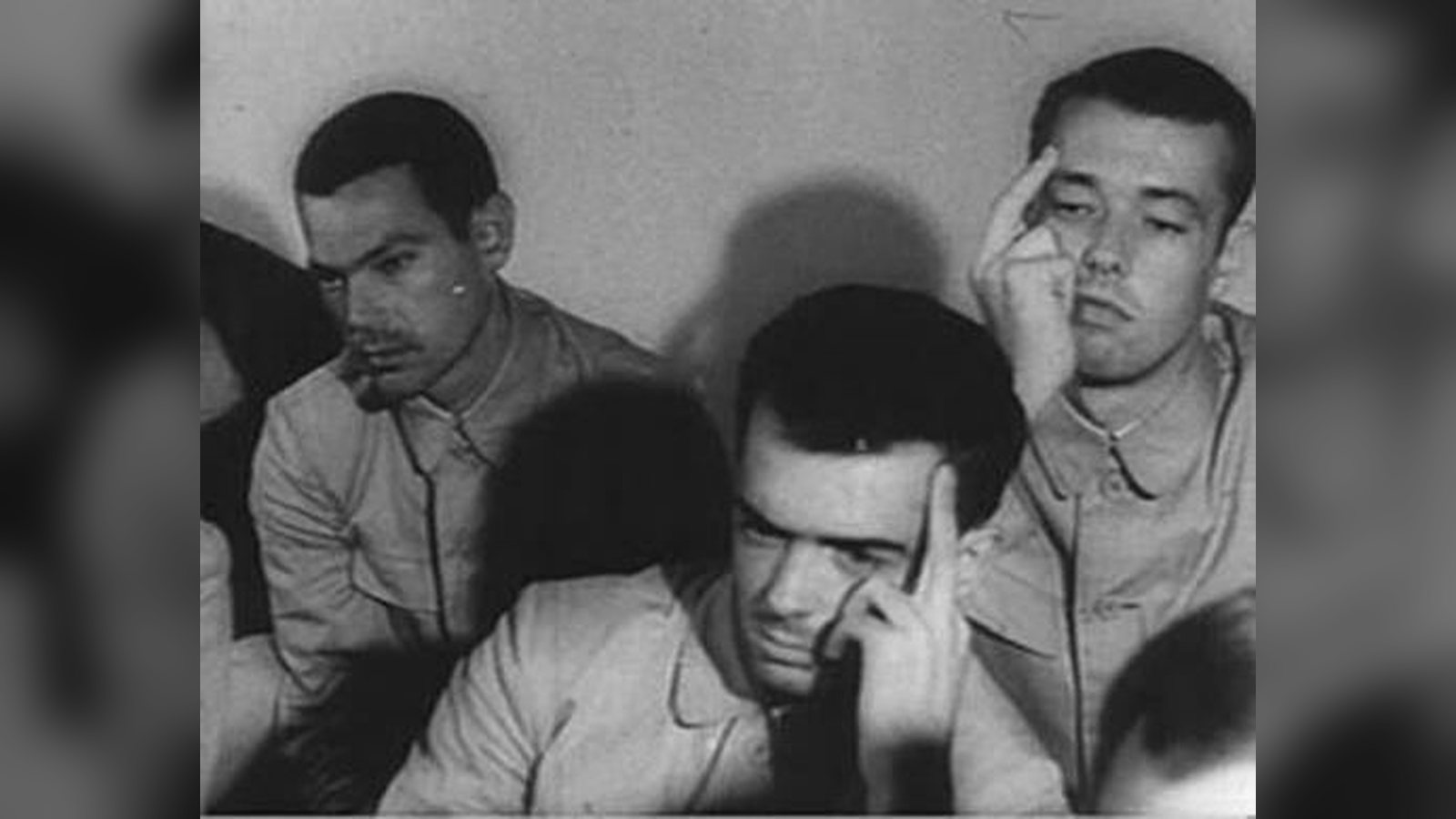
The photograph captures a group of American sailors from the USS Pueblo, sitting and standing in a stiff, staged environment, looking directly into the lens of a North Korean state camera. At first glance, the image appears to be a routine propaganda portrait designed to show the world that the captured crew was being treated humanely. The men wear heavy, dark-colored, buttoned-up prison uniforms. Their faces are kept carefully neutral, devoid of any obvious anger, fear, or smirking that might alert their captors. Yet, a closer inspection of the sailors’ hands reveals a coordinated, silent act of rebellion. Multiple crew members have casually but prominently raised their middle fingers, resting them against their knees, crossing their arms to display the gesture, or holding them up in plain view. The composition is tight, the lighting is flat and harsh, and the sterile background emphasizes the isolation of the prisoners. It is a visual testament to a high-stakes game of psychological warfare played out in front of the very cameras meant to document their submission.
The moment behind the image
On January 23, 1968, the USS Pueblo (AGER-2), a light cargo ship retrofitted as an environmental research vessel but secretly operating as a Navy intelligence-gathering ship, was intercepted by North Korean naval vessels and MiG jets in international waters off the coast of Wonsan. Despite attempts to maneuver and destroy classified materials, the ship was fired upon. Fireman Duane Hodges was mortally wounded, and the remaining 82 crew members, including Commander Lloyd M. Bucher, were taken prisoner. This marked the beginning of an 11-month ordeal. The crew was subjected to starvation, freezing temperatures, systematic beatings, and intense psychological torture. The North Korean regime, eager to exploit this massive Cold War coup, immediately began staging photographs and film segments. They wanted to broadcast images of submissive Americans confessing to espionage and praising the lenient treatment of their captors. It was during these forced photo sessions that the sailors decided to fight back using the only weapon they had left: their wits.
The birth of the Hawaiian good luck sign
The rebellion began when the sailors noticed a crucial vulnerability in their captors: extreme cultural isolation. During propaganda film screenings, the crew observed that Western movies shown by the North Koreans—often intended to depict Western moral decay—contained scenes where characters used the middle finger gesture, yet the censors had left it in. The sailors realized that the North Koreans had absolutely no understanding of Western obscene gestures. When ordered to pose for still cameras to show how well they were being treated, the sailors began raising their middle fingers. When suspicious guards demanded to know what the gesture meant, the crew members calmly and collectively lied, explaining that it was a traditional “Hawaiian good luck sign” used to wish someone prosperity and goodwill. The guards, desperate to document cooperative prisoners and completely ignorant of Western pop culture, accepted the explanation. For months, the sailors successfully inserted this symbol of absolute contempt into official North Korean propaganda photographs, which were proudly distributed to international news agencies and printed in publications like the English-language newspaper, The Pyongyang Times.
Photographer and provenance
The photographs were taken by official state photographers working for the North Korean Ministry of Culture and Propaganda. These military and civilian media personnel operated under strict guidelines to produce clean, triumphant images of the regime’s victory over “American imperialism.” The negatives were processed in state laboratories in Pyongyang and released to the international press to counter reports of prisoner abuse. The provenance of these images is well-documented; they were intercepted by Western intelligence and published by global news outlets. The deception worked flawlessly until October 1968, when Time magazine published one of the propaganda photos and explicitly explained the meaning of the “good luck sign” to its readers. When North Korean officials read the article, they realized they had been mocked on the global stage. The retaliation was immediate and horrific. The crew was subjected to a week of concentrated, brutal beatings and torture, which they later referred to as “Hell Week,” as guards tried to break their spirit once and for all.
Historical context and legacy
The seizure of the USS Pueblo occurred at a moment of extreme global tension. It coincided with the Tet Offensive in the Vietnam War and a North Korean commando raid on the South Korean presidential palace in Seoul, bringing the Korean Peninsula to the brink of renewed war. The crew was finally released on December 23, 1968, after the U.S. government signed a formal admission of espionage, which U.S. negotiators publicly and verbally rescinded immediately after the prisoners crossed the Demilitarized Zone (DMZ). The USS Pueblo remains the only commissioned U.S. Navy ship currently held by a foreign government; it sits today as a museum ship and tourist attraction in the Potong River in Pyongyang. Decades later, the physical and psychological scars remained. In February 2021, a U.S. federal court ordered North Korea to pay $2.3 billion in damages to the surviving crew members and their families, acknowledging the severe and lasting trauma of their captivity. The photograph of the “Hawaiian good luck sign” remains one of the most famous symbols of prisoner-of-war resistance in military history, capturing the exact moment where human dignity refused to be extinguished by totalitarian force.