


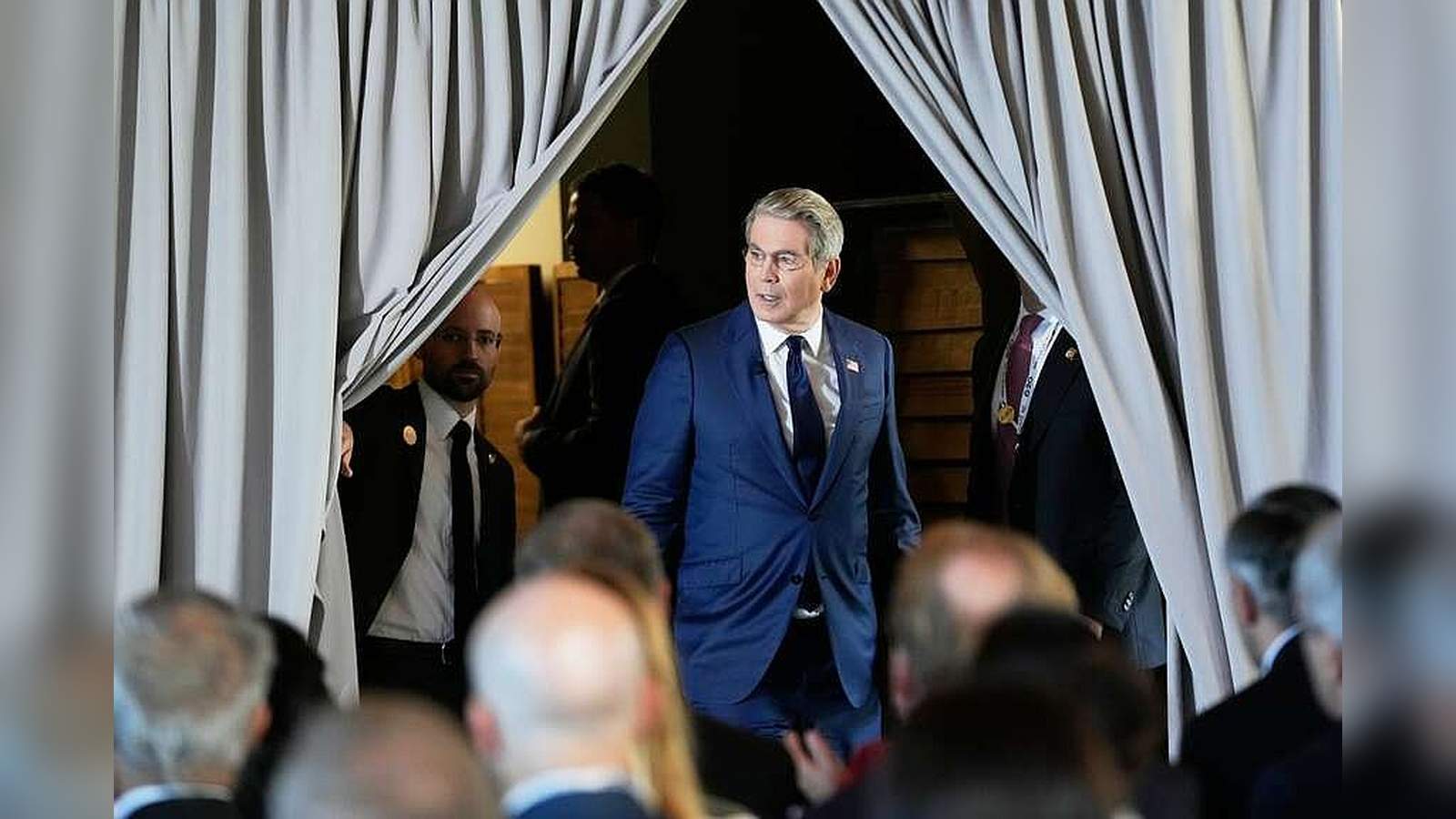
United States Treasury Secretary Scott Bessent called on Group of 20 finance ministers to adopt targeted tariffs and trade restrictions to counter global economic imbalances, warning that high volumes of Chinese exports risk undermining manufacturing sectors across major economies. Speaking on the sidelines of the G20 ministerial meetings in Asheville, North Carolina, Bessent argued that foreign governments must protect domestic employment against redirected trade flows created by Washington’s own import barriers.
Addressing reporters during the two-day gathering, Bessent stated that his prior warnings regarding a shift in international trade patterns had materialized following the U.S. implementation of broader trade measures. He urged international counterparts to take proactive steps to prevent foreign manufacturing capacity from displacing local industries, framing national tariff structures as an essential policy mechanism for long-term industrial stability.
This report draws on information published by CNBC.
Global Tariffs and Supply-Chain Realignment
The push for international tariff adoption follows significant legal and economic shifts within the U.S. trade posture. Following a February ruling by the U.S. Supreme Court that invalidated broad global tariffs imposed under emergency power statutes, the Trump administration has begun restructuring its trade enforcement framework. Federal officials are currently evaluating a targeted 7.5% tariff on specific Chinese imports following investigations into industrial overcapacity and forced-labor regulations.
Economic analyses highlight the broad financial impact of these measures. Data from the Tax Foundation, an independent research institution, indicated that U.S. tariffs implemented throughout 2025 raised consumer prices on imported retail goods by approximately 7% relative to pretariff projections. Despite these cost pressures, U.S. officials maintain that trade barriers are necessary to address structural disparities, pointing to China’s record $1.2 trillion trade surplus recorded in 2025 as a key obstacle to balanced global growth.
During discussions with Chinese representatives in Asheville, Bessent emphasized a policy of economic de-risking rather than complete decoupling. U.S. officials noted areas of diplomatic alignment with Beijing, including shared objectives regarding Iran’s nuclear program and maintaining open maritime trade routes through the Strait of Hormuz.
Market Stability Amid Rising Sovereign Bond Yields
The G20 finance meeting took place against a backdrop of volatility in global fixed-income markets. Benchmark 10-year U.S. Treasury yields rose to their highest levels in nearly 20 months during the conference, driven by broader global bond sell-offs, elevated energy prices, and renewed military tensions near the Strait of Hormuz. The upward yield movements coincided with broader fiscal concerns, as global debt reached a record $353 trillion, while U.S. national debt topped $40 trillion in August.
In interviews with Fox Business and CNBC, Bessent defended the performance of U.S. sovereign debt, asserting that the American bond market has remained resilient relative to foreign counterparts. Market data indicates that while the benchmark 10-year Treasury yield has risen by approximately 18 basis points since January 2025, the yield increase in U.S. debt has been comparatively more contained than movements observed across several G7 peer economies.
Diplomatic Tensions Over Russian Attendance
The conference host duties were further complicated by ongoing geopolitical friction regarding the participation of Russian Finance Minister Anton Siluanov. While Siluanov held bilateral discussions with Bessent on the sidelines of the summit, host officials excluded the Russian representative from the traditional official G20 group photograph.
Canadian Finance Minister François-Philippe Champagne stated publicly that Russia’s presence created substantial tension among attending delegations, confirming that several countries formally raised objections regarding the guest list. European Commissioner for the Economy Valdis Dombrovskis echoed those concerns, telling reporters that international economic forums should not move toward normalizing diplomatic or economic relations with Moscow under current global conditions.