


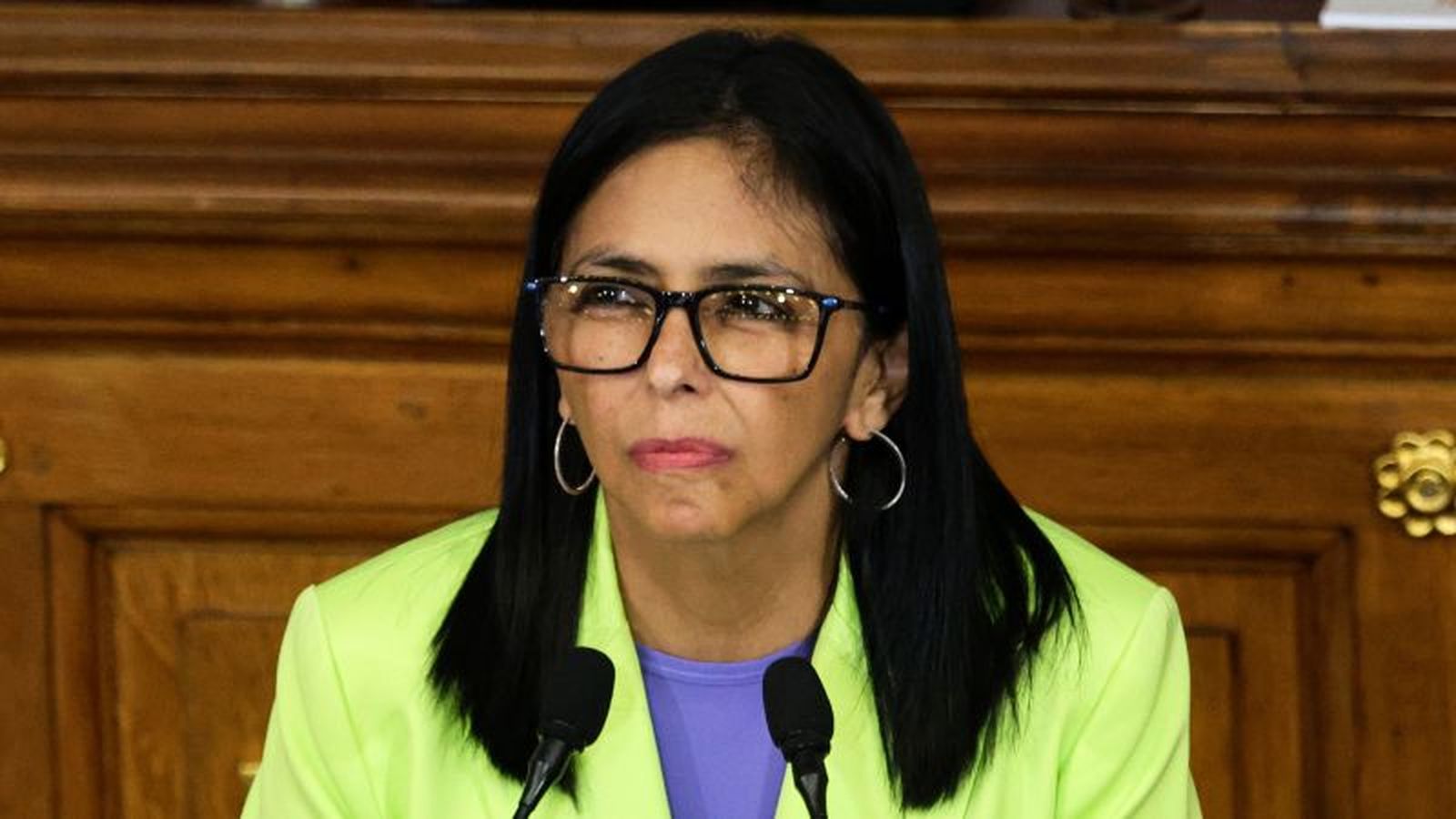
CARACAS (Azat TV) – Acting Venezuelan President Delcy Rodríguez publicly declared she has had “enough” of Washington’s demands, challenging the United States’ influence over Venezuela’s internal politics and economic policy, particularly regarding oil production. Her statement, made Sunday in Puerto La Cruz city and broadcast by state television, marks a significant shift in tone for the US-backed interim leader, who has been balancing domestic loyalties with international pressure since assuming power after the early January capture of former leader Nicolás Maduro.
Rodríguez’s remarks come almost a month into her new role, following a period where she has navigated a delicate political landscape, attempting to keep Maduro loyalists on board while also satisfying the White House. The US has maintained steady pressure on Venezuela since Maduro and his wife, Cilia Flores, were seized in a raid and taken to the US, where the former leader is facing charges.
Rodríguez Asserts Sovereignty Amidst Pressure
Addressing a group of oil workers, Delcy Rodríguez stated, “Enough already of Washington’s orders over politicians in Venezuela. Let Venezuelan politics resolve our differences and our internal conflicts. This Republic has paid a very high price for having to confront the consequences of fascism and extremism in our country.” The statement, broadcast by state-run channel Venezolana de Televisión, directly pushes back against ongoing US pressure, which includes demands for Venezuela to resume oil production under specific conditions.
Despite her current stance, Rodríguez, who previously served as Maduro’s deputy, was backed by US President Donald Trump as the country’s interim leader. In the immediate aftermath of Maduro’s capture, President Trump had claimed the US was “going to run” Venezuela, but later praised Rodríguez as a “terrific person” after a phone call, stating, “I think we’re getting along very well with Venezuela.” Rodríguez has consistently insisted in recent weeks that the US does not govern Venezuela, while carefully avoiding direct confrontation with Washington until now.
Washington’s Broader Demands and Internal Divisions
Since the US strikes on Caracas in early January, the Trump administration has outlined a series of demands for Venezuela. These include cutting ties with China, Iran, Russia, and Cuba, and agreeing to partner exclusively with the US on oil production, according to senior White House officials cited by CNN. Rodríguez was also expected to prioritize the Trump administration and US oil companies for future oil sales. Venezuela, possessing the world’s largest reserves of extra-heavy crude, relies heavily on oil as its main economic driver, a variety compatible with US refineries.
Internally, Venezuela faces deep divisions. Maduro loyalists remain a significant force, alongside left-wing factions who have opposed the government’s direction. A group known as “Chavistas No-Maduristas” – supporters of the late Hugo Chávez who reject Maduro – accuse him of betraying 21st-century socialist ideals. This fractured political landscape presents a challenge for Rodríguez as she seeks to consolidate a stable source of authority in Caracas, a goal Washington also shares after 25 years of confrontation with the socialist nation.
Opposition’s Vision and Criticism of Current Leadership
Leaders of the Venezuelan opposition are closely monitoring developments, and their future involvement remains uncertain. Opposition leader María Corina Machado has been particularly vocal, envisioning a successful democratic transition for Venezuela as the “fall of the Berlin Wall” for the Americas, which she believes would rapidly transform the nation’s economy and reshape the region’s political landscape. Machado, who had lunch with President Trump at the White House earlier this month and presented him with her Nobel Peace Prize, intends to return to Venezuela despite the risks.
Machado has also been critical of the current interim leadership. She told Fox News that if Delcy Rodríguez remains in power, “nothing truly changes. There will be no rule of law, no trust, no stability. Venezuelans will not come home under a criminal.” President Trump had previously expressed a desire to see Machado “involved” in Venezuela’s leadership in some capacity.
Concessions on Political Prisoners Continue
Among the US demands was the release of political prisoners held across Venezuela. On Sunday, at least 104 people were freed, according to the rights group Foro Penal. The group stated this marked one of the highest daily figures since the government announced on January 8 that it would release “a significant number” of detainees as a “peace” gesture to the US. Foro Penal reports that the total number of releases since then has reached at least 266.
Acting President Rodríguez, however, provided a higher figure, stating on Friday that 626 people had been released from prison in recent weeks. She confirmed plans to contact the office of the United Nations High Commissioner for Human Rights, Volker Türk, to verify the list of released individuals, which has not yet been made public despite demands from activists and opposition members.
This public pushback by Acting President Rodríguez underscores the complex and fragile nature of Venezuela’s political transition, revealing the inherent tension between external influence and the interim government’s need to establish domestic legitimacy and independence among its diverse internal factions.