


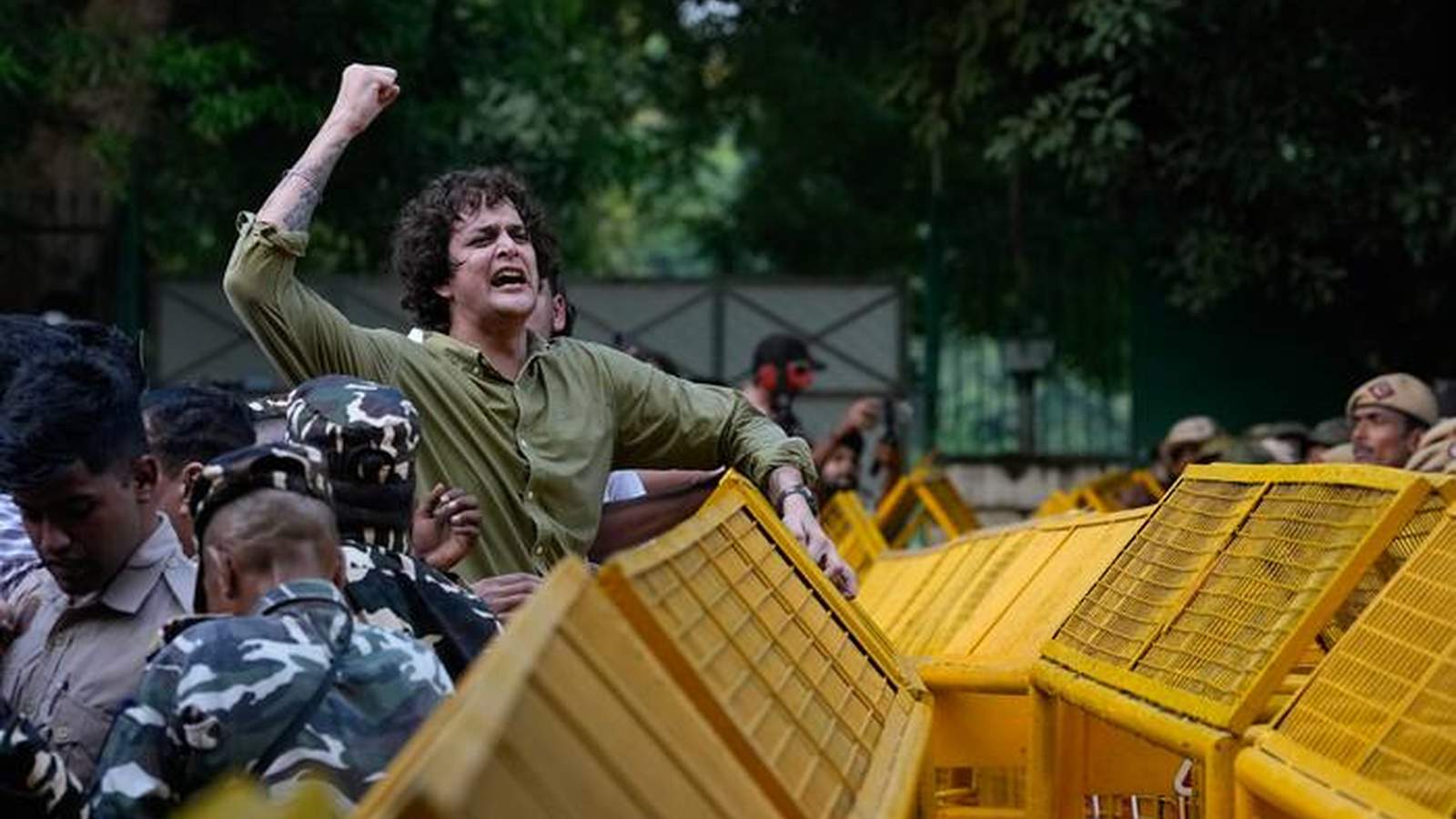
NEW DELHI (Azat TV) – A generation of young Indians, mobilized by the grassroots “Cockroach” movement and backed by opposition parties, has taken to the streets in New Delhi to challenge Prime Minister Narendra Modi’s government, demanding the immediate resignation of Chief Election Commissioner Gyanesh Kumar, as reported by The Independent. The unrest erupted following a contentious Special Intensive Revision of voter lists that has removed more than 130 million names since last year, sparking accusations of politically motivated disenfranchisement.
Demonstrators, including students who traveled from various parts of the country, faced a heavy police crackdown in the capital. According to The Independent, authorities deployed metal barricades, detained protesters, and used force to disperse crowds attempting to march toward the Supreme Court. Opposition leaders, including Congress party figures Rahul Gandhi and Priyanka Gandhi Vadra, joined the march, heightening political friction around the electoral oversight body.
The Voter List Purge and Institutional Stakes
The core of the conflict centers on the mass removal of voter names. Critics argue that the ongoing revision campaign favors Modi’s ruling Bharatiya Janata Party (BJP) by systematically stripping eligible voters from rolls ahead of key political cycles. The Election Commission maintains that the rigorous exercise is essential to eliminate duplicate and ineligible entries from the system.
Modi has not publicly addressed the demonstrations, though ruling party leaders have dismissed the protesters as anarchists while suggesting external backing, without presenting supporting evidence. For many young participants, the dispute strikes at the foundational integrity of Indian democracy, calling into question the neutrality of institutions that have operated under Modi’s administration for more than a decade.
Youth Mobilization and Broader Political Impact
The current protests build on earlier youth-led demonstrations earlier this summer that successfully forced the resignation of Modi’s education minister, marking a rare instance of street pressure yielding direct political outcomes. Participants such as 22-year-old economics student Kashish Rawat and 19-year-old sociology student Maya Ribeiro emphasized that the mobilization reflects deep-seated disillusionment with political checks and balances, religious minority targeting, and press freedom pressures.
As opposition parties struggle to coalesce these grievances into a unified national alternative, young demonstrators maintain that creating institutional accountability remains an urgent imperative. The ongoing confrontations signal a sustained test for the Hindu nationalist government’s grip on public dissent as the electoral dispute moves forward.
Expanding Unrest and Government Response
As demonstrations intensified in New Delhi, thousands of protesters gathered around designated sites where authorities imposed sweeping restrictions, including the suspension of mobile internet services. Police officials defended the security measures by stating that permission for certain large-scale gatherings had been denied because formal requests were submitted past official deadlines. These restrictions caused widespread travel disruptions across the capital, as metro stations and train services experienced temporary suspensions designed to limit the influx of demonstrators reaching key protest venues.
The active deployment of thousands of police personnel alongside yellow metal barricades highlighted the state’s determination to contain the growing youth campaign. Despite these obstacles, protesters continued to utilize digital platforms, sharing viral mobile phone footage of police interactions that quickly circulated across social media networks. This digital sharing transformed localized clashes into a nationally visible confrontation over the boundaries of free expression and public assembly under Modi’s administration.
Origins and Evolution of the ‘Cockroach’ Movement
The current voter list controversy has allowed the “Cockroach” movement to significantly broaden its organizational scope. Originally emerging online in May, the movement gained widespread prominence through coordinated demonstrations, sit-ins, and hunger strikes focused initially on alleged exam paper leaks. Those summer protests culminated in July when sustained street pressure forced the resignation of Modi’s education minister—a notable political setback for a prime minister who has maintained a tight grip on national authority for over twelve years.
For many participants, the transition from protesting educational administration failures to challenging the national electoral oversight body represents a natural evolution in their pursuit of systemic transparency. Movement participants note that they do not strictly align with any single political party, operating instead through decentralized networks fueled by campus debates, family discussions, and peer-to-peer digital exchanges.
Democratic Institutions Under Scrutiny
The dispute over the voter rolls has placed India’s broader democratic framework under intense international and domestic scrutiny. Critics of the Modi administration argue that executive overreach has systematically eroded traditional checks and balances, weakened independent media outlets, and generated heightened anxiety among religious minorities, particularly Muslims. Government representatives and BJP officials consistently reject these allegations, asserting that national institutions remain fully robust and that law enforcement agencies act solely to maintain public order rather than suppress legitimate dissent.
Nevertheless, student activists like 21-year-old philosophy student Aryan Kajaniya argue that the practical ability to exercise constitutional rights has become increasingly constrained. Protesters emphasize that navigating official restrictions on public gatherings while attempting to voice opposition to central policies creates severe hurdles for civic participation.
Personal Tolls and Future Electoral Tests
The friction generated by these protests has also manifested within private households, where generational divides over political loyalty have strained family dynamics. Participants like Kashish Rawat noted that divergent views on Modi’s leadership—often influenced by contrasting consumption of television news and social media—have made political discourse inside families increasingly difficult.
Looking ahead, the political ramifications of these youth-led demonstrations remain uncertain as India approaches upcoming state elections. While national general elections are not scheduled until 2029, upcoming legislative contests in key states such as Uttar Pradesh, India’s most populous state, and Gujarat, Modi’s home state, will provide an immediate test of the ruling party’s electoral strength and the long-term impact of the youth mobilization.