


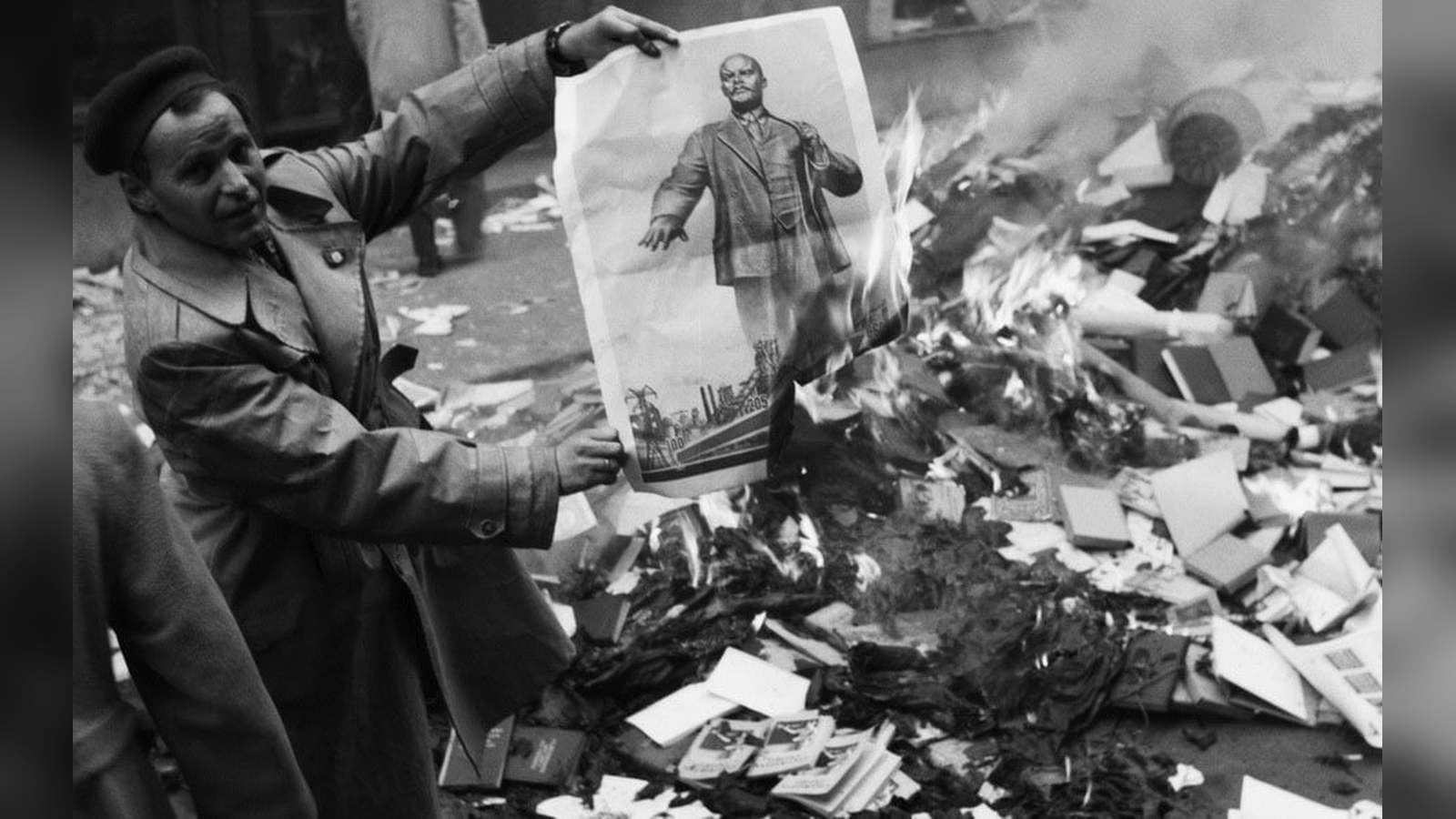
In the autumn light of Budapest in late October 1956, a stark black-and-white photograph captures Hungarian protesters encircling a portrait of Vladimir Lenin as bright flames consume the face of the Bolshevik leader. The camera catches a precise instant of iconoclasm: paper and board curling under heat, thick smoke drifting over cobblestones, and ordinary citizens looking on as the supreme symbol of Soviet ideology is reduced to ashes on a public street. This photograph does not merely record an act of destruction; it anchors a pivotal historical moment when a population long suppressed by foreign dominance reclaimed its voice. The central question the image poses to history is how a peaceful student protest transformed so rapidly into a visceral rejection of an empire, and how a single photographer managed to preserve this fragile flash of liberty before Soviet tanks returned to extinguish it.
What the photograph shows
In the center of the frame, the iconic visage of Vladimir Lenin—reproduced millions of times across the Eastern Bloc as an unassailable symbol of state power—is caught in the process of physical disintegration. Fire eats through the paper, charring the features that once adorned schoolrooms, government offices, and parade banners across Hungary. Surrounding the small bonfire are citizens dressed in the heavy winter coats, caps, and working-class attire typical of mid-century Budapest. Their postures reveal a mix of sharp focus, quiet satisfaction, and tense alertness. Some individuals lean forward to ensure the flames catch, while others stand back against the blurred backdrop of urban architecture, keeping watch over the street. The composition pits the burning flat image of the father of Soviet communism against the three-dimensional, living reality of Hungarian workers and students. Dust, debris, and torn paper litter the ground, emphasizing the immediate collapse of administrative authority in the city.
The moment behind the image
The scene unfolded during the explosive opening days of the 1956 Hungarian Revolution. What began on October 23 as a peaceful demonstration by university students in Budapest—marching in solidarity with political reforms in Poland—swiftly gathered momentum, drawing hundreds of thousands of factory workers, intellectuals, and off-duty soldiers into the streets. As demands for free elections, national independence, and the withdrawal of Soviet troops were met with gunfire from the hated State Protection Authority (ÁVH, commonly referred to as the AVO), popular anger boiled over. Protesters throughout the capital systematically targeted every visible emblem of Soviet rule. They dismantled the massive bronze statue of Joseph Stalin in City Park, tore down red stars from public buildings, and dragged official portraits into public squares to be burned. This photograph records one such spontaneous act of symbolic purging, occurring during a brief, intoxicating window when the initial Soviet garrison hesitated and began pulling back from the inner city.
Photographer and provenance
This image was taken by Erich Lessing, one of the earliest and most celebrated photojournalists of the Magnum Photos agency. Lessing was the first international photographer to reach Budapest as the revolt broke out, driving across the Austrian border to document the unfolding crisis firsthand. Working under chaotic and hazardous conditions with minimal equipment, Lessing moved through the street battles, public rallies, and makeshift field hospitals, capturing both the political fervor and the grim human cost of the uprising. His archive from Budapest was distributed globally through Magnum, appearing in major international picture magazines such as Life, Picture Post, and Paris Match, providing the Western world with its primary visual window into the Hungarian struggle. However, the experience left an indelible mark on Lessing himself. Witnessing summary executions, shattered bodies, and the devastation wrought by war caused him to re-evaluate his profession. Lessing later remarked, “I did not want to cover any revolutions or any wars any more. It makes no sense. I’ve seen too much.” Shortly after documenting 1956, he largely stepped away from frontline conflict reporting, pivoting toward long-term cultural and historical book projects.
Historical context
To fully understand the burning of Lenin’s portrait, one must look at the decade of intense repression that preceded October 1956. Following the defeat of Nazi Germany, the Soviet Union installed a hardline communist regime in Hungary led by Mátyás Rákosi, who modeled his government on Stalinist totalitarianism. For ten years, the Hungarian population endured political purges, forced collectivization, economic hardship, and pervasive surveillance by the ÁVH secret police. The death of Stalin in 1953 and Nikita Khrushchev’s 1956 “Secret Speech” denouncing Stalinist crimes opened a crack in the ideological facade. When Hungarian citizens took to the streets in October, their fury was directed not only at economic misery but at the total ideological domination symbolized by Lenin and Stalin. For a few brief days between late October and early November, a revolutionary government led by Imre Nagy attempted to restore democracy and declared Hungarian neutrality. However, on November 4, 1956, the Soviet military launched a massive armored invasion, crushing the revolution with overwhelming force, killing roughly 3,000 Hungarians, and driving over 250,000 refugees across the border into Western Europe.
Why it still matters
Erich Lessing’s photograph remains one of the defining visual artifacts of the Cold War. While military force ultimately re-established Soviet control over Hungary for another thirty-three years, images of protesters burning party portraits proved that ideological legitimacy could not be imposed indefinitely by force. The visual reading of an empire’s symbol dissolving in flames provided an enduring template for future anti-authoritarian movements across Eastern Europe, foreshadowing the eventual fall of the Berlin Wall in 1989. By anchoring the political history of 1956 in a immediate, tactile human gesture, Lessing’s camera ensured that the Hungarian people’s brief taste of freedom would remain permanently preserved in collective global memory.