


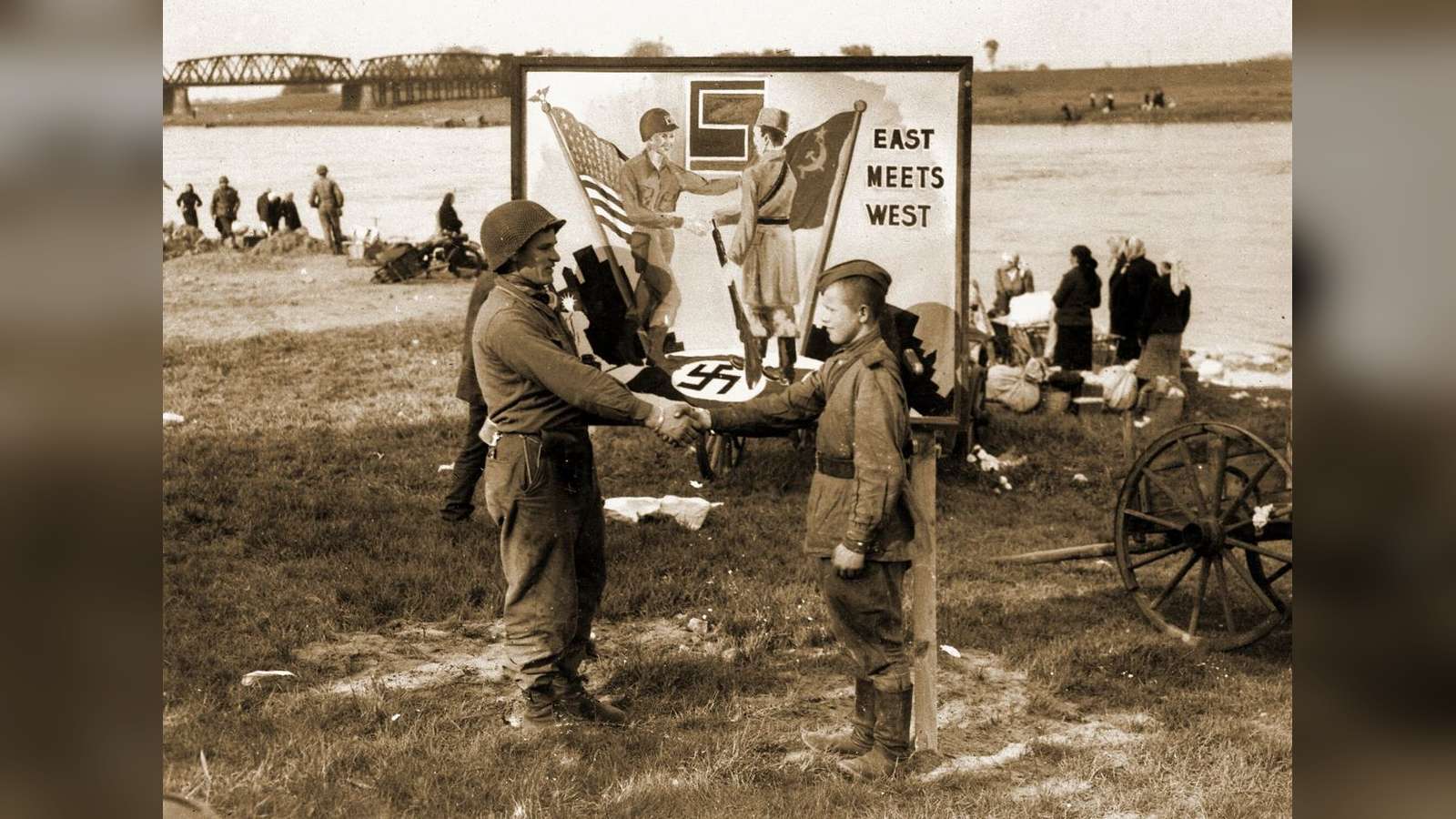
This photograph captures one of the most celebrated moments of human connection from the final weeks of World War II: an American soldier and a Soviet Red Army officer clasping hands over a ruined bridge in the German town of Torgau. The image is not merely a record of a tactical meeting; it is the visual manifestation of ‘Elbe Day,’ the historic moment when the advancing Western Allies and the Soviet forces finally linked up, effectively cutting the remaining territory of the Third Reich in half. The photograph raises a compelling question for modern viewers: how did a chaotic, spontaneous encounter between small scouting patrols transform into a carefully choreographed symbol of global alliance, and what does the image reveal about the brief window of hope before the onset of the Cold War?
What the photograph shows
In the frame, we observe two young men leaning toward each other with genuine, broad smiles, their hands locked in a firm grip. On the left is Second Lieutenant William Robertson of the US Army’s 69th Infantry Division, and on the right is Lieutenant Alexander Silvashko of the Soviet Red Army’s 58th Guards Rifle Division. They stand amidst the twisted, jagged steel girders of the destroyed bridge spanning the Elbe River in Torgau. Their field uniforms are worn and dusty, reflecting the grueling campaigns they had survived to reach this destination. Robertson wears his standard US military gear, while Silvashko is clad in the classic Soviet gymnasterka tunic. The background reveals the gray, flowing waters of the Elbe and the skeletal remains of the bridge, which had been blown up by retreating German forces. The composition is tight, focusing almost entirely on the physical contact and the emotional relief of the two men. This direct visual evidence conveys a powerful sense of triumph and mutual respect, separating the raw human joy of the soldiers from the complex geopolitical calculations occurring in Washington and Moscow.
The moment behind the image
To understand the photograph, one must reconstruct the events of late April 1945. The actual initial contact between the two armies occurred on April 25, 1945. The very first meeting took place near Strehla, about 30 kilometers south of Torgau, when a patrol led by US Lieutenant Albert Kotzebue met Soviet soldiers under Lieutenant Grigori Goloborodko. Later that same day, around 3:30 PM, Lieutenant Robertson led his patrol into Torgau, where they spotted Soviet soldiers on the opposite bank of the Elbe. Lacking formal signaling equipment, Robertson improvised by painting a crude American flag on a sheet and waving it from the tower of Hartenfels Castle. After crawling across the ruins of the demolished bridge, Robertson met Lieutenant Silvashko on the damaged structure, securing the historic link-up.
However, the famous photograph shown here was not taken during that initial, spontaneous encounter on April 25. Because no professional press photographers were present during the first, chaotic meetings, military commanders realized the immense propaganda value of the event. Consequently, on April 27, 1945, an official re-enactment was arranged for the international press. Robertson and Silvashko were brought back to the ruined bridge to recreate their handshake for dozens of military and civilian photographers. This dual nature of the image—a staged performance of a very real, deeply felt historical milestone—defines its place in photographic history.
Photographer and provenance
The provenance of the Elbe Day photographs is complex, as multiple photographers captured the scene from different angles on April 27. The most famous versions of the handshake were taken by American military photographers, including Allan Jackson of International News Photos, and various correspondents from the US Army Signal Corps, alongside Soviet war correspondents such as Georgiy Samsonov. These images were developed in mobile field darkrooms and quickly transmitted via radio-photo technology to newspapers worldwide. The negatives eventually found their way into major national repositories, including the US National Archives and Records Administration (NARA) in Washington, D.C., and the Russian State Archive of Documentary Films and Photos in Krasnogorsk. Despite the staged nature of the photo-op, the genuine camaraderie between the American and Soviet troops during those three days in Torgau was widely documented, with soldiers exchanging watches, insignia, and toasts to the end of the war.
Historical context
The meeting at Torgau occurred against the backdrop of a rapidly collapsing Nazi regime. Throughout April 1945, the Allied forces made a decisive sweep through German territory. The British and Americans had successfully encircled over 300,000 German troops in the Ruhr pocket, while Soviet forces launched their massive final offensive on Berlin on April 16. As the two fronts converged on the Elbe, Allied soldiers were also uncovering the horrific crimes of the Third Reich, including the British liberation of Bergen-Belsen on April 15 and the American discovery of Buchenwald. The link-up at Torgau effectively split the German army into northern and southern pockets, preventing any unified defense. Just five days after the official photo-op in Torgau, on April 30, Adolf Hitler committed suicide in his Berlin bunker, and the war in Europe ended officially on May 8.
Why it still matters
This photograph remains one of the most enduring symbols of World War II because it captures a fleeting moment of pure, unblemished optimism. Within months of this handshake, the alliance between the United States and the Soviet Union began to fracture, giving way to decades of ideological hostility, nuclear brinkmanship, and proxy wars during the Cold War. The image of Robertson and Silvashko serves as a poignant reminder of what was briefly possible: a moment when two opposing systems put aside their profound differences to celebrate the defeat of a common tyranny. For subsequent generations, the photo has stood as a monument to the common soldier and a symbol of hope that cooperation, rather than conflict, might one day define global relations.