


A New Paradigm for the Desktop
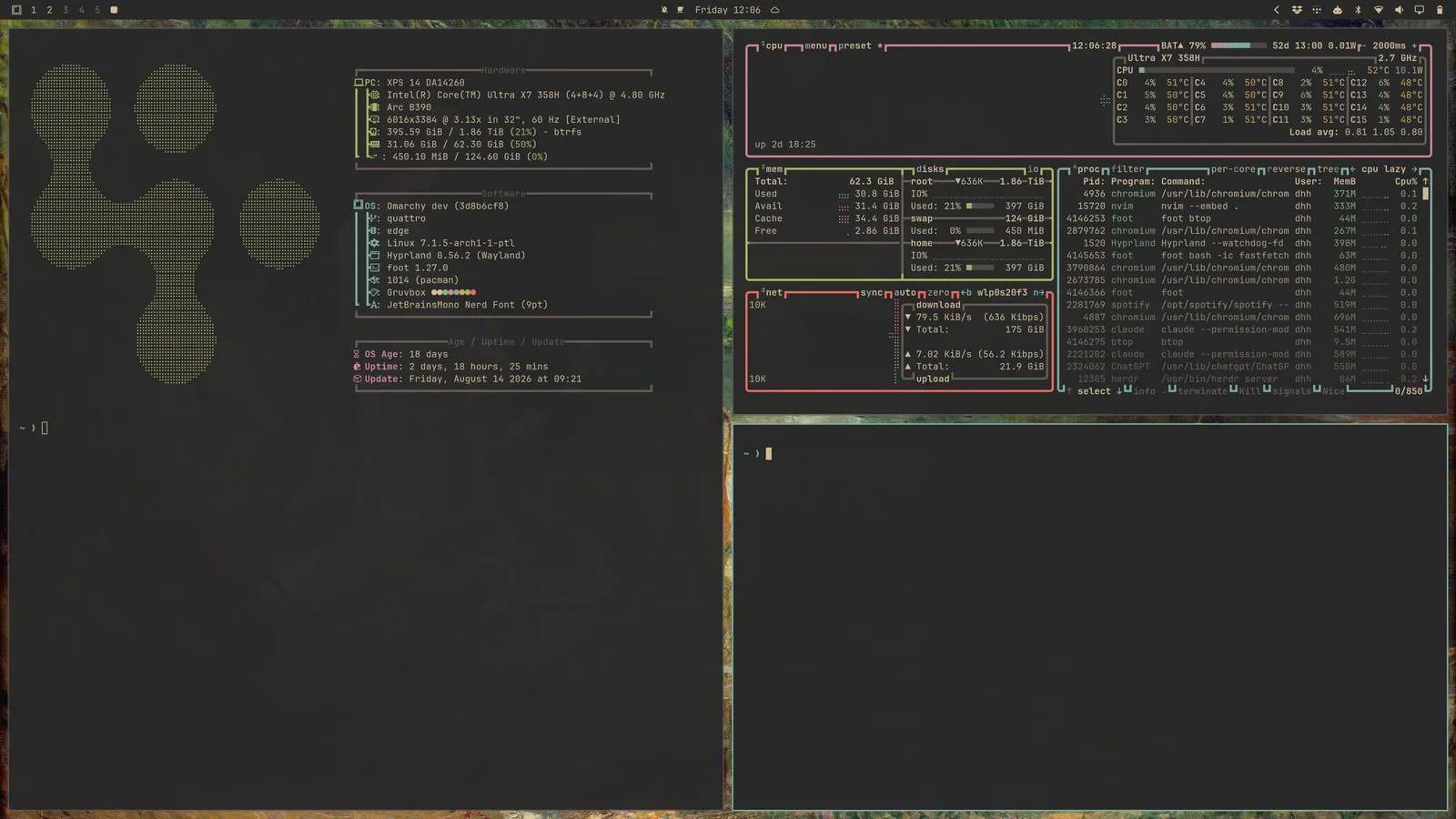
The Linux desktop landscape is undergoing a fundamental transformation as developers shift from traditional interfaces to environments designed for the agentic AI age. At the forefront of this movement is Omarchy, an Arch-based distribution created by David Heinemeier Hansson (DHH). Unlike conventional operating systems, Omarchy integrates AI agents directly into the desktop shell, allowing users to automate system diagnostics, interface theming, and complex configuration tasks.
The release of the “Quattro” version has drawn significant attention, highlighted by a widely viewed demonstration from tech educator NetworkChuck. The core appeal of Omarchy lies in its opinionated design: it leverages the Hyprland tiling window manager and the Quickshell desktop shell to provide a pre-configured experience that bypasses the weeks of manual setup typically associated with Arch Linux.
Institutional Backing and Sustainability
To ensure long-term viability, DHH recently announced the establishment of the Omacom Foundation, a nonprofit entity tasked with managing the project’s trademarks and infrastructure. The foundation has been seeded with $8 million in capital from eight prominent tech industry figures, including Shopify’s Tobi Lütke, Stripe’s Patrick Collison, and Dell’s Michael Dell. This injection of capital shifts Omarchy from a solo hobbyist project to a well-funded initiative with a clear development runway.
The project’s repository, which has garnered over 28,000 stars on GitHub, serves as a testament to the community’s interest in “agent-first” computing. The system supports a variety of coding agents—including Claude, Codex, and ChatGPT—and provides users with the ability to run local models via LM Studio or Ollama, addressing privacy and API-cost concerns.
The Competitive Landscape
Omarchy is not the only distribution vying for dominance in the agentic era. Major players in the Linux ecosystem are also adapting their offerings:
- Ubuntu 26.04 LTS: Canonical is positioning its release as the “OS for the agentic era,” utilizing confined “inference snaps” to deliver local AI models securely.
- Fedora: The Fedora community is pursuing a more integrated approach, proposing a “Fedora AI OS” that relies on SELinux-governed agents to control desktop functions natively.
- CachyOS: Focusing on performance, CachyOS utilizes custom kernels and CPU-optimized packages to accelerate local AI workloads.
- Pop!_OS: With its new COSMIC desktop environment written in Rust, System76 is emphasizing a privacy-first, NVIDIA-friendly architecture suited for modern AI tasks.
As the industry moves toward agentic workflows, the distinction between a “general-purpose” OS and an “AI-integrated” OS is narrowing. Whether these distributions will achieve the long-promised “Year of Linux on the Desktop” remains to be seen, but the current investment and development velocity suggest that AI integration is now a primary competitive vector for operating system designers.