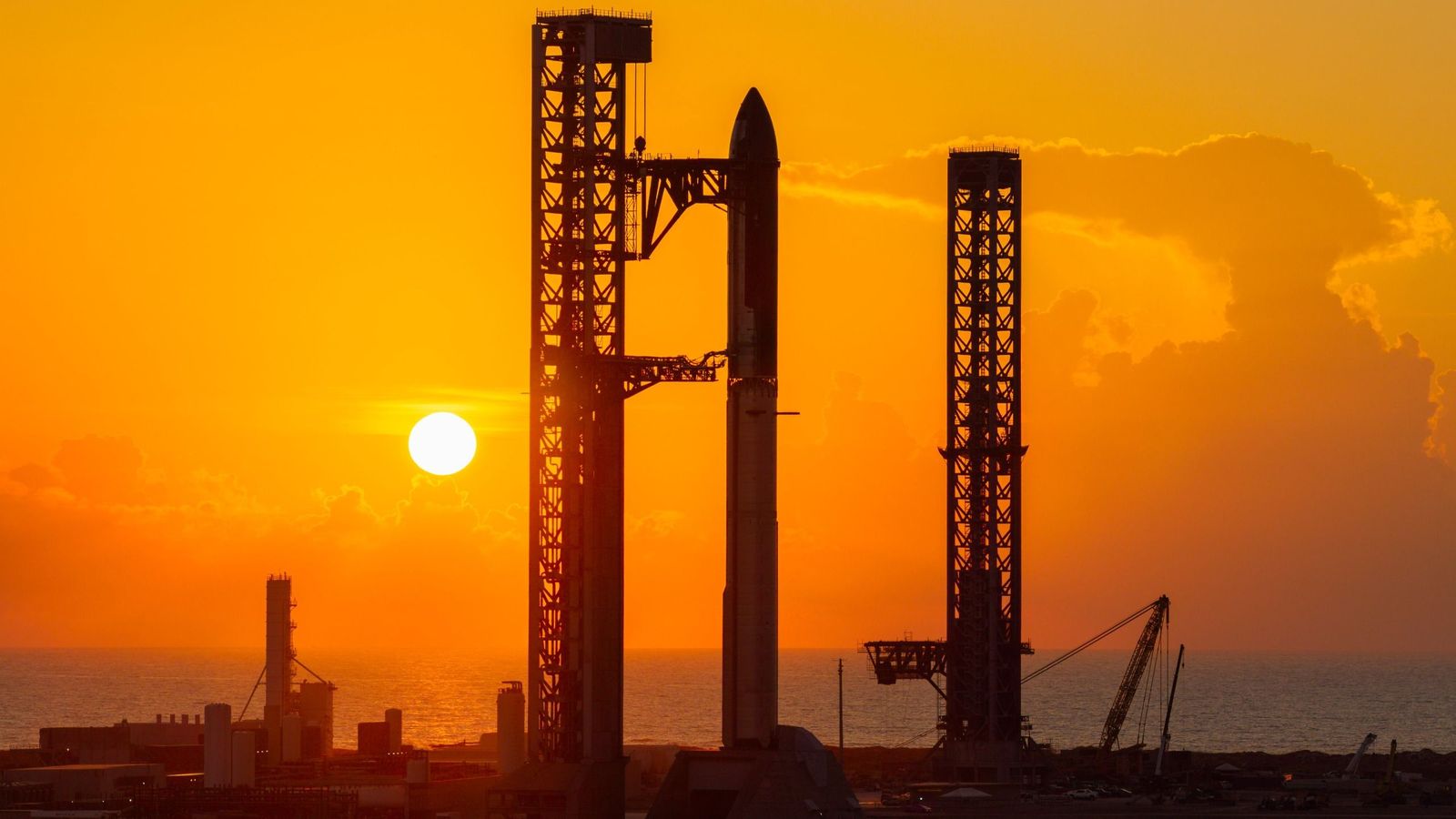
People near the sandy shores of Texas’ southernmost coastline are accustomed to the earth-shattering roar of the most powerful rocket ever made: Since 2023, various prototypes of SpaceX’s Starship have taken flight from the area 13 times, with nearly half ending in some form of unintended explosion, according to reporting by CNN. But the stakes are about to reach a decisive new threshold as the company prepares for an unprecedented mission.
SpaceX is attempting to launch Starship into orbit for the first time, allowing the massive vehicle to deploy an inaugural batch of 26 upgraded Starlink internet satellites. Liftoff is targeted during a 75-minute launch window opening at 8:15 a.m. ET. If successful, the test flight will mark a monumental step forward, signaling that Starship may soon transition out of its pure test phase and into operational service for commercial heavy-lift requirements.
For its previous 13 test flights, SpaceX intentionally placed Starship on a passively safe suborbital trajectory. The company acknowledged in a public briefing that even if control over the spacecraft was completely lost, it was already on a natural path to reenter the atmosphere and splash down in a predetermined location.
As Starship attempts to reach orbit, it will lose that safety net. Traveling at extremely high speeds on a precise trajectory, the vehicle will enter free fall around the planet. If control is lost, it cannot be easily dragged back down to Earth. Aerospace experts note that while the ship will fly well below crewed space stations at an altitude of roughly 171 miles (275 kilometers), a runaway orbital object could pose collision risks to active satellites and other valuable orbital infrastructure.
To mitigate these dangers, CNN reported that SpaceX may abort planned engine burns to keep the rocket on a suborbital path if any anomalies appear in the opening minutes of flight.
The Technical Roadmap and Reusability Goals
Monday’s mission is designed to test critical upgrades across both vehicle stages. During the previous test flight in July, the Super Heavy booster successfully relighted only eight of its 13 engines before practicing an upright splashdown in the Gulf of Mexico. SpaceX has since introduced hardware modifications to improve engine filtering and software updates to enhance relight reliability.
While the upper Starship spacecraft powers up for a nearly 10-hour flight encompassing six orbits around the planet, it will also face grueling atmospheric reentry temperatures topping 2,500 degrees Fahrenheit (1,370 Celsius). Reusing both the booster and the ship remains the ultimate goal for driving down mission costs and enabling future deep-space exploration.
Follow-up Questions
What happens if Starship loses control while in orbit?
Because the vehicle will be traveling at high speeds in free fall around the planet, it cannot be easily dragged back down, posing potential collision risks to active satellites
What remains unclear: It remains unverified whether minor trajectory deviations can be corrected automatically without aborting the mission
Will the Super Heavy booster attempt a landing on land during this flight?
No, SpaceX will once again conduct a practice landing over the ocean rather than returning the massive booster to the launch tower
What remains unclear: SpaceX has not disclosed a definitive timeline for when tower-catch recovery will be attempted for orbital-class boosters
Perspectives
SpaceX’s Strategic View vs Aerospace Engineering View
Story lens
SpaceX’s Strategic View
SpaceX frames the orbital test as a necessary threshold to transition Starship from development testing into regular commercial operations. By attempting to deploy 26 upgraded Starlink satellites, the company aims to prove the rocket’s utility for scaling global internet capacity and securing future government contracts
Aerospace Engineering View
Aerospace experts emphasize that moving from suborbital profiles to full orbital velocity introduces severe thermal and trajectory challenges. The increased heat shield temperatures and lack of a passive safety net mean that minor engineering flaws could result in uncontrolled orbital debris
Meta Platforms reached an agreement with CEO Mark Zuckerberg to issue non-voting stock, helping him cover a potential California wealth tax if Proposition 40 passes.
An American marine stands guard in Baghdad’s Firdos Square on April 9, 2003, watching as a colossal bronze statue of Saddam Hussein is dragged down by military equipment in a moment that forever blurred the line between combat reality and media spectacle.
Birmingham City have appointed former Manchester United football director John Murtough as their new director of football, filling a vacancy left by Craig Gardner.
As soaring jet fuel costs drive up U.S. airfares and reduce passenger volume, major airlines prioritize ticket yields to protect profits amidst rising expenses.
WNBA star Azzi Fudd announced she will model for the 2027 Sports Illustrated Swimsuit Issue, releasing a teaser video from her recent photoshoot in Ibiza, Spain.