


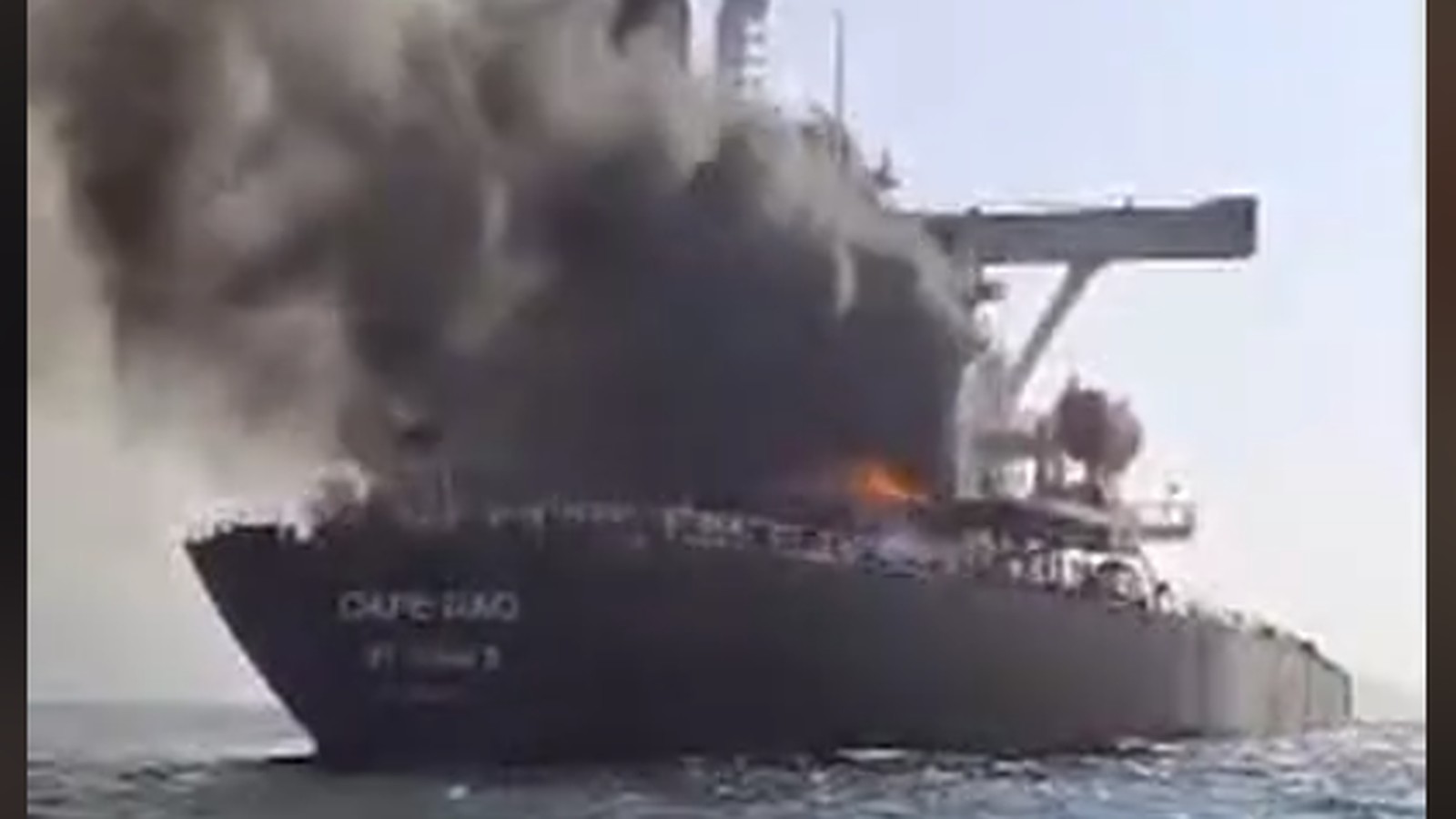
Strait of Hormuz Incident and Rising Oil Prices
Brent crude, the international benchmark for oil prices, surged above $105 a barrel this Thursday as diplomatic efforts at the United Nations General Assembly (UNGA) showed little sign of progress in resolving the seven-month Iran war. The price hike follows a commercial vessel strike in the Strait of Hormuz on Wednesday, which resulted in one crew member’s death and the evacuation of over 20 mariners, according to Oman’s navy. This incident underscores the escalating maritime risks in the vital waterway, which Iran has stated it will control indefinitely unless the United States accepts its conditions, citing an agreement on vessel transit reached with Oman, as reported by CBS News and AFP.
The vessel strike coincided with a renewed exchange of threats between the U.S. and Iran. A senior adviser to Iran’s supreme leader warned that Iranian forces and their Houthi allies in Yemen could open “a new front” targeting energy supplies in the Red Sea, in response to any new U.S. attacks. This statement came after U.S. President Donald Trump threatened Iran with “annihilation” during his address to the UNGA.
Economic Pressure and Sanctions on Iran
The U.S. has intensified economic pressure on Iran, with maritime tracking data indicating that three Iran-linked oil tankers seized by the United States are currently in the Atlantic Ocean, carrying nearly 6 million barrels of Iranian crude oil valued at approximately $600 million. These tankers—the Majestic X, Tifani, and Lenore—were seized under U.S. sanctions programs aimed at limiting Iran’s oil exports. The Majestic X and Tifani were seized in April after loading oil in Iran, initially listing China and Singapore as destinations, while the Lenore was seized in early June in the Indian Ocean, according to Kpler data cited by AFP. The U.S. Department of Defense described these seizures as efforts to “disrupt illicit networks and interdict sanctioned vessels providing material support to Iran.”
Further impacting Iran’s economy, the U.S. imposed new sanctions on Iran’s aviation sector in early September, requiring companies to cease operations with Iranian airlines by Wednesday or face exclusion from the dollar-based financial system. In response, several neighboring countries, including the United Arab Emirates (UAE) and Turkmenistan, have suspended flights operated by Iranian airlines. Iran’s semi-official ISNA news agency reported that all flights by Iranian airlines to the UAE were canceled since midnight Thursday, while Turkmenistan denied Iranian airlines permission to fly over its airspace, forcing a Tehran-Dushanbe flight to return to Tehran’s Imam Khomeini Airport. Despite these measures, some small Iranian carriers continue to operate flights to China and Armenia, which have not acceded to U.S. pressure, CBS News and AFP reported.
Diplomatic Engagements and Domestic Political Fallout
Amidst the escalating tensions, Iranian President Masoud Pezeshkian addressed the UNGA, asserting that Iran is a victim of Israel and the U.S., and that the U.S. uses the Strait of Hormuz to “impose their aggression upon us.” He declared that Iran “will never bow our head or bend at the knee” but is “ready for dialogue and diplomacy and negotiations without accepting the language of force.” Separately, Iranian Foreign Minister Abbas Araghchi met with Ukrainian Foreign Minister Andrii Sybiha on the sidelines of the UNGA, marking the first such meeting since Ukraine attacked an Iranian commercial vessel in the Caspian Sea in July, an incident the U.S. had urged Ukraine to halt due to concerns about rising oil prices.
Domestically, the prolonged conflict has become a significant issue in U.S. politics. The Senate is set to vote on a war powers resolution aimed at halting President Trump’s military actions, which many blame for the spike in fuel prices. This vote is seen as the last opportunity for lawmakers to express their stance on the war before the November midterm elections, with some Republicans reportedly breaking from the president. Senator Tim Kaine (D-Va.) and Senator Thom Tillis (R-N.C.) both voiced support for the resolution, with Tillis stating the need to “break the cycle.” War powers resolutions, while largely political statements, serve as a tool for congressional disapproval of the White House, CBS News reported.
Regional Instability and European Concerns
The conflict’s ripple effects are evident in Yemen, where renewed fighting since June has displaced over 134,000 people, according to the International Organization for Migration (IOM). This displacement primarily occurred in the country’s southwest, along the Red Sea coastline, where Houthi forces have made territorial gains. Yemen had experienced a period of relative calm since a 2022 ceasefire between Saudi-backed government forces and Iran-backed Houthi rebels, which broke down as the Iran war reignited in the region, the IOM stated.
In Europe, the potential for a U.S. diesel export ban, supported by President Trump to address surging domestic fuel prices ahead of the midterm elections, has drawn strong criticism. The European Union (EU) described such a ban as a “bad idea” that would negatively impact both sides. European Commission spokesman Olof Gill stated that the EU is conveying this concern “at the highest level” to U.S. counterparts. Europe, significantly more dependent on fuel imports than the U.S., has seen average diesel prices reach a record high of 2.23 euros per liter across the 27-nation bloc, with the U.S. accounting for approximately 50% of EU diesel imports in August, according to an AFP analysis of commission data.