


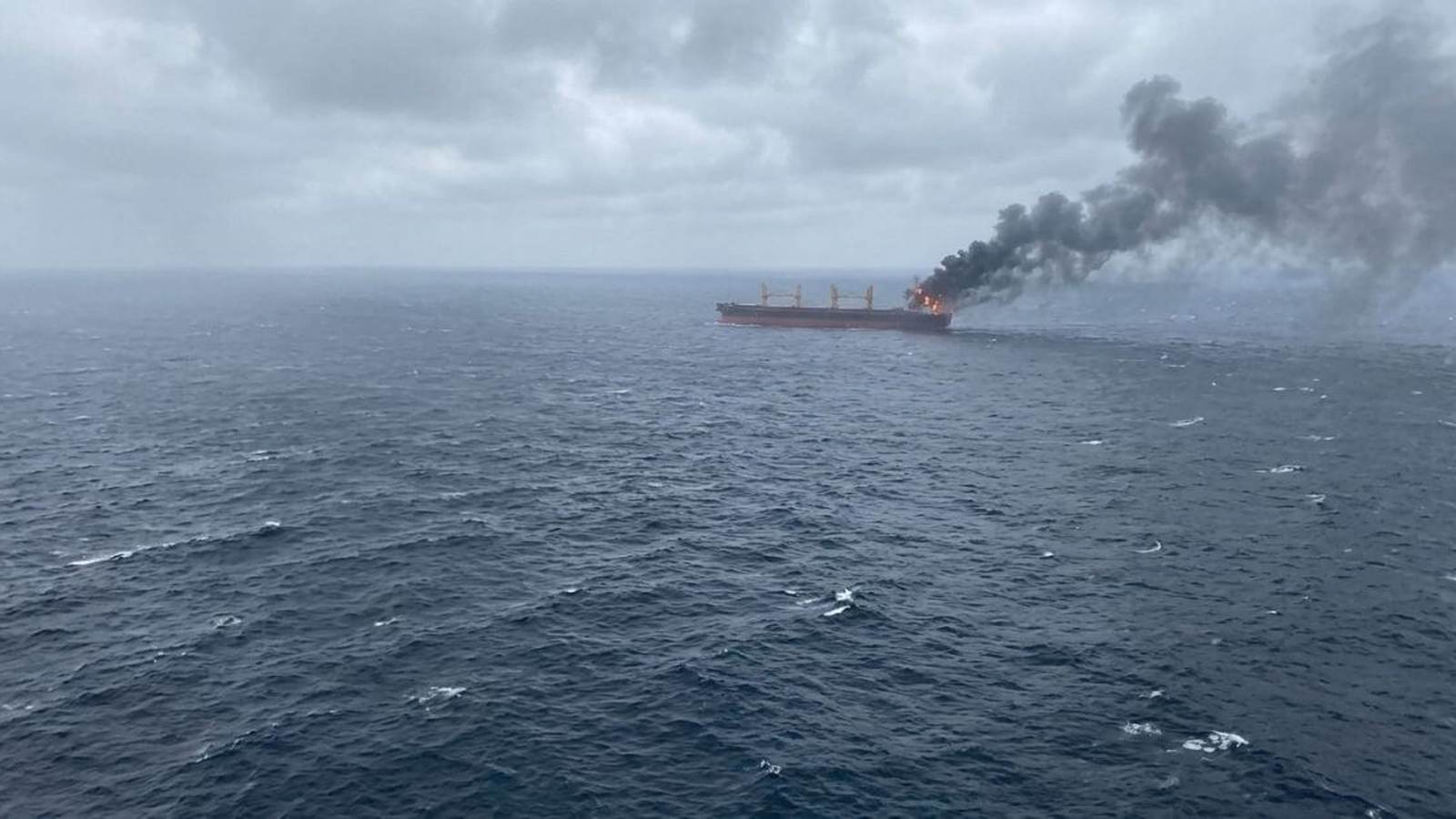
WASHINGTON (Azat TV) – On Thursday, November 26, 2026, U.S. military aircraft struck and disabled the Palau-flagged bulk carrier Pacific Archer in the Gulf of Oman after the vessel attempted to breach the ongoing naval blockade of Iranian ports, U.S. Central Command announced. According to Marine Insight, precision munitions were directed at the stern of the 2001-built merchant ship, leaving it without propulsion. Central Command confirmed that no members of the civilian crew were injured during the engagement.
Reporting by The Inquirer noted that the 190-meter vessel, owned by Pacific A Shipping Ltd. and managed by Optimo Marine Ltd., had departed from the Iranian port of Bandar Abbas. Ship-tracking data indicated that the bulk carrier listed Singapore as its intended destination. The military stated that the vessel ignored multiple warnings before military aircraft fired upon it, marking the 15th disclosed vessel disabled by American forces since the blockade’s inception in the spring.
Escalation and Enforcement of the Naval Blockade
The Pacific Archer incident represents the sixth ship disabled by American forces since the naval blockade was reinstated in July, following a temporary pause during diplomatic talks with Tehran over the summer. Washington originally established the blockade in April to curtail Iran’s oil revenue and compel authorities to reopen the strategic Strait of Hormuz, which Iranian forces had restricted following the outbreak of the conflict in late February.
U.S. Central Command figures show that American forces have redirected 158 merchant vessels that complied with warning directives, while those refusing to stop face kinetic action. Admiral Brad Cooper, heading CENTCOM, previously reported that the blockade had cost Iran approximately $25 billion in oil revenue by mid-October. The ongoing enforcement has maintained a heavy American naval presence in the region, including two deployed aircraft carriers operating continuously to oversee commercial traffic.
Regional Security Stakes and Economic Impact
The enforcement actions have drawn severe international criticism and raised regional tensions. In June, an American strike on the Palau-flagged tanker M/T Settebello resulted in the deaths of three Indian seafarers, drawing condemnation from the International Maritime Organization. Meanwhile, Iran’s military leadership has vowed countermeasures, with Iranian state television reporting that navy chief Shahram Irani announced operations aimed at breaking the blockade and pushing foreign forces from regional waters.
At the same time, regional trade flows have suffered notable contractions. Rystad Energy data indicates that oil flows through the Strait of Hormuz dropped by roughly 20% in the first two weeks of November compared to October levels. Compounding these pressures, a United Nations Trade and Development report highlights that disruptions across the Strait of Hormuz, Red Sea, Black Sea, and Panama Canal are extending voyage durations, increasing bunker and fuel costs, and causing port congestion globally.
Diplomatic Pressures and Stalemate Dynamics
While the military conflict has largely settled into a stalemate, diplomatic maneuvers persist in parallel with the naval enforcement. Regional officials in the Persian Gulf, alongside counterparts from Pakistan and Turkey, have engaged in concerted diplomatic outreach to Washington to avert an expansion of hostilities. Reports indicate that diplomatic discussions involve balancing security enforcement against the risk of broader regional escalation, even as the Trump administration weighs its long-term strategy.
As American forces maintain strict surveillance over the Gulf of Oman and surrounding waterways, maritime authorities and commercial operators face continuous uncertainty. U.S. Central Command has reiterated its directive for all mariners in the region to obey warning orders immediately, while Tehran continues to warn vessels against transiting regional choke points without explicit authorization.