


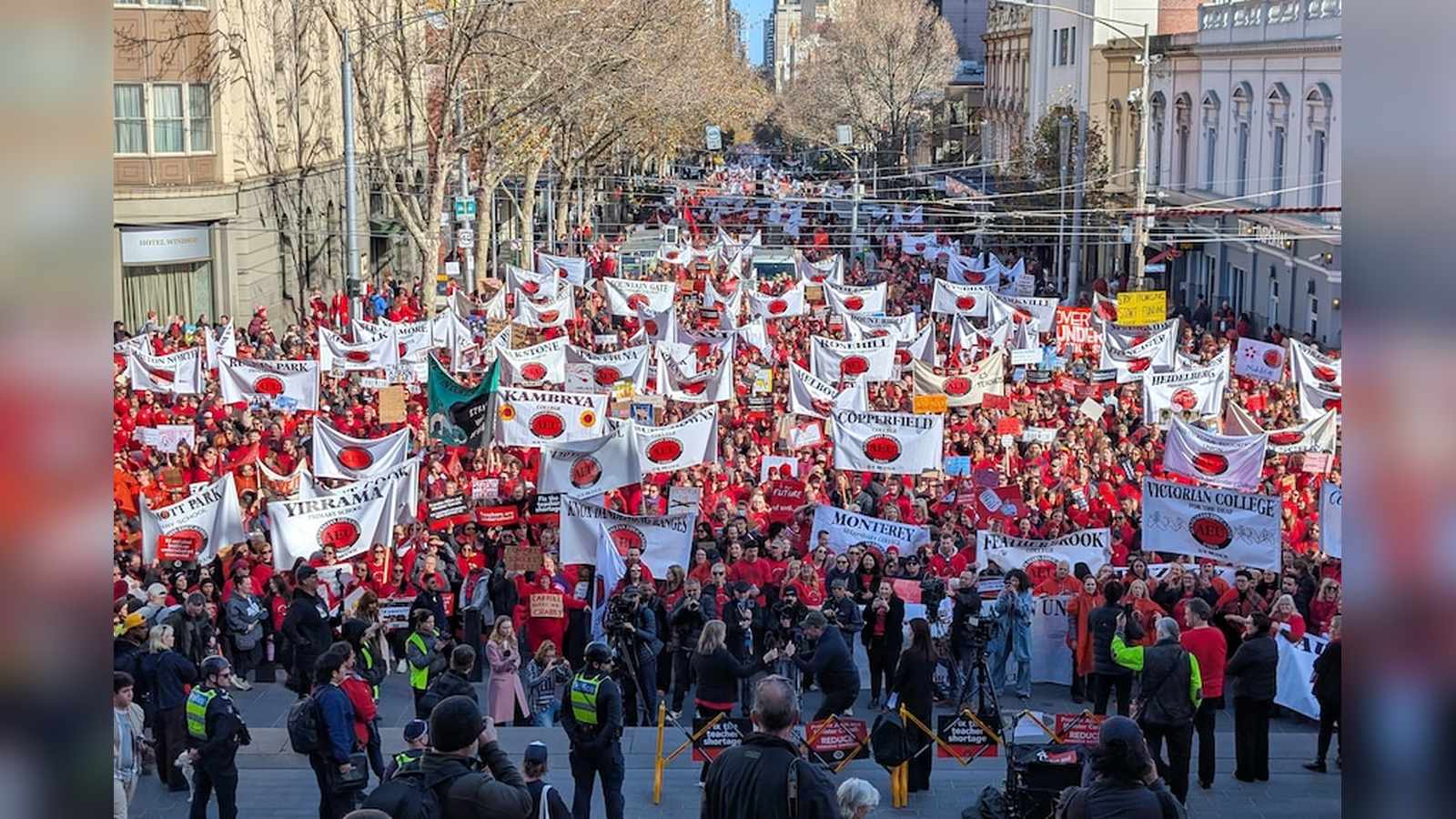
The Breakthrough in Melbourne
In a decisive turn of events for Australia’s public education system, members of the Australian Education Union (AEU) voted on Monday, August 17, 2026, to accept a groundbreaking enterprise bargaining agreement (EBA) with the Victorian state government. The vote, which passed with a substantial 79% majority, officially called off a planned 24-hour statewide strike scheduled for Wednesday, August 19. This resolution marks the end of a highly contentious, year-long industrial dispute that has repeatedly disrupted classrooms and tested the political resolve of Victoria’s Labor administration.
According to official union and government statements, the newly accepted four-year package is valued between $5 billion and $5.5 billion, representing an additional $700 million commitment compared to the state’s previous offer. Under the terms of the agreement, Victorian public school teachers, principals, and education support staff will receive compounding salary increases ranging from 28.3% to 32.4% over four years, alongside an immediate $2,000 sign-on bonus. The deal successfully positions Victoria’s educators as the highest-paid in Australia, leapfrogging their counterparts in neighboring New South Wales (NSW) and establishing a precedent for public sector wage negotiations nationwide.
Breaking Down the Multi-Billion Dollar Package
The financial scale of the agreement is designed to address both recruitment crises and long-standing wage stagnation. For early-career teachers, the deal guarantees a $12,343 salary increase by October 2026, immediately correcting the previous pay disparity with NSW. For experienced educators, salaries will climb from $118,063 to $151,419 by 2029, bolstered by an initial $15,393 boost in the current year. Education support staff and school leaders are also locked in for minimum wage increases of 28.3% over the life of the contract, with all covered employees receiving at least a 13.04% bump in 2026, followed by annual increments of 4% to 4.9% through 2029.
Beyond direct compensation, the agreement introduces significant structural changes to daily working conditions, which had become a primary point of friction. Key provisions include a strict cap on face-to-face teaching hours—secured at 18.5 hours per week for secondary teachers and 21 hours for primary teachers. Additionally, the deal mandates a reduction in after-school meetings, guarantees four professional practice days annually, and introduces eight student-free days each year starting in 2027. These measures directly target systemic burnout, a major factor driving teachers out of the profession.
The Power of the Rank-and-File Rebellion
While both the state government and formal AEU leadership have claimed credit for the resolution, the final terms were heavily shaped by an unprecedented grassroots rebellion within the union itself. Dissident rank-and-file groups, including “Socialists in Schools,” the “Committee for Public Education,” and “Fight the Crisis,” successfully channeled deep-seated frustration among educators. These groups argued that the union’s leadership had historically been too quick to compromise, pointing to the 2022 enterprise agreement which delivered a meager 8% pay rise over four years—a figure that resulted in a massive real-wage cut amid soaring inflation.
In contrast to 2022, when the union avoided industrial action, the 2026 campaign saw extraordinary mobilization. On March 24, 2026, 98% of members voted to strike, leading to the closure of roughly 500 schools and drawing 35,000 educators to the streets of Melbourne in the largest protest in the union’s history. When the government offered an 18.5% to 28% increase in May, union leadership recommended acceptance, but rank-and-file organizing led to a stunning 58% “no” vote in June. A subsequent revised offer was also rejected by 51% of members, proving that the grassroots campaign held a functional majority within the union’s active base.
Activists drew strategic inspiration from the 2024 Victorian nurses and midwives’ dispute, where members defied leadership recommendations to reject an initial offer, ultimately forcing the government to return with an improved 28.4% package within weeks. Liz Walsh, a prominent organizer with Socialists in Schools, noted that this precedent proved to teachers that rejecting a subpar deal did not mean returning to square one, but rather demonstrated the leverage of collective pressure. Although her group respects the 79% majority that accepted this third offer, they plan to maintain pressure by campaigning for full federal Gonski funding standards and fielding candidates in the upcoming state election.
Fiscal Headwinds and the November Election
The political timing of the agreement is critical. Victoria is heading toward a state election in November 2026, and the Labor government was desperate to avoid the optics of shuttered schools and mass protests just months before voters head to the polls. The resolution represents a major personal and political victory for Ben Carroll, who transitioned from Education Minister to Premier just three weeks prior to the vote. Carroll reportedly pitched his ability to resolve the long-running teacher dispute swiftly as a key reason for Labor MPs to back his leadership over his predecessor, Jacinta Allan.
However, the fiscal reality of the $5.5 billion deal presents a formidable challenge for the state treasury. Victoria’s budget has been under intense pressure, and government sources have acknowledged that funding the additional $700 million required for this latest offer may force the administration to draw from its hard-fought budget surplus. Compounding these fiscal concerns is Premier Carroll’s parallel commitment to fully fund public schools to federal Gonski standards before November—a move that could cost billions more. While the political upside of removing the strike threat is immense, the long-term impact on Victoria’s public debt and credit rating remains a subject of intense debate among economic analysts.
Next Steps Toward Implementation
The acceptance of the offer by AEU members represents the political resolution of the dispute, but formal administrative steps remain. Under the provisions of the federal Fair Work Act, the revised enterprise agreement must now proceed to a formal ballot of all covered public school employees, including those who are not union members. Education Minister Gabrielle Williams indicated that this statutory voting process is expected to take several weeks, with official endorsement and implementation projected for October 2026. Until then, the state’s schools will return to operational stability, ending a year of historic labor friction.