


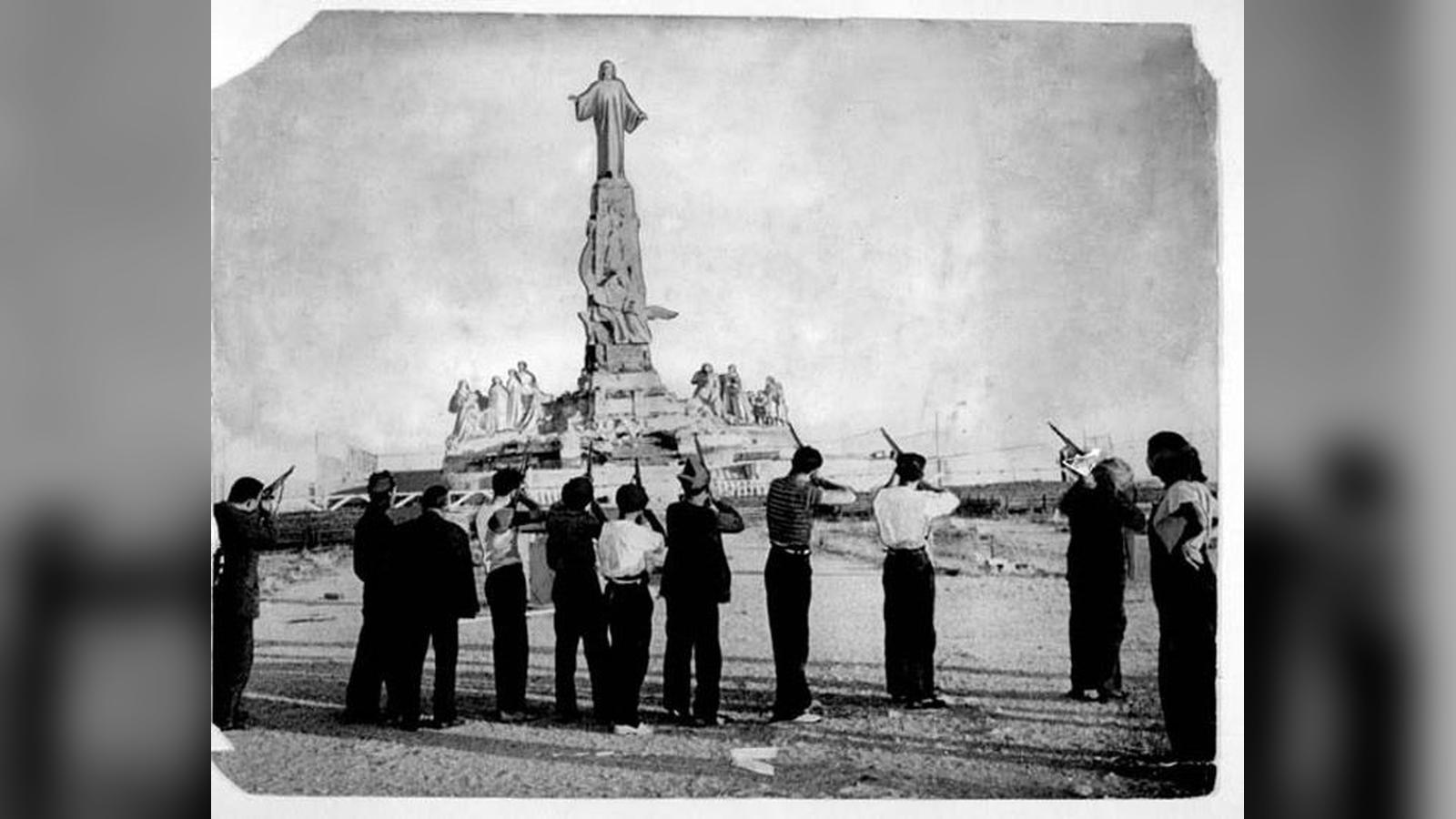
Frozen in the stark black-and-white tones of mid-20th-century newsreel stock, this photograph captures a moment of calculated ideological destruction at the dawn of the Spanish Civil War. An armed squad stands arrayed before an immense stone effigy, rifles raised and leveled against the colossal stone figure of Christ. The image does not merely record a conflict between political factions; it documents a profound cultural and spiritual rupture, framing an act of iconoclasm that reverberated globally as news agencies rushed to broadcast the visual evidence of Spain’s descent into fratricidal war.
What the photograph shows
The visual composition centers on the monumental scale of the Cerro de los Ángeles statue contrasted with the human figures of the firing squad. Several men, dressed in a mixture of militia attire and civilian clothing, stand in loose formation with their long-barreled rifles raised toward the towering stone monument of the Sacred Heart. The immense statue looms above them, its sculpted arms outstretched in a gesture of divine blessing that stands in eerie irony against the hostility of the armed men below. The stark outdoor lighting highlights the dust and rugged terrain of the hilltop, emphasizing the physical reality of the scene over any studio staging. Every detail—from the grim focus of the militiamen to the immobility of the stone—underscores a confrontation between transient human political rage and permanent religious symbolism.
The moment behind the image
This striking frame was captured in August 1936, just weeks after the military uprising led by Francisco Franco plunged Spain into civil war. The location was the Cerro de los Ángeles, a strategic and symbolic hill situated roughly ten miles south of Madrid, widely celebrated as the geographic center of the Iberian Peninsula. Before the camera shutter clicked, Republican forces and left-wing militias had secured the area, viewing the massive Catholic monument not merely as a religious landmark, but as a stronghold and emblem of the conservative, traditionalist establishment that backed the Nationalist insurrection. The execution of the monument—first subjected to rifle fire and later dynamited—served as a visceral ritual of eradication, symbolizing the systematic dismantling of the Church’s historic dominance in Spanish public life.
Photographer and provenance
According to contemporary archival records preserved in collections such as the UC San Diego Library, this photograph originated from the lens of a Paramount Newsreel representative in Madrid. In an era before instant digital transmission, newsreel footage and still frames were rushed by air transport to international bureaus to satisfy an intense global appetite for news from the Spanish front. Paramount’s cameraman operated under extreme wartime constraints, navigating the chaotic revolutionary atmosphere of Republican-held Madrid to secure footage that rivaled or exceeded the impact of print journalism. The image was swiftly disseminated across international syndicates, appearing in publications abroad to illustrate the escalating anti-clerical violence that shocked foreign observers.
Historical context
The destruction depicted in the frame must be understood within the broader tapestry of the Spanish Civil War’s anti-clerical terror. Following the outbreak of hostilities, the Catholic Church in Republican zones was widely targeted by left-wing revolutionaries, anarchists, and communists who held the ecclesiastical hierarchy largely responsible for centuries of social stagnation and its vocal alliance with reactionary politics. Thousands of clergy members were executed, and countless religious buildings and monuments were sacked or destroyed. The Cerro de los Ángeles monument, inaugurated in 1919 by King Alfonso XIII and dedicated to the Sacred Heart of Jesus, was a prime ideological target. By reducing the monument to rubble, the republican militias sought to symbolically cleanse the geographic heart of Spain of clerical influence.
Why it still matters
Decades after the smoke cleared from the hills south of Madrid, this photograph survives as an enduring historical artifact of modern iconoclasm. It bridges the gap between moving newsreel documentation and static historical memory, preserving a fleeting second of intense ideological zeal. By recording the physical assault on a towering symbol of faith, the unnamed Paramount cameraman left behind a haunting visual testimony to how visual media was harnessed to broadcast the totalizing nature of 20th-century ideological warfare to the wider world.