


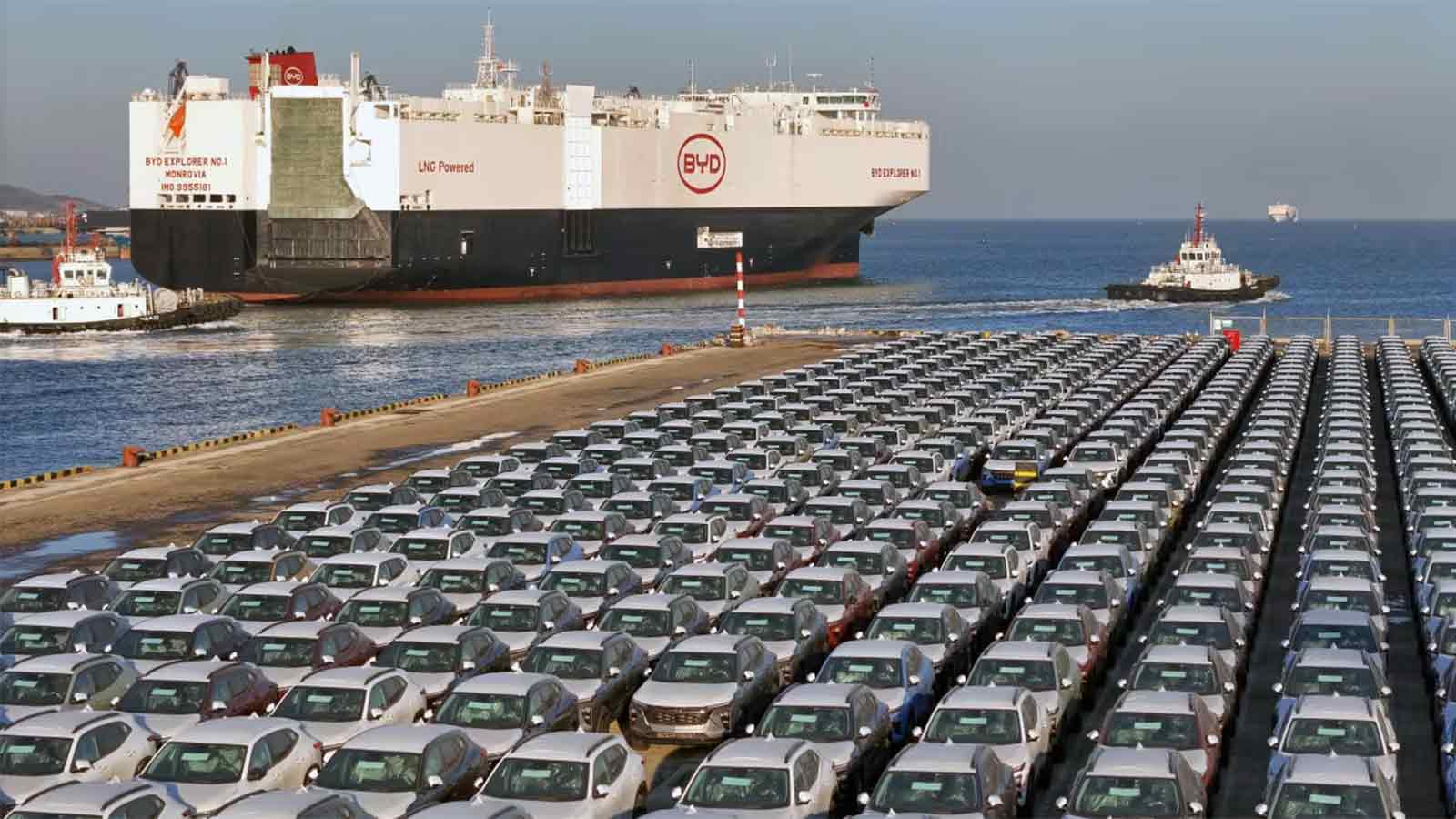
BEIJING (Azat TV) – Autumn showroom traffic across China has plummeted to some of the lowest levels in decades, transforming the country’s export push from a growth strategy into an urgent survival mechanism for domestic automakers. According to an October 28, 2026 report by CNBC, passenger car retail sales dropped 21.7% year-over-year through September 2026, totaling 13.33 million units.
Traditional peak sales periods, known locally as the “golden September and silver October” season, have largely failed to materialize for dealerships. Industry veterans report that showroom activity has slowed dramatically compared to previous years, driven by an unstable job market and a prolonged slide in property prices that has severely weakened consumer confidence across the country.
To understand the depth of the crisis, one only needs to visit a dealership in Beijing. Car salesman Li Ke noted that other than the disruptions of the Covid-19 pandemic, the 2026 autumn sales window is the slowest he has witnessed in his 26 years on the job. In past years, customers would visit showrooms continuously, with sales staff handling contracts daily. Today, many lots see only a couple of deals completed each week, representing a stark operational contraction.
Shrinking Margins and Vanishing Incentives
The domestic downturn has been compounded by shifts in government policy. Car salespeople told CNBC that central and local authorities have scaled back financial incentives, including cash-for-clunkers subsidies and specific tax breaks previously designed to encourage electric vehicle adoption.
Even the new-energy vehicle sector, which had served as a primary growth engine for years, experienced a contraction. Sales of new-energy vehicles dropped by 12.8% from January through September 2026, according to data from the China Passenger Car Association cited by CNBC. While gasoline car sales had already been declining due to the nation’s rapid structural transition toward electric vehicles, the simultaneous pullback in new-energy vehicle demand caught many manufacturers off guard.
Market participants point out that consumers are becoming exceedingly cautious with their finances. Rather than engaging in impulse purchases, buyers scrutinize every new feature on modern vehicle models, weighing practical utility and long-term economic value. Economic headwinds have extended replacement cycles, leaving showrooms largely reliant on hesitant buyers who prefer to postpone large-scale expenditures.
The Economic Toll on Dealerships and Manufacturers
For the full year 2026, the China Passenger Car Association projects domestic passenger car retail sales will fall by 22% to 18.5 million vehicles, dipping below the figures recorded during the first year of the COVID-19 pandemic. This severe contraction has directly impacted industry balance sheets. Official figures from China’s National Bureau of Statistics, reported by CNBC, show that profits within the auto manufacturing sector shrank by 22.8% from January to September 2026 compared to the same period in 2025.
To cope with falling margins, dealerships are downsizing physical footprints and relocating to lower-cost districts to reduce overhead. For instance, Li’s dealership abandoned a high-rent streetside location in favor of a facility on the urban periphery where rent requires only a fraction of previous expenditures. Meanwhile, industry analysts note that bruising price wars at home have left manufacturers with little room for further domestic discounting, intensifying pressure to aggressively target international markets despite rising global trade barriers.
Although broader industrial profits across China remained positive over the first nine months of the year, September data revealed pronounced softness compared to the preceding eight months. With profit metrics inside auto manufacturing deteriorating sharply, local carmakers face mounting pressure to offload excess production outside domestic borders, creating acute friction as international trading partners contemplate coordinated barriers against rising Chinese automotive imports.