


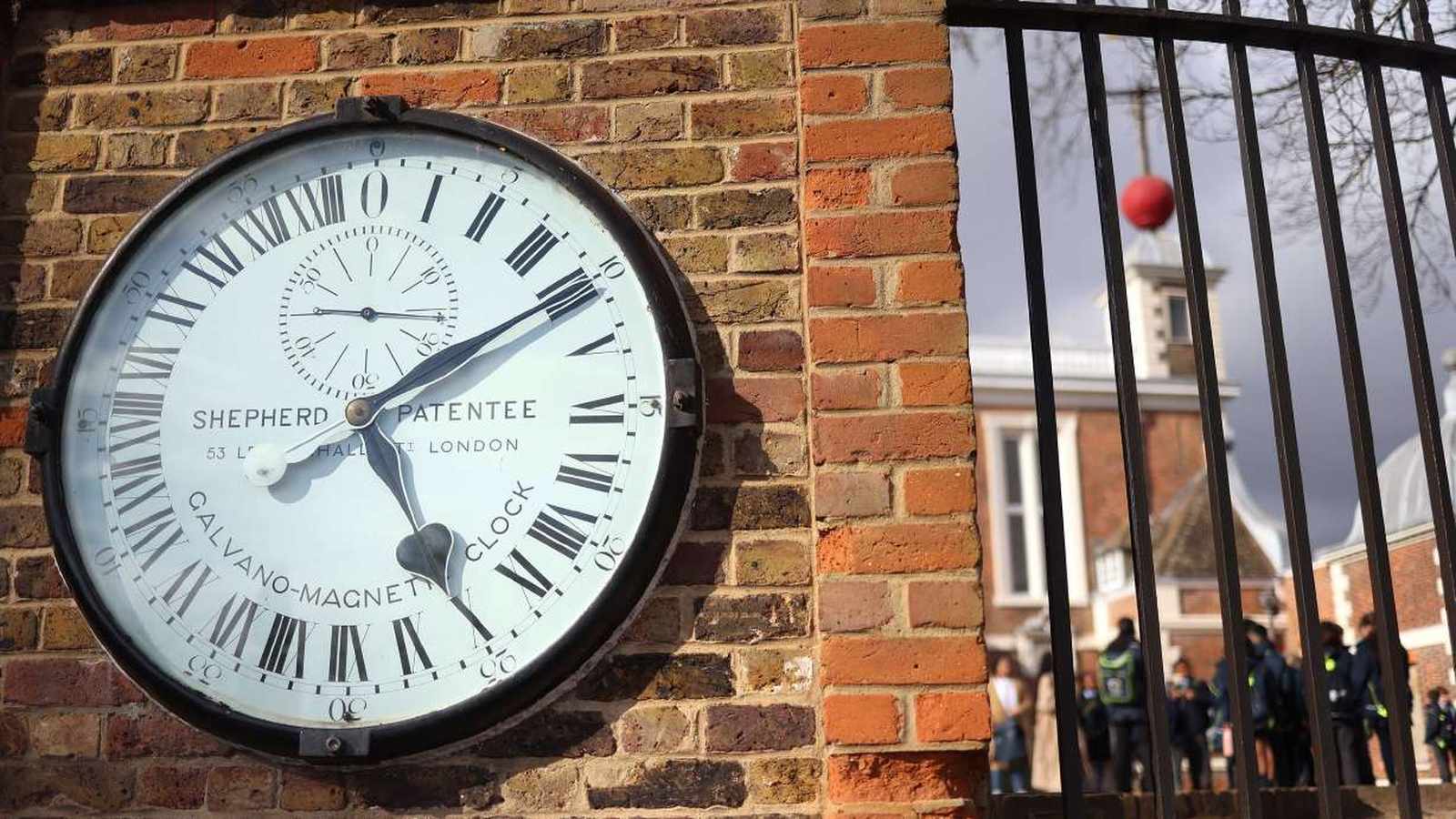
A Critical Vote on Global Time
Delegates from member states of the International Bureau of Weights and Measures (BIPM) are convening in Versailles this week to decide the future of global timekeeping. At the heart of the debate is the “leap second,” a mechanism that has allowed Coordinated Universal Time (UTC) to remain tethered to Earth’s astronomical rotation since 1972. The proposed resolution seeks to abandon this tradition, potentially replacing it with a “leap hour” as early as 2027. The shift is not merely academic; it is a response to an urgent, unexpected change in the physics of our planet.
For decades, Earth’s rotation has been gradually slowing due to lunar tidal friction, a phenomenon documented in historical records of solar eclipses dating back over 3,000 years. To keep human clocks in sync with the sun, metrologists have historically added a “leap second” to UTC when the gap between atomic time and planetary rotation grew too wide. This has happened 27 times, most recently in 2016. However, since roughly 2020, the Earth’s spin has accelerated due to complex factors, including shifts in the liquid outer core, changes in ocean currents, and the redistribution of mass linked to melting polar ice caps, according to ABC News. The planet even set a new rotation speed record on July 4, 2024, completing its daily spin 1.66 milliseconds faster than the standard 86,400 seconds, a record that was further challenged throughout 2025.
The Risks of a Negative Leap Second
This acceleration has introduced a terrifying prospect for modern digital infrastructure: the first-ever “negative leap second.” In this scenario, clocks would be forced to skip a second to catch up with a planet that is spinning faster than expected. While positive leap seconds have historically caused significant outages for major tech companies like Reddit, Cloudflare, and Meta, as well as airline reservation systems and high-frequency trading platforms, they have always been additive. Software systems are generally designed to handle an extra second, but they are completely untested for a minute that contains only 59 seconds. A negative leap second would force the clock to run 23:59:57 to 00:00:00, effectively erasing two timestamps entirely.
Patrizia Tavella, director of the Time Department at the BIPM, noted that the urgency of the situation cannot be overstated. “We estimated that if we wait till 2035, we have 30 percent risk of a negative leap second,” Tavella stated. After consulting with stakeholders across telecommunications, power grids, and computing, the consensus was clear: even a 10 percent risk of a negative leap second is considered unacceptable by global infrastructure operators. The comparison to Y2K has been raised by experts, with the critical caveat that Y2K benefited from decades of planning and testing, whereas a negative leap second remains an uncharted systemic threat.
The Complexity of Modern Timekeeping
The engineering challenge is compounded by a fragmentation problem that has grown over the last decade. There is no longer a single, universally authoritative time standard. While UTC is distributed via the Network Time Protocol (NTP), GPS satellites run on atomic time and ignore leap seconds entirely, opting instead to broadcast a static offset. Furthermore, major cloud providers have implemented their own proprietary workarounds, known as “leap second smearing,” where they spread the extra second across a 24-hour window by running clocks slightly slower. Because these smear algorithms are not standardized across platforms like Amazon, Google, and Microsoft, distributed systems communicating across provider boundaries during a leap event face severe risks of timestamp corruption and transaction ordering errors.
Duncan Agnew, a professor emeritus of geophysics at UC San Diego, has highlighted that the planetary acceleration is inherently volatile. While some experts, such as Leonid Zotov of Moscow State University, suggest the spin may naturally slow again, the infrastructure community cannot rely on such fluctuations. The legislative path toward a “leap hour” aims to provide a buffer that could last for centuries, effectively decoupling civil time from the immediate, wobbling reality of Earth’s rotation. This resolution acknowledges that our modern, high-speed digital economy requires a stable, monotonic clock that does not stutter or jump, regardless of the celestial mechanics occurring deep within the planet’s core.
Severing the Celestial Link
The transition toward a “leap hour” represents a fundamental shift in how humanity defines time. Traditionally, civil time was anchored to the physical location of the sun, measured by observatories like the Royal Observatory in Greenwich. Atomic clocks, which rely on the vibrations of caesium atoms, are far more precise but entirely detached from the celestial bodies. Jeff Sherman, a group leader at the National Institute of Standards and Technology (NIST), described the dilemma as a choice between the “lousy” clock of a wobbling Earth and the stability of man-made, lab-based instruments.
If the proposal passes, it would effectively sever the direct, real-time link between civil time and astronomical position. Instead of minor, frequent adjustments, a “leap hour” would only be required once every few centuries, sparing computer networks from the recurring fragility of the leap second. While the proposal aims for a 2027 implementation, it marks the end of an era where our daily schedules were dictated by the rotation of the Earth beneath our feet, favoring instead the rigid, unyielding precision of the atomic age. For the engineers maintaining the backbone of the internet, this decision is not about losing a connection to the stars; it is about ensuring that the digital systems upon which global society depends do not collapse under the weight of an unexpected, un-coded temporal anomaly.